• TalkBass has been independent since 1998. Add your voice.
    Create a free account to reply to discussions, view embedded media, and browse with fewer display ads.
    Join freeLog in
    Want zero display ads or expanded classifieds tools? Compare plans.

Double Bass What exercises do you practice?

Nov 14, 2019
1,983
3,032
For those of you who play mostly bluegrass/oldtime - what exercises or drills do you practice? And HOW and HOW LONG do you practice?

For the last several months, I've been working on my bowing, and playing up the neck, trying to expand what I bring. I've also been playing some classical ensemble work, which involves reading music - not my strength. To put is mildly, my bowing sucks (tho it is getting better), and my timing w/ the bow is execrable. (In my BG comfort zone, I pride myself on being steady as a rock.) And any significant shifting is pretty much an adventure.

Let me put it this way - I KNOW I'll never be a great classical bassist. I also KNOW that what I'm working on will improve my BG chops (tho I'm not sure I could say exactly how.) But the damned work I'm putting in right now feels like some awfully heavy lifting. I can get into working my scales with the metronome pizz, but usually down in 1st position. Trying to do it arco, and with shifting, turns it into hard labor.

I know the classical students put in hours and hours. But I'm finding more than 5-10 minutes of scales and arpeggios darned hard work - especially when doing 2 octaves. My brain hurts!

Then, when I turn back to my wheelhouse, it seems almost too simplistic, and i feel like I'm wimping out.

Does any of this make sense?

I guess I'm facing a bit of a tough patch here, where I'm really trying to improve, and trying to put in the time, but not really feeling confident that I'm working on the right things. And I'm kinda frustrating myself by just feeling like all I'm doing is making clear to me how much I DON'T know.
 
The way you feel is exactly why bluegrass was invented :laugh: Stress relief.

It's supposed to be simplistic.. If I think about what I'm playing I get bored and start playing too many notes, so I just listen to the other instruments, watch the dancers and forget I'm even playing the bass. One of the best experiences I've ever had as a musician was playing bass for a large contra dance.. hundreds of folks dancing their butts off and none of them staring idly at the stage..

The bass role in that realm is meant to be sparse to leave space for the rest of the picking frenzy.. we're just there to lift the whole thing off the ground. So basically, if I know my bass's intonation well and keep good time, there's not a whole lot to practice solo really within the genre right? Which is why, when left to our own devices, we end up blending it with other "genres" like classical or jazz. These departures do take practice, lots and lots and lots of it unfortunately..

I'm right there with ya though, I've been working on arco for about 8 years and still have days where it just doesn't come out the way I want it to. But I don't give up, I consider it a meditation for lack of a better word. Trying to play, say, Blackberry Blossom arco at speed seemed impossible at first, but I slowed it way, way, way, way down and tried to make each note very clear and articulate. That in itself turned out to be pretty fun, or got my mind off other crap anyway, to the point where I wanted to do it every day for an hour or two. To me, learning to enjoy practice intrinsically and not just as a means to an end is what makes it a positive association, sustainable if you will. Otherwise it's work, and I don't need any more of that...

So while I'm not much a bluegrass listener (the modern stuff anyway, with a few notable exceptions..), grass and old time have been probably 65% of my gigging experience. I like to be prepared to stretch my legs when given the opportunity, so I practice fiddle tunes as mentioned, and sometimes just play all over recordings, Doc or Delmore Bros or such, to work out what I might play as a solo if anyone points at me. Or I'll find alternative ways for the bass part to go besides predominately 1-5 half notes, stuff which I rarely pull out on a stage since that's often not what the other musicians want, but sometimes, sometimes there's the right environment to let the music drift - my favorite :)
 
Hi, 50-ish percent of what I play on the DB is in the american roots music vein, heavily influenced by bluegrass and old time too. I practise and play lots of arco nowadays, and I think that I play a acoustic DB, meaning that the bass is set up to project well in any situation, be that busking in the park or unamplified jamming in a noisy bar. I`ve had some right shoulder issues that had me relearn both my pizz and arco technique. What I do nowadays with my arco practise is dividing the time between standing and seated playing -This way I can turn some of the heavy lifting into exercising with gravity. It`s very different when seated, with my bass at more of a horizontal angle. It allows me to sort of hang from the bass on my left hand, and just lay my arm with the bow in to the string. However, it`s easier for me to move around the bass when standing, and I mostly play live that way. I practise 1, 2 and even 3 octave scales, arpeggios, melodies, with different bowings, tempos, dynamics, colours of sound, with and without metronome. I try to spend time in the money register, hazard called neck heel / transition area and thumb position, and moving between all the three.

I`m originally ( and still am, off course ) a drummer and percussionist. Bowing the double bass is easily the hardest thing I ever tried to do on any instrument, technically and physically. I have to practise every day, 1 hour a day minimum.

Hope it helps, good luck!!!

Edit: About the simplicity aspect -I enjoy playing and even practising simple stuff, and I think it`s the essence of folk music like bluegrass. I mean what`s hard really? Timing is when the notes are sparse, good drive and groove in one`s rhythmic approach is, great intonation is, no matter how simple the music...
 
Last edited:
Thanks for the responses.

I think - in part - I'm just being hard on myself. I KNOW that I AM improving. It is just that the improvement is so slow and incremental, that it can often be hard to perceive.

Also, I know I should most likely get myself a teacher, rather than frustrating myself by trying to work through things alone. (Well, not ENTIRELY alone, as I pay regularly w/ classically trained string players, including cellists, 2 of whom a HS orchestra directors. So while I'm lacking on bass-specific guidance, I'm getting SOME direction and support.)

I also feel frustration over a sense that I am not progressing even as quickly as a beginner at the instrument should. I've decided upon a couple of middle-school/high school level curricula as my main focus. Simandl kicked my butt, and even Suzuki starts friggin Twinkle Twinkle up around the heel! :(

Sure, I sat through my share of horrific middle/high school recitals with my kids! ;) But I feel like I'm not even progressing as quickly as an average teenager would - even though I feel I have at least as much dedication (not to mention some pre-existing knowledge/experience/etc.) I suspect that I am reaping the disadvantages of having developed significant bad - or simply OTHER - habits/concepts/perceptions, from my time thumping away.
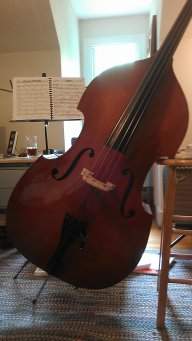
I like the idea of treating it as a meditative process, and contenting myself (for now) with long bowed scales. I just really was frustrated yesterday, trying (and failing) to bow some pretty simple pieces up to speed.

It is hard, as an adult, to try to learn something completely new, as a variation of something you already are somewhat accomplished at. I'm comparing it to about a decade ago, when I took lessons and committed to completely changing my golf swing - as I needed to do to get better. 1.5 years ago, I picked up clawhammer. That was quite different, because I was an abject beginner, so ANYTHING I learned was an improvement.
 
  • Like
Reactions: EddiePlaysBass
I am feeling your pain Ed S. I am working through a similarly slow bowing progression with scales, Simandl and the string crossing exercises in John Goldsby‘s Jazz Bowing book with David Allen Moore’s Discover Double Bass German bowing course as a guide to technique.

I feel like I have reached a plateau where I am not going to improve much without some personalized feedback on my bowing form and address to the instrument (left arm and hand shape in particular). I will be trying to get in touch with a local teacher who plays German Bow on gut strings in similar genres as I want to play and see if he’ll do online or outdoor lessons. If you have access to a teacher, it might be something to consider.
 
The technical side of bass playing tends to be similar no matter what style of music you are playing. As a player in a similar place...trying to become acceptable at arco while still focusing on the bread and butter skills of my preferred style, ie pizz thumping...i can offer what i do currently.

The first stage of my practice sessions are all the technical things i feel i need to do to retain and progress my basic proficiency. I do this kind of progressively, by first playing exercises that isolate certain techniques, then playing exercises that bring it all together. Since arco is where i struggle, i prioritize that first in my technical practice. If you stick with the same exercises for while, you will realize at some point they become second nature and that is when it is time to mix them up in some way to make them less familiar. The idea is to warm you up to the basic physics of just playing the bass before even attempting a piece of music which you can assume will have you doing all elements together at once. Sometimes you might get into a rabbit hole with the exercises which takes up the bulk of your practice time that day. This is OK because that is the work you need to do to figure out technical challenges which will make executing an actual piece way easier:

Arco Technical Practice:

Bow Hand Isolation ~5-10 mins: Long open string tones with bow to a metronome. Set the nome at 60 and play whole notes on each open string until you feel like you get a consistent start and pleasing tone for the length of the note. Each note should go from frog to tip, and tip to frog. Pay attention to the speed and weight of the bow, especially as you move from string to string. The left hand is ignored in this exercise and allows you to put all your focus on the bow hand.

Left Hand Finger Replacement ~ 5 mins: Bow half notes at 60 bpm while stopping a note with the left hand index finger. Each half note, replace the index finger with the middle, then pinky, then middle, then index, etc all on a single note, like the D on the G string. Focus on shifting between the fingers in a swift and accurate way. The goal is to keep the note in tune and fully stopped each time you replace one finger with another on the same note. Even though we are using the bow hand for this exercise, the focus should be on the left hand and as such this is a left hand exercises at it's core. You will start to be able to better feel out small shifts of the left hand based on where another one of your fingers is already resting.

Vomit Exercise ~5-10 mins: Rather than having me explain this one, just Google how to do this exercise. This is the first exercise that focuses on both the left and right hands at the same time. The left hand focus is on accurate/clean shifts from small to large, keeping the fingers close to the string during the shift, and reinforcing shifting of the hand from the big shoulder/back muscles. The bow hand focus is on shifting the bow higher or lower on the string with relation to your left hand shifting. As we stop notes higher on the neck, we need to also bow closer to the bring and this exercise will help reinforce that. I do this exercise with a metronome.

Slow 2 Octave Scales/Arpeggios ~5-10 mins

Miscellaneous Exercise ~5-10 mins: This can be any arco exercise that addresses a more specific aspect on arco technique. Check the Incredibly Useful Exercises youtube channel for ideas. I am currently doing his even trill exercise but plan to rotate it periodically.

Anyway, this is just an example. The main point is trying to break down the specific technical challenges of the bass into smaller exercises and start all practice sessions with that before diving into any actual music. Be honest about where you are getting hung up and it can really inform a clear baseline of where you need to spend time.
 
Thx, Seanto. That helps. I think (one of) my problem(s) is that my practices lack structure. I might have a really good practice session - but maybe go too long on basics that I get sick of them, and the next day, I do something completely different.

I'm going to come up with some simple list of 3-4 things I can do for 15-20 minutes EVERY DAY - and what you are doing suggests a good format.

BTW - bass is getting closer to completion. Should be a couple of weeks! :D Still digging the new hybrid? Neglecting the old ply?
 
Thx, Seanto. That helps. I think (one of) my problem(s) is that my practices lack structure. I might have a really good practice session - but maybe go too long on basics that I get sick of them, and the next day, I do something completely different.

I'm going to come up with some simple list of 3-4 things I can do for 15-20 minutes EVERY DAY - and what you are doing suggests a good format.

BTW - bass is getting closer to completion. Should be a couple of weeks! :D Still digging the new hybrid? Neglecting the old ply?

Hybrid is starting to get into the rotation more and more now. Amazing how long it takes to really get to know a bass, especially when you've played another one exclusively for many years! Enjoying the experience and playing the new bass of course. Can't wait to see how yours turns out.
 
I've been lifting weights and exercising on a regular basis for a while but i have increased the intensity over the last couple years. it has been amazing how much my overall physical health helped my playing. my forearms are stronger and my endurance has greatly extended (which helps because my one fiddle band likes to "jam out" for long periods of time).

upright bass is a very physical instrument to play, especially in bluegrass. keeping time at high speed takes lots of mental focus but, also the having the physical energy and endurance, makes it easier to do.
 
All of the above is good advice, all that I can do is echo and add my thoughts. I too primarily play DB in a NewGrass band. The guys I play with are younger, great players, and open minded and not traditionalists (They all have large and complex pedalboards and use them well). So I am free to do more than 1-5 thumping, with the expectation that my time and tune will be solid to maintain the strong foundation. It mostly is, sometimes I have intonation issues when trying more out-there stuff, but thats part of the process.

My practice routine is similar to Seanto's. I loosen up with open strings, then Major/minor 2-octave scales (Google Duple Exercises). I work my way through parts of Simandl, building on lessons years ago. Right now its intervals - 3rd, 4ths, and 5ths - and 1 Simandl Etude per week, from the 30 etudes book. All of this is with the bow. Sometimes Goldsby's jazz bowing book for the crossing and rhythm exercises.

For pizzicato, I usually do descending mode scales and ascending mode arpeggios. I'd like to work on learning some fiddle tunes - anyone have a source in notation? I can read bass clef pretty well but not so much treble clef. I've never been a strong soloist and am hoping that learning some trad melodies might help.

I do try to be fairly structured, do ing all of the above takes me about 60-90 minutes each day. I probably hit 5-6 days/week.
 
  • Like
Reactions: Keith Rawlings
I never did any exercises per se when I was playing bluegrass. Once I knew how to play all 12 major scales in lower positions I was ready to play all the old school stuff. After all, it's mainly root-five with some walkups, maybe a few triad "walks" here and there. Bowing? :confused:

There's a reason why almost everybody who plays other instruments in bluegrass and old-time bands can pick up a DB and play it :roflmao:

Now if you're thinking of getting together with grassers who just graduated from Berklee, like Sierra Hull, then it's a different story. :thumbsup:
 
Outside of my typical practice routine (2-3 octave scales, thirds, vomit, etudes, jazz standards, etc) I've found simply playing and working up endurance to be the best practice. And always playing with a metronome to work on your timing.

Can you do root-5ths in time for 2 hours straight? It's super hard. I've found a local fiddle/ contradance jam group and I sit back and play nonstop. It's pretty straightforward, but not simple to do at all. I thought my fingers were going to fall off at first.

There is also this book "4 Hour Bluegrass Workout". Steve Kaufman's Four-Hour Bluegrass Workout, Volume One
It's got a great backing track that you can play along with- they play each piece at 2 different tempos.