
I've been thinking about adding a master volume to a preamp that doesn't offer that option normally, but then I realized, I don't know what a master volume is. In fact, I've been wondering this for a while, but didn't know how to ask it. So, if I added a pot at the end of my signal path, I'd just be limiting the audio. I could only lower the volume, where if it was fully open, there'd be no boost. I guess that would work in my circumstance, but is that something you'd do? What is common practice?

Enjoy the benefits of a premium membership!
Upgrade Account
-
TalkBass has been independent since 1998. Add your voice.
Create a free account to reply to discussions, view embedded media, and browse with fewer display ads.
Join free Log in
Want zero display ads or expanded classifieds tools? Compare plans.
You are using an out of date browser. It may not display this or other websites correctly.
You should upgrade or use an alternative browser.
You should upgrade or use an alternative browser.
What is master volume?
- Thread starter Amalgam
- Start date
More options
Who Replied?AFAIK, that's what a master volume is, so you're on the right path.
Essentially, you can either put a variable limit on the signal passing from one device to another (like the volume control on a passive bass, or the input volume control on most amps), or vary the gain applied to the signal passing through a device. The ability to vary the gain is something that has to be built into a circuit - you can learn how to do that, but it's probably not the best place to start.
What are you trying to accomplish, that you can't do with the instrument's volume control? Is it a passive bass whose tone changes along with the volume?
Essentially, you can either put a variable limit on the signal passing from one device to another (like the volume control on a passive bass, or the input volume control on most amps), or vary the gain applied to the signal passing through a device. The ability to vary the gain is something that has to be built into a circuit - you can learn how to do that, but it's probably not the best place to start.
What are you trying to accomplish, that you can't do with the instrument's volume control? Is it a passive bass whose tone changes along with the volume?
TLDR; It's complicated.
Well, I want to use an Aguilar OBP-3 as a main preamp and EQ, with a secondary EQ on a push pull knob. I will have three pickups, and each will have it's own volume and push pull to activate whether it get's sent to the secondary EQ first. I'm trying to break the design down into pieces.
Basically, I need a master volume because it's either that or a toggle switch, and I like the idea of being able to control the whole chain's loudness once I get a balance I like, which honestly could be variable, though that could be hard and is not optimal, and I'll put in the effort to get it right.
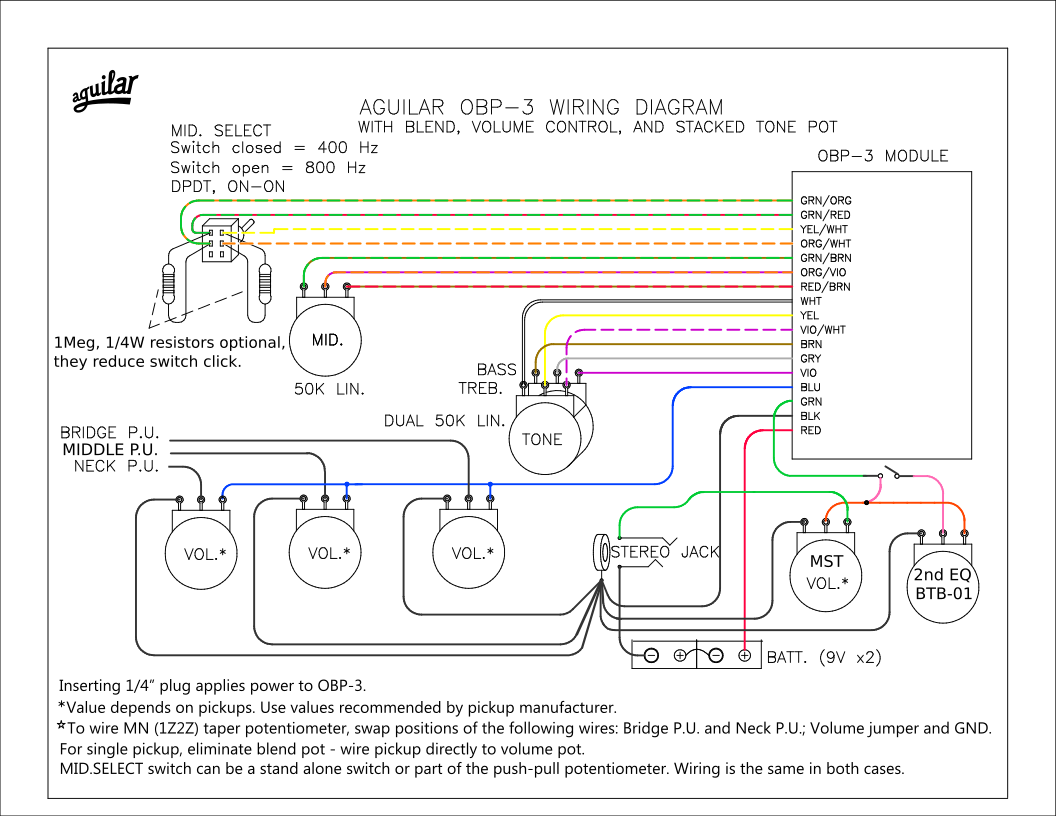
The OBP-3 does not come with a three pickup, three volume configuration, but today I was looking around, and I *think* I figured out how to add another volume control, but I'm not 100% sure it'll work cause my background knowledge is sparse, but I understand simple on/off's, and I think this would work. Please take a look as that's one problem down with the design. I modified an Aguilar OBP-3 diagram and it's below. Green wire to 1/4" jack is where I'd add master volume, right?
So, I'd like a master volume for more control over the balancing of pickups, though I hope that they'll play nicely together. Each pickup is a different model, coming from two separate manufacturers, Aguilar and Nordstrand. It's kind of a headache, but with the correct switching, and possibly a four channel mixer that I can fit in my bass, I'll maybe, hopefully, be able to mix the pickups evenly regardless of what signal chain they use.
Anyway, if I can modify the Aguilar OBP-3 to have push pull, three volumes, three pickups, and a master volume, I can use it in my build, but I still don't know whether I should just add a volume pot at the end of the signal, or do something else. Is there anything negative about just adding a pot at the end?

Master Vol: Pushed: Secondary EQ Selectable Before Main EQ
Pickup1: Pulled--> Vol1--> Secondary EQ--> Mixer*
Pickup2: Pulled--> Vol2--> Secondary EQ--> Mixer--> Mixed Signal--> Main EQ--> Master Vol?
Pickup3: Pushed--> Vol3--> Mixer
Master Vol: Pulled: Secondary EQ after Main EQ
Pickup1: push/pull: no effect--> Vol1--> Mixer
Pickup2: push/pull: no effect--> Vol2--> Mixer--> Mixed Signal--> Main EQ--> Secondary EQ--> Master Vol?
Pickup3: push/pull: no effect--> Vol3--> Mixer
*No mixer if not needed. Looking at East-UK's MBP-01... not sure if it's still being manufactured, but I have a pdf.
Well, I want to use an Aguilar OBP-3 as a main preamp and EQ, with a secondary EQ on a push pull knob. I will have three pickups, and each will have it's own volume and push pull to activate whether it get's sent to the secondary EQ first. I'm trying to break the design down into pieces.
Basically, I need a master volume because it's either that or a toggle switch, and I like the idea of being able to control the whole chain's loudness once I get a balance I like, which honestly could be variable, though that could be hard and is not optimal, and I'll put in the effort to get it right.
The OBP-3 does not come with a three pickup, three volume configuration, but today I was looking around, and I *think* I figured out how to add another volume control, but I'm not 100% sure it'll work cause my background knowledge is sparse, but I understand simple on/off's, and I think this would work. Please take a look as that's one problem down with the design. I modified an Aguilar OBP-3 diagram and it's below. Green wire to 1/4" jack is where I'd add master volume, right?
So, I'd like a master volume for more control over the balancing of pickups, though I hope that they'll play nicely together. Each pickup is a different model, coming from two separate manufacturers, Aguilar and Nordstrand. It's kind of a headache, but with the correct switching, and possibly a four channel mixer that I can fit in my bass, I'll maybe, hopefully, be able to mix the pickups evenly regardless of what signal chain they use.
Anyway, if I can modify the Aguilar OBP-3 to have push pull, three volumes, three pickups, and a master volume, I can use it in my build, but I still don't know whether I should just add a volume pot at the end of the signal, or do something else. Is there anything negative about just adding a pot at the end?
Master Vol: Pushed: Secondary EQ Selectable Before Main EQ
Pickup1: Pulled--> Vol1--> Secondary EQ--> Mixer*
Pickup2: Pulled--> Vol2--> Secondary EQ--> Mixer--> Mixed Signal--> Main EQ--> Master Vol?
Pickup3: Pushed--> Vol3--> Mixer
Master Vol: Pulled: Secondary EQ after Main EQ
Pickup1: push/pull: no effect--> Vol1--> Mixer
Pickup2: push/pull: no effect--> Vol2--> Mixer--> Mixed Signal--> Main EQ--> Secondary EQ--> Master Vol?
Pickup3: push/pull: no effect--> Vol3--> Mixer
*No mixer if not needed. Looking at East-UK's MBP-01... not sure if it's still being manufactured, but I have a pdf.
Last edited:
Looks like your practical technical knowledge exceeds mine, as I haven't touched (or owned) a soldering iron in way too many years.
If you're packing all that into the instrument, a)I'd like to hear how this turns out, and b)I vote for the simple approach of sticking a passive volume control on the output to the jack, after the secondary EQ.
If you're packing all that into the instrument, a)I'd like to hear how this turns out, and b)I vote for the simple approach of sticking a passive volume control on the output to the jack, after the secondary EQ.

Haha, you should see my unfinished four EQ design! It got so complicated that I decided to build this easy version instead! Long story short... four moveable EQ's paired with one-to-three pickups mixed together in either parallel or series, in any combination. I'm still not sure I could fit that in a bass, but I'm still planning to look at the design every now and again as a mental exercise, and because it's freakin' ridiculous. For that though, I'm probably going to have to go to the transistor level if I wanted it to be even a hair practical.
I've got the user interface designed already actually. It requires a player to use a "set" button so I could cut down on knobs, switches, and buttons, and it has a screen, but only to show which pickup is where, and what EQ is attached to it. The signal chain would be fully analog, but with digital switching. That's the easy part for me, though it took a long time. This electrical engineering sort of stuff though is much harder.
I've got the user interface designed already actually. It requires a player to use a "set" button so I could cut down on knobs, switches, and buttons, and it has a screen, but only to show which pickup is where, and what EQ is attached to it. The signal chain would be fully analog, but with digital switching. That's the easy part for me, though it took a long time. This electrical engineering sort of stuff though is much harder.
Quick related question: I've been trying to wrap my head around unity gain, and loudness. I understand that it is important to have a clean signal path, but when chaining things together, like EQ's, would a person desire unity gain, or would that take away from the whole point of EQing like boosting the bass or treble? My mind goes two ways with this one. One way is finding a certain amount of gain that is desirable, while the other is that EQ's just change the shape of the frequency and gain is separate? Or perhaps both are true?
IIUC, unity gain is mostly a design goal for buffer circuits, and otherwise not much of a concern.
Changing the overall signal level (gain/volume) is a separate concern from EQ. As you say, equalisers/filters/tone-controls change the shape of the frequency-response curve, while gain/volume controls affect all frequencies in the same way*. I'd focus on getting the EQ to work the way you want it first, and then see whether you want the resulting signal boosted before it hits the passive master-volume control.
If you're thinking of putting a buffer circuit at the end, I don't know whether you'd be better off with a pot to control the gain, or a passive volume pot after the buffer, and set the gain as either a fixed value or via a trim-pot that you tweak to set the maximum output level.
*Yes, I'm glossing over phase issues that can be introduced by the gain/volume circuitry. Mostly because I know they're there, but not when to expect them and what to do about them.
Changing the overall signal level (gain/volume) is a separate concern from EQ. As you say, equalisers/filters/tone-controls change the shape of the frequency-response curve, while gain/volume controls affect all frequencies in the same way*. I'd focus on getting the EQ to work the way you want it first, and then see whether you want the resulting signal boosted before it hits the passive master-volume control.
If you're thinking of putting a buffer circuit at the end, I don't know whether you'd be better off with a pot to control the gain, or a passive volume pot after the buffer, and set the gain as either a fixed value or via a trim-pot that you tweak to set the maximum output level.
*Yes, I'm glossing over phase issues that can be introduced by the gain/volume circuitry. Mostly because I know they're there, but not when to expect them and what to do about them.

The master volume pot should be at the 'end' - after the preamp. (in my opinion). The preamp's output of course is buffered, so 'tone suck' (treble loss) shouldn't be an issue. Because of the preamp's lower output impedance, you'll most likely have to use a lower value pot for the master volume, most active systems use a 25 k-Ohm pot, but you might see if Aguilar has a recommendation.
Last edited:
This is the wiring diagram for my Dolphin. It only had two pickups, so instead of three volumes, it has a balance pot. The output of the balance pot goes to a 500k linear taper pot that acts as the volume. That then goes to the preamp. In your case, that would be like having a volume pot inserted in series in the blue wire before the input to the preamp.
I think you could also put the volume pot after the preamp for the same effect. I don't think it would make much difference, but it also wouldn't take long to try out both. It would be like the difference of having a passive bass plugged into a preamp and turning the volume down on the bass or on the preamp. I'm not sure I like one better.
Thanks everyone. You've all offered a variety of perspectives and ideas, which I really appreciate.
I worked on the design a bit more, including the master volume at the end of the signal as I just don't really see the point of messing with gain when that's sometimes the only point of having a preamp, and it'd be easier to keep gain levels in check. I've also added what the second EQ would look like if it was just after the main EQ, and before the master volume. The second preamp (East BTB 01) is a stacked knob with a push pull so it's not completely represented, but I think it get's the point across. The switch at the end is supposed to show what the push pull on the master volume's effect would be. In this case, the EQ would be bypassed with an open circuit (pushed), with the main EQ going straight to the master volume. If it was pulled, the main EQ would point to the secondary EQ, then the master volume before being outputted.
I'm not anticipating issues with this part of the design since the signal should be simple.
Next, I'm going to add what it'd look like if the secondary EQ was just before the main EQ's tone controls, and I need to get into contact with Aguilar with some questions. Mostly, whether they use standard volume pots before it hit's the main EQ or whether they kind of normalize(?) or process the pickups before it hits the EQ stage. Basically, I need to know how I'm going to keep my pickup levels consistent when I'm inserting another EQ. After that, I'll have a better idea of what I need to do with the mixing of the main signal chain. If anyone knows how that works, I'm all ears. I should have this part roughly mapped out tomorrow hopefully.
I worked on the design a bit more, including the master volume at the end of the signal as I just don't really see the point of messing with gain when that's sometimes the only point of having a preamp, and it'd be easier to keep gain levels in check. I've also added what the second EQ would look like if it was just after the main EQ, and before the master volume. The second preamp (East BTB 01) is a stacked knob with a push pull so it's not completely represented, but I think it get's the point across. The switch at the end is supposed to show what the push pull on the master volume's effect would be. In this case, the EQ would be bypassed with an open circuit (pushed), with the main EQ going straight to the master volume. If it was pulled, the main EQ would point to the secondary EQ, then the master volume before being outputted.
I'm not anticipating issues with this part of the design since the signal should be simple.
Next, I'm going to add what it'd look like if the secondary EQ was just before the main EQ's tone controls, and I need to get into contact with Aguilar with some questions. Mostly, whether they use standard volume pots before it hit's the main EQ or whether they kind of normalize(?) or process the pickups before it hits the EQ stage. Basically, I need to know how I'm going to keep my pickup levels consistent when I'm inserting another EQ. After that, I'll have a better idea of what I need to do with the mixing of the main signal chain. If anyone knows how that works, I'm all ears. I should have this part roughly mapped out tomorrow hopefully.
Last edited:
I am assuming the switch before the 2nd EQ is an on/on DPDT switch. I think the way it is drawn may be technically wrong. It looks like a SPDT switch that would create a loop with the second EQ.
I don't know how you feel about the option, but you've given me the idea of having a stacked master volume/gain pot on a guitar.
I don't know how you feel about the option, but you've given me the idea of having a stacked master volume/gain pot on a guitar.
I am assuming the switch before the 2nd EQ is an on/on DPDT switch. I think the way it is drawn may be technically wrong. It looks like a SPDT switch that would create a loop with the second EQ.
I don't know how you feel about the option, but you've given me the idea of having a stacked master volume/gain pot on a guitar.
I was trying to use a SPDT just as a starter, and it would have worked, but I didn't draw it correctly at all. Now there is a DPDT.
I had wondered what a gain control would sound like last night after I got offline, but I was thinking of a separate knob on a different build just because it would color the signal so much, but I didn't think of stacking it on the master volume. I think it's a great idea, especially for guitar. A lot of basses built specifically for metal are distorted or at least noisy as hell, and that's definitely on purpose. I'm not really much into that, but I can appreciate it, and having it within half an arms reach would make sense.
I didn't think I'd get this thing done tonight, but barring some modification so it'd all play nicely, the general idea is done now, I think. I'm going to email East tonight, and Aguilar tomorrow as they never got back to me from a few days or so ago.
There are some quirks to this system that I had to think about, but I don't think it'll be too bad... for me, since I'll know how it works and it's not THAT wonky. But, if the volume is pulled, and any pickup is routed (pulled) to the 2nd EQ, they'll basically be completely turned off. They other option with these same parts is to allow pickups mixed with the second EQ to be mixed in after the main EQ, but I think the way I've got it now is safer as far as mixing goes, but I'm not tied to either idea, but it'll probably be one or the other as I'd rather not add even more controls to the design/bass.
Last edited:
Yeah, it's much different than I would imagine for myself, but I don't see any holes in the circuit. Interested to hear how it goes.
Latest posts
-

-
 New guitar design, with interesting adjustment/assembly features…
- Latest: IanStephenson
-

-
-
