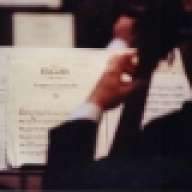
Do you know the Time Signature to the above example?
Common Time. 4/4.

TalkBass has been independent since 1998. Add your voice.
Create a free account to reply to discussions, view embedded media, and browse with fewer display ads.
Join free Log in
Want zero display ads or expanded classifieds tools? Compare plans.
Do you know the Time Signature to the above example?
I got rid of all of my bass excerpts and parts a while ago so I looked through my wife's violin music and found an example from Tchaik 1. The first measure hides 2, 3, and 4 while the second shows 3 because the note changes.
Common Time. 4/4.

 In our own way, we contributed to the understanding that written music is no law, but just a means of communication. Subject to manipulation, sure, but what really counts is the way the performer plays it. If the composer/arranger wants some specific rendering, he or she should simply be more clear about intentions.
Long ago Harry Happel, a friend of mine came, up to me. He is the father of Sven Happel, a top Dutch BG and DB player with whom I was in a band (me playing the alto sax) when he was still studying. Harry (who passed away too young) was a well known Dutch pianist who performed at the famous North Sea Jazz Festival several times. But the guy couldn't read any music at all. Now a famous Japanese builder of electric pianos asked him to play a few demos for a new model, to be played by the buyer who only needed to press the DEMO button.
He made digital recordings (Autumn Leaves, Someday my prince will come, forgot the third tune) and sent them in. The Japanese loved them, edited them, installed them. Only after that, they wanted sheet music for those songs exactly the way Harry played them. Harry - who couldn't read music - came to me to have the stuff transcribed. Of course I had to simplify the stuff, since, with Harry's timing, the written music would have looked way too complicated. Harry sent my stuff to the guys in Japan.
They were very, very disappointed. They had made MIDI files of Harry's play and had the computer write out what he played. Those files, as you may expect, did not match what I wrote.
So what we are really looking at in this thread is the importance of the human factor. I write stuff my taking that factor into account.
It took us some time, but Harry and I succeeded to convince our Japanese clients.
They used my sheets, and Harry's interpretation, or, infact the other way around

I personally don't think you should apologize for posting. This is a good forum to ask your questions & there are plenty of people who will reply with information. You will occasionally get a surly reply. It's the internet, you don't even have to read the reply, no less take it seriously.I'm sorry I started a "Fail" thread. I am just trying to learn and improve my reading.
I really did learn somethings and want to thank the people that helped explain it to me.
That is the intro of the song and the drum does not come in until the second bar. The first bar is never used again. David1234 nailed it.
I think in the first bar it should have been two 1/8's tied. That is were I think I got lost.


There is a very important rule in written music that imply in 4/4...
Just wanted to clarify: is this actually a 'rule' or just a suggested way of writing?

I'm sorry I started a "Fail" thread. I am just trying to learn and improve my reading.
I really did learn somethings and want to thank the people that helped explain it to me.
That is the intro of the song and the drum does not come in until the second bar. The first bar is never used again. David1234 nailed it.
I think in the first bar it should have been two 1/8's tied. That is were I think I got lost.
But this is a rule or a way to write rhythms that is taught in schools.
If so, I'd think that's a rule. Even if there isn't any 'Official Book Of Standard Notation', there are certain rules that are followed by (almost) everyone.


