• TalkBass has been independent since 1998. Add your voice.
    Create a free account to reply to discussions, view embedded media, and browse with fewer display ads.
    Join freeLog in
    Want zero display ads or expanded classifieds tools? Compare plans.

What is the "standard" gauge for bass strings?

Interestingly, there's a way to work through the physics to get a relationship between frequency and gauge. For equal tension, 2 strings have their gauges in the same ratio as their frequencies (assuming equal string density). The frequency ratio for a 'fourth' is 4/3, for a 'fifth' is 3/2. So starting with a 45 ...
45 x 4/3 = 60
60 x 4/3 = 80
80 x 3/2 = 120
So these gauges result from the simplified physics too.
Of course the string density does vary a little so it's best to go by the tension charts.
 
May I will ask for your help on this issue?
Fender Standard MIA Jazz Bass 4 string 2012 goes with 0.45 0.65 0.85 0.110TW (taperwound).
There are stock string for standard EADG tuning and standard tension.

Please recommend/link a set of strings with the same tension for DADG tuning.
 
I use the fender 45-110 set on w of my basses. They work well for drop D tuning.
Most companies don't make a 45-110 set at all. D'addario has a string tension chart you can look at on their website that is fairly standard. (sort of). They also sell sets of "even tension" strings. They use 45-107 for standard tuning so 45-110 is pretty even tuned to drop D.

May I will ask for your help on this issue?
Fender Standard MIA Jazz Bass 4 string 2012 goes with 0.45 0.65 0.85 0.110TW (taperwound).
There are stock string for standard EADG tuning and standard tension.

Please recommend/link a set of strings with the same tension for DADG tuning.
 
They are called balanced tension strings.

Invalid Link Removed

3 different sets for light, medium, and heavy.

40-95, 45-107, & 50-120. The 50-120 set is very hard on the neck unless you stay tuned down to drop c# (c#, g#, c#, f#) or lower.


I use the fender 45-110 set on w of my basses. They work well for drop D tuning.
Most companies don't make a 45-110 set at all. D'addario has a string tension chart you can look at on their website that is fairly standard. (sort of). They also sell sets of "even tension" strings. They use 45-107 for standard tuning so 45-110 is pretty even tuned to drop D.
 
So I guess the EB Power Slinkys I use are considered heavy gauge?

.050, .070, .085, .105, .135. No, I don't play particularly hard, but I have a firm stroke. I just like the feel of these strings. And while they aren't the brightest strings out of the package, they retain their brightness for a good long while.

It's a good thing that I like these strings and use them exclusively. They are the only strings I can find as a stock set in a few stores. I usually order 10 sets at a time. I would like to try other strings, but I don't feel like going through the hassle of a custom-gauge order.

I keep hearing about ill effects from using strings this heavy, but I've used these gauges in 4-strings all through the 70s, 80s and some 90s, and now 5-strings with Fenders, Music Mans (men?), and a T-40 and Alembic Series One. Once the necks were adjusted for the tension, I never had any trouble whatsoever with them.
 
I came across this thread when searching the Web for the answer to this question. This is what I now think the answer is:

On Fender website, the four-string Precision and Jazz basses listed all tend to come with a 0.045"-0.100" string set if they're in the nature of '50s, '60s or even '70s reissues*, while the Standard basses tend to be come with 0.045"-.0.105". My guess is that the 0.045", 0.065", 0.080", 0.100" gauge was the standard on Fender basses from early on (from all the way back to 1951?) while John Entwistle's high-profile switch to Rotosounds in 1966 is what popularised the 0.045", 0.065", 0.085", 0.105" gauge and made it into a new standard—he apparently asked Rotosound for a heavier D and G, which suggests that he'd been on 0.045", 0.065", 0.080", 0.100" strings before then—at the same time as inventing or popularising roundwounds for electric bass.

If anyone knows better please jump in!

(EDIT: * This was partly wrong, as some of the vintagey Fender basses have the modern 0.045"-.0.105" sets anyway. I'm still inclined to guess that 0.045", 0.065", 0.080", 0.100" was the historic standard. After all this is the company which 10/46es ALL THE THINGS when it comes to six-stringers, even offset guitars with pure-vintage bridges which simply don't work properly with modern string sets.)
 
Last edited:
I really don't care about the terminology as to what's considered "standard". One manufacturer's "standard" is another's "medium"; one's "regular-light" is another's "medium-light", etc. etc...

My only wish is more manufacturers offer the option for a factory balanced set, 45-60-80-105, in addition to the usual 40-60-80-100 and 45-65-85-105.
 
  • Like
Reactions: MrAB4003
No "standard" as such, every manufacturer uses different strings on the instruments they release. And then different players use different sets - the flats crew seems to use about a .50 - .110 set. Old school funksters go .40-.90.

For a long time I was using Rotosound RS66 LD (.45/.65./.80/.105). I failed to notice on my last order I was getting RS66 LF sets instead - (.45/.65./.85/.105). Small difference in the "A" string is all, but really like how it evens up the tone.
 
  • Like
Reactions: Leo Comerford
I really don't care about the terminology as to what's considered "standard". One manufacturer's "standard" is another's "medium"; one's "regular-light" is another's "medium-light", etc. etc...

My only wish is more manufacturers offer the option for a factory balanced set, 45-60-80-105, in addition to the usual 40-60-80-100 and 45-65-85-105.
I wish flatwounds makers would make 50/65/85/110
Or at least singles to make your own.
Such a shame to have limited options with that.
But luckily my favourite flats (Ernie Ball) sells them in singles.
Just wish my second favourite (Fender) would.
 
A lot of basses come with 45-100. MIA Fender Js and Ps come with 45-110 with a taperwound E.
Sorry, not correct. This from Fender's web site:
American Standard Precision:

icon-miscellaneous.png

Miscellaneous
  • Strings:
    Fender® USA, NPS, (Gauges .045 - .105)
American Standard Jazz
Strings:
NPS, Gauges .045-.105
 
A lot of basses come with 45-100. MIA Fender Js and Ps come with 45-110 with a taperwound E.

Sorry, not correct.

Info posted by SuperSnake2012 is actually correct in the light of the fact it was posted in 2007, when MIA Js and Ps did come factory equipped with the 8250M. ;)

Fender since changed the factory strings for MIAs to the 7250M, so @Gravedigger Dav is also correct. :thumbsup:
 
No "standard" as such, every manufacturer uses different strings on the instruments they release.

Looking over other manufacturers, for 34"-scale solid-body fretted basses in standard tuning they do mostly seem to stick with the .045", .065", .080", .100" and .045", .065", .085", .105" string sizes that Fender favours. D'Addario refers to them as "Light" and "Custom Light" or "Light Top/Med Bottom" respectively: I'll say 45/105 and 45/100 here. Yamaha, Invalid Link Removed and Invalid Link Removed are 45/105; Ibanez seems to be largely 45/105 with at least one 45/100 in the range at the moment; Warwicks are mostly 45/105 too. The Ernie Ball Music Mans all seem to be 45/100. The current Gibson Thunderbird and SG basses are 45/105 while the Les Paul bass is 45/100. I'm not sure what's up with Aria. Rickenbacker basses come with very different string sizes but then they have a non-standard scale length as well. The biggest exception I've seen so far is Alembic, which puts a Link Removed on its own long-scale basses; I'm sure there are others too. (There's actually also one Invalid Link Removed shipping with 0.045", 0.065", 0.085", 0.100" at the moment.)

As you say, what ships as a manufacturer standard isn't a sure guide to what has a significant following among players. Still, it's probably a fair sign that there's at least a large constituency for those pretty-standard sets, between the people who actively expect a new bass to come with them, and the people who will just be happy to stick with them when the time comes to restring.
 
Last edited:
My SR500F came with 45-105--I liked that gauge--so I will try to stay as close as possible to that.
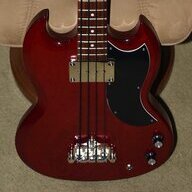
On my shortscale EB3 copy I mostly have sued whatever shortscale string I can find--which normally has been 5-105 or 50-100
 
Info posted by SuperSnake2012 is actually correct in the light of the fact it was posted in 2007, when MIA Js and Ps did come factory equipped with the 8250M. ;)

Fender since changed the factory strings for MIAs to the 7250M, so @Gravedigger Dav is also correct. :thumbsup:
I actually really liked those strings, it's a shame I haven't played them in forever, need to see what they have in 5 strings.