• TalkBass has been independent since 1998. Add your voice.
    Create a free account to reply to discussions, view embedded media, and browse with fewer display ads.
    Join freeLog in
    Want zero display ads or expanded classifieds tools? Compare plans.

I use whatever bass I'm taking out. I regularly maintain them.

I generally practice through a 210 or 2x112 with a gig amp I'm dialing in.
Mainly I'm just setting the amp up to work with any bass I'm looking to gig.
I'm not going to be messing with EQ on a gig.
Its plug and play..so I need to be ball park there with what I choose to take out.
Can't recall when I last tweaked EQ on a gig...but all my basses have an active option, although i may open up or dial down the tone on the bass.
I'm more about pickup blend too...
 
  • Like
Reactions: YourGuitarist
1a.) Home rig is a Hartke Kickback 12, sitting in a tight corner.
1b. ) I turn the bass frequency down because it's in a corner and receives sonic benefits from that required placement. Mid frequency knob a bit less than halfway. Treble frequency a bit more than halfway.
2.) I play passive and active Precision Basses, passive and active Jazz Basses, and 5-string Stingrays.
3.) I typically play Pop, Rock, Funk, Country, R&B.
4.) Low end extension cabinet/feature completely unnecessary. I don't need it at home. I don't need it onstage, as I'm almost always going through PA.

My live bass amp is almost always the Fender Rumble 500, which is maddeningly MIS-LABELED because as a stand-alone amp, is (only) 350 watts. It's only when an extension cab is used, does the output increase to 500 watts. My very strong opinion is an amp should be labeled explicitly with its stand-alone wattage, and not how much wattage in any other circumstance.

Other thoughts/suggestions, relating to this 36-pound 2x10 with tweeter combo amp, and what could be better in a different combo amp: A true XLR DI out, instead of a XLR line out. Deeper recessed back panel features, and deeper recessed top panel features that are less susceptible to damage by being more recessed into the cabinet faces. Have numbers or hashmarks on the control plate so you have a way to consistently dial in the exact setting/volume/tone, etc... every time. As a person who plays upright, it would be nice to have an input jack that is equipped with 1Mohm impedance for piezo and upright bass pickups so that unlike most electric bass amps, there isn't an impedance mismatch between the pickup and amp. Otherwise, a great amp, and a great product to be a target product in which to make yours... with improvements.

I'm gearing up to develop a bass combo with the goal of optimizing for playing quietly with a big sound and keeping up with medium/small gigs (no PA support).

With that in mind, I wanted to do some "research" here first:

What is your home rig and how do you dial it in?
What model of bass do you play *(mainly is it a 4 or 5er)?
What genres do you typically play?
How valuable is low end extension for playing at home and on stage?

Feel free to deviate with any other thoughts and suggestions. I appreciate any and all feedback, the more the merrier.
 
  • Like
Reactions: YourGuitarist
I only play 4s but for the most part, they're tuned C standard for my stoner rock band. I don't like the feel of 5ers and I don't like active pickups or eqs or anything in the way of my thunderfart mud tones. Low end extension isn't all that important to me at home (or in the band) because despite my love of crap gear, I generally have enough ass to massacre the rest of the band. I suppose that might come from Gibson-style basses with TB pickups or some version of mudbuckers.

Since I don't record or anything aside from a crappy iphone clip now and then to remember a riff or something, I don't have any fancy computer stuff. I basically run a muff into a showman clone into a borrowed 16ohm egnater 212. Sad as it sounds, at lower volumes it pushes more low end than my 810s, which, in general, is boosted by the muff and perfectly adequate. On stage, it's the same head but with a slightly better board and an 4ohm 810e to handle the volume.

I'm a total phony...this is also my at-home guitar rig; I just use the Zipper and Joyo instead of the BM and SP. I see no reason I should have a bunch of fancy special stuff when I can convincingly approximate both my (od->muff) bass and (fuzzface->) guitar tones with one little board into one rig mostly with junk I've already got.
home rig.jpg
home board.jpg

home stage rig.jpg

home stage board.jpg
 
Last edited:
Howdy OP! Not sure you're still lookin for answers but I figured I'd toss my hat in the ring anyways:

What is your home rig and how do you dial it in? - I have 2 rigs worth at home. An Aguilar DB750 that lives with an Avatar 115, and a Darkglass RB900 that pairs with my Aguilar DB112. Dialed in based on what is being rehearsed and with what bass. Typically start everything at noon, tend to boost treble and low mid just a hair.

What model of bass do you play *(mainly is it a 4 or 5er)? - Always a 4, but my covers gig life would be better with a 5 due to key change requests from vocals. Current rotation tends to be a stock Fender Jazz bass, Dingwall NG3, and a '75 Gibson Ripper

What genres do you typically play? - Rock, Punk, some artsy avant garde stuff. Craziest is some from Mr Bungle's self titled album

How valuable is low end extension for playing at home and on stage? - if by this you are referring to extended range instruments I would say it varies. My originals group basically never requires anything other than a quick downtune to drop d. That said, the cover fellas I've fallen in with have made it something that has become quite a challenge. For songs like those by The Killers or Volbeat (they have them in Eb standard and D standard) in a set with drop D songs make tuning or multiple basses more of a challenge for minimizing dead air on stage. It'd be easier if I had a 5 and was competent with them in order to accommodate our vocalist asking to move things down a semitone keywise. Maybe you won't be in that position but having the extra couple of low notes would mean 1 bass would suffice whereas currently I may see a setlist where only 4 strings may need extra tuning on stage or a second bass (or they may ask for a situation where not wanting to tune so much might necessitate 3 basses). I don't feel my current musical excursions would be better served with a 6 string though.
 
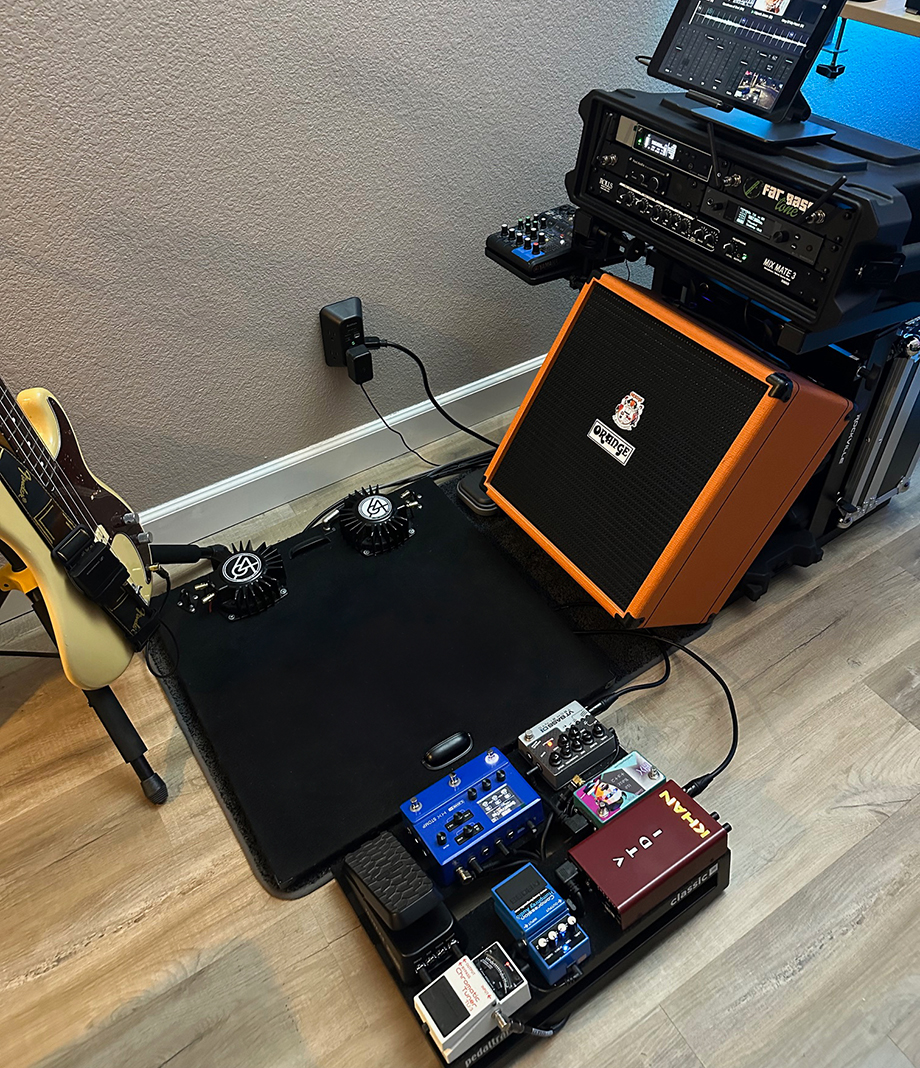
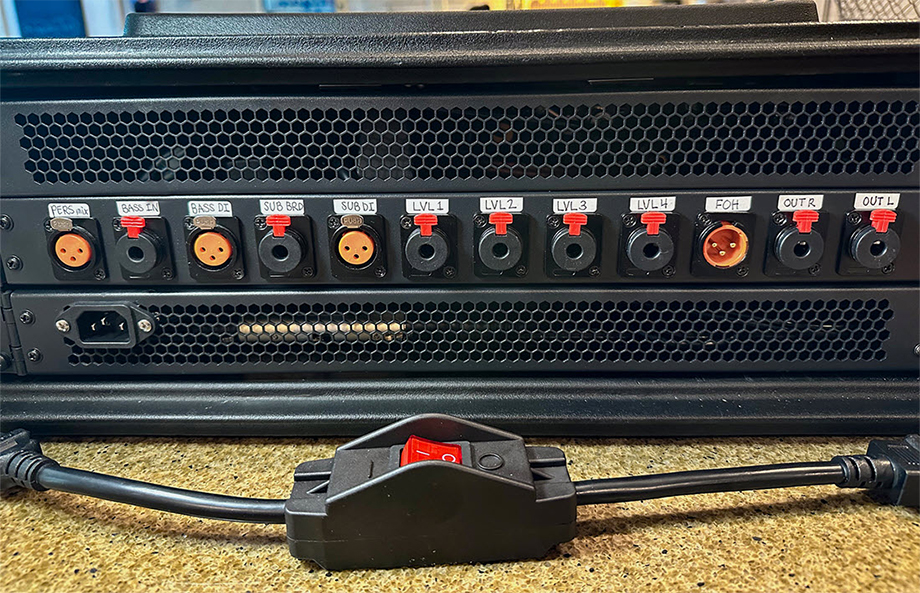
I play at 4 different churches, and all are ampless/silent stage. I pretty much use the same setup at home on stage... minus the mini Yamaha mixer, and Orange amp. I just bring the personal wireless mixing rack, pedalboard, bass, and sub/bassboard for stage.

At home... I output my bass (FOH output on stage) to my orange amp if I want to play with an amp... but most of the time, I use my 64 Audio A12t's in silent practice at home. I prefer IEM's at home since I'm wireless, I can walk and practice anywhere in the house without bothering anyone. Either with sound or silent, it still feels/sounds loud with the sub-bassboard... but at lower volume.

homerig27feb24.jpg

bkpersrack.jpg


I have other amps that are unused and stored away... but the orange is the perfect size in my office/gaming/music room.
 
What and how everything is dialed at home usually, has no relevance if you’re a gigging musician. I’ll play any of my rigs at home in my living room for practice and those same go out to gigs with me, but there’s not much similarity with the settings on the gear for the two locales.

Exactly, home playing typically follows what sounds good in isolation or turned up relative to the rest of the track while gigging requires the ability to both give space to other instruments and cut through with your own.

What changes to your settings do you typically make between gigging and home?
 
  • Like
Reactions: BOOG and Formula73
You've got a lot of feedback already, you really don't need mine. But I like to see my words in print so here goes.

My home and gig rig, Mesa WD 800 into Subway 115.

4,-5 strings, fretted and fretless, upright in the mix too.

The WD has a HPF that I use to shape the low end response as needed to not bug the wife. It's not an issue, the low end for me around the house, I know it's there. Sometimes headphones are utilized.

If she is off shopping, all bets are off.

The music can and will be anything, including thrashcore reggae.


:)
Especially thrashcore reggae.

HPFs are a must. I think there's value in allowing the user to more finely sculpt their low end. There's quite a bit of variety to be had just by adjusting the sub bass, mid-bass and upper bass regions.
 
To your question about low end extension, I’m of a bent that more cabs operating at a lower percentage of the potential RMS rating will give you better results more so that one cab maxed out.

Best wishes.

Very much truth to this, there is an increase in the speaker efficiency as the # of cones is doubled due to surface area and often halving of impedance. Not only that, but as speakers approach their max ratings, they heat up which increases resistance and decreases each individual driver's efficiency. Thus, the system is less responsive at higher volumes often denoted as thermal or power compression.

Another interesting tangent to this is that as the speaker heats up, its damping typically reduces, thus increasing the bass around the system's resonant frequency and reducing bass content below the resonance. This may be part of the reason why certain cabs sound boomy as they are turned up and why you may prefer the low end response of cabs that are dividing the load to more modest requirements per speaker.
 
  • Like
Reactions: dbsfgyd1
  • Like
Reactions: Formula73
Exactly, home playing typically follows what sounds good in isolation or turned up relative to the rest of the track while gigging requires the ability to both give space to other instruments and cut through with your own.

What changes to your settings do you typically make between gigging and home?

I think you might be speaking from the POV of a guitarist, here. Personally, and I'm not in a band that requires a lot of tonal variety, I strive to make my home tone as close as possible to where I sit in a band mix. It might not sound as 'good' by itself but it does make it a lot easier for my ear to go between band and home playing.
 
I think you might be speaking from the POV of a guitarist, here. Personally, and I'm not in a band that requires a lot of tonal variety, I strive to make my home tone as close as possible to where I sit in a band mix. It might not sound as 'good' by itself but it does make it a lot easier for my ear to go between band and home playing.

I'm actually bassist primarily (lead for that matter), my username is a bit of a ****post.
 
  • Like
Reactions: Formula73
I'm actually bassist primarily (lead for that matter), my username is a bit of a ****post.

I guess the biggest part of my point was that there's not much difference, effectively, between my home and gig rigs, tonally, and that it works for me because I'm not a very versatile bassist. I only play to the needs of the music I write specifically for my current band. In fact, everything about my bass playing has been in response to this band as primarily, I was a Gibson into Marshall guitarist (playing 70s and 80s rock/metal covers) prior to moving to Gibson into Muff (with some mids...) into clean loud amp bassist (writing doomy stoner riff-heavy rock) many moons ago. I'm in a 3pc so the fine tone sculpting capability of my different setups is not nearly as important as just the overall character of my sound within the band mix and the fret-clacky smack of my right fingers on the strings.

I am continually awed by the versatility of so many of the bassists here but also realize I'm more of a sloppy knuckledragging luddite than the average TB member.