• TalkBass has been independent since 1998. Add your voice.
    Create a free account to reply to discussions, view embedded media, and browse with fewer display ads.
    Join freeLog in
    Want zero display ads or expanded classifieds tools? Compare plans.

What Makes Some P-Basses Sound Good?

Maybe it's just me, but most p-basses I've played sound muddy and blah, but a few that I've heard on YouTube have quite a defined and aggressive low-mid growl. I really don't think it's a matter of technique either because I dig in and play close to the bridge and I can get a good growl from most J and humbucker basses, but not P basses.

Is it because the good sounding p-basses are being played through tube amps? Are there different types of P pickups, like how Js have single and dual coils? Is it pickup placement?
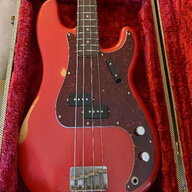
 
I am currently searching this topic heavily....it's a combination of Tube Amps, vintage instruments, and either high end pickups with more resonance or original vintage pickups. I am almost dont figuring out what works..still need some more help on it.

Try these 2 clips for the sound I am talking about...
 
I'm convinced that vintage Ps can produce that tone, but how do modern Ps do it or is it even possible for modern Ps to produce that low-mid growl? Maybe some of you folks with high-end Ps like from Alleva, Sadowsky, Lull, and Nordstrand can chime in?
 
Even thought my bass is not a vintage fender I can produce some aggresive growl. It's mostly in the technique (well, at least I think so) but my bass is quite unique:

Mahogany neck
Maple board
Plywood body.. Or mahogany, kind of hard to tell
Mini humbucker in the p position
Flatwound strings

To get a nice growl i pluck right on the pickup, lightly "pulling" the string up...
 
Maybe it's just me, but most p-basses I've played sound muddy and blah, but a few that I've heard on YouTube have quite a defined and aggressive low-mid growl. I really don't think it's a matter of technique either because I dig in and play close to the bridge and I can get a good growl from most J and humbucker basses, but not P basses.

Is it because the good sounding p-basses are being played through tube amps? Are there different types of P pickups, like how Js have single and dual coils? Is it pickup placement?


Try not digging in and not playing close to the bridge. A P bass is not a J bass. :)
 
a few years ago I bought an American P bass and could never get the classic sound I wanted out of it. Then I bought a used Highway one P bass on e-bay. I think its a 2005 and it sounds great. Maybe its the nitrocellulose lacquer finish or that it doesn't have the graphite rods in the neck.
 
a few years ago I bought an American P bass and could never get the classic sound I wanted out of it. Then I bought a used Highway one P bass on e-bay. I think its a 2005 and it sounds great. Maybe its the nitrocellulose lacquer finish or that it doesn't have the graphite rods in the neck.

With all respect...i really dont think nitro vs poly has anything to do with it. I would put my money on: the "right" pickup and a good setup.

...and of course a good player.
 
It's probably me and my poor hearing (getting older sort of thing) but... when I gig with my Precision, the tone I'm getting always sounds good to me but not knock-my-socks-off great. But... whenever I record with that very same Precision and hear the playback... wow!

Somehow... and this is totally not scientific... I've come to conclude that from my vantage point on stage, the sound I'm hearing is way, way different than what the audience is hearing. I may not be crazy about the tone I'm getting from where I'm standing but the audience is hearing a beautiful and solid bass tone that's sitting very well in the mix.
 
Is it because the good sounding p-basses are being played through tube amps? Are there different types of P pickups, like how Js have single and dual coils? Is it pickup placement?

It's amazing the tonal difference that changes in pickup heights can make - the tone on my mates '58 and '59 custom shop P's goes from open and sweet to focussed and growly with just a 1/8 turn of the pickup screws... could be worth experimenting with!
 
I'm a P bass fan and believe the pickup and string height setup is of utmost importance for good tone. I cannot believe how poorly most of the P bass setups are on basses at the music stores. Even the top of the line Fenders and others.

Long story short, the strings must be set at the proper height over the neck AND FOLLOW THE NECK RADIUS!! The split pickups also must be set at the proper height and adjusted (and angled) to follow the arc of the strings........ adjusted over the neck radius. I often see them set way to low and flat instead of angled. The beauty of the P pickup over a J pup is this ajustability and most of the time it's not taken advantage of.

The only way to nail this adjustment is to play around and experiment with the tone until you get the proper tone. If the P bass pickup sounds woofy or muddy, it's probably set to low. If the pickup is a good one, you can adjust some zing into the tone very easily. I like to put the pickup slighlty closer the the G string and a bit more space under the E string using the angle of the split pups to even out the difference on the A and D strings.

If you cannot dial in a good tone using this type of setup, I would try a different set of pups. I have about 20 sets of various P pups that I experiement with and sometimes the big dollar name brand ones don't always sound the best. Try changing pickups before you give up on the bass itself :bassist:

Here's a photo of what a proper P pickup adjustment should look like. If you pick up a bass and the P pup is set flat........it probably hasn't been dialed in at all :(


Precision_Bass_pickup.jpg


The setup on my Old Aria P bass, now fitted with Fralin pups and LaBella Deep Talkin' Flats.
 
Strings make a big difference as well. IMO one reason TI flats get so many raves here is that growl. I think it's a combination of flexibility and the right mids. Personally, I have never been a fan of really stiff strings on a P. Obviously it worked for Jamerson, but I wouldn't say he had a growly sound.

I first put TI flats on one of my P basses. I wanted to try flats and they seemed to be the most raved about :) To me, they had an odd, zingy tone that just put me off completely. Someone on here suggested LaBella Deep Talkin flats and I bought some. They are amazing!! IMHO, they have the perfect tension, a smooth feel and AWESOME tone. If I put flats on another bass, they will be LaBellas.
 
I've got three P basses I'm looking at right now. Two Fenders and an SX.

They all sound exactly the same sitting on their stands.


Like the old saying goes....

It's more the Archer than the arrow.


Also reminds me of the old Chet Atkins story. (the version I heard was Chet... could have been someone else)

fan: Wow... that's a great sounding guitar!!

Chet (takes off the guitar .. leans it against the amp) How does it sound now? (walks away)
 
I agree with many of the posts above... that is, there are many factors: the player, the set-up, the amp rig, the bass itself. I think a lot of it is EQ: what sounds big and phat for a bass with a bridge pickup will often sound too woofy for a P-bass.


One thing that hasn't been mentioned: a P-bass is harder to play than a bass with a bridge pickup dialed in. This is because it has a *lot* more dynamic range: the split-coil pickup is farther from the bridge (especially the bass coil, the one on the E+A strings) and therefore sees a lot more string excursion. I think this is important: many players become accustomed to the compression of the bridge pickup, and uneven playing will really show on a P-bass! So, this is another big reason why P-basses are frequently referred to as "woofy".