
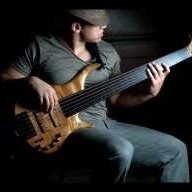
well, i picked up the bass for the first time about 5 years ago.. (bass player at our church wanted to do a song in guitar, for which there was no bass player so i said what the hell.. its just pressing down on string anyway  ) after that, we got a little band going about 2 years ago and thats where i got more interested. well about 4 months ago i decided i wanted to learn how to play this thing for real. up to then all i had really done is just listen to stuff and play or imitate it.. i'm pretty proficient finger wise, and slapping is comming along pretty good, but i'm working on theory right now hence my question:
scales, modes, arpegios, etc.. do you guys actually memorize them? (as in- their locations on the fretboards) or do you practice being able to derive them quickly. for example, i learned a 2octave scale from a book in a particular fingering. well one day i looked for a 3 octave scale (in, lets say, cmaj). should i try to memorize that fingering? or practice being able to find the same scale all over the fretboard? i'm confused as in what i should just "know" and what i should be able to "find"... Thanks for the help in advance, this place is great
) after that, we got a little band going about 2 years ago and thats where i got more interested. well about 4 months ago i decided i wanted to learn how to play this thing for real. up to then all i had really done is just listen to stuff and play or imitate it.. i'm pretty proficient finger wise, and slapping is comming along pretty good, but i'm working on theory right now hence my question:scales, modes, arpegios, etc.. do you guys actually memorize them? (as in- their locations on the fretboards) or do you practice being able to derive them quickly. for example, i learned a 2octave scale from a book in a particular fingering. well one day i looked for a 3 octave scale (in, lets say, cmaj). should i try to memorize that fingering? or practice being able to find the same scale all over the fretboard? i'm confused as in what i should just "know" and what i should be able to "find"... Thanks for the help in advance, this place is great

 ) and then its just matter or trying to get what i know its supposed to "sound" like transcribed onto the fretboard


