• TalkBass has been independent since 1998. Add your voice.
    Create a free account to reply to discussions, view embedded media, and browse with fewer display ads.
    Join freeLog in
    Want zero display ads or expanded classifieds tools? Compare plans.

Whatever happened to U.S. Masters Luthiers?

alaskaleftybass

Will Hanbury, Jr.
In Memoriam
Mar 21, 2012
9,920
22,352
Sitka, Alaska
I remember a number of years back I went to a couple music stores in Portland Oregon and found some really unique high quality basses by a company called U.S. Masters. They seemed kind of like a poor man's Alembic of sorts. One bass that I wish I bought on the spot was a U.S. Masters 4 string Lefty. It was shaped like the Alembic Orion and sounded fantastic. Tone for days, sharp and clear, and unique.

Now, years later, I see them pop up on eBay or wherever but never have seen the mahogany lefty I fell in love with those years ago. Does anyone know the story about them, maybe some details besides, "they went out of business..." ?

Does anyone here own a U.S. Masters and are they still great after you've owned it for a while?

Thanks in advance guys and gals.

Here's a sample I found online from a New Jersey music store, except this is fretless. If it were fretted, I would have been on the phone buying it in a second.

usmasters.JPG
 
Last edited:
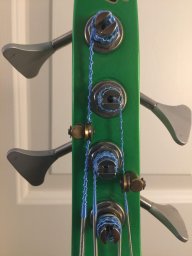
I had 2 5 strings with P pickups for a while. And a 4. They were very well made. Beautiful bird's-eye maple neck and flamed body on one. Their patented captive neck joint was ingenious. The heel of the neck was designed to go into a recess in the body and the neck coupling was wonderful. Wicked low B, but it was 35". The ergonomics of the body shape made playing in firat position a bit of a pain, the 4 was better playing. Sperzel locking tuners were a wonderful touch and something you don't see every day.

Sadly, I have nothing else to offer other than they went out of business.
 
  • Like
Reactions: alaskaleftybass
I had 2 5 strings with P pickups for a while. And a 4. They were very well made. Beautiful bird's-eye maple neck and flamed body on one. Their patented captive neck joint was ingenious. The heel of the neck was designed to go into a recess in the body and the neck coupling was wonderful. Wicked low B, but it was 35". The ergonomics of the body shape made playing in firat position a bit of a pain, the 4 was better playing. Sperzel locking tuners were a wonderful touch and something you don't see every day.

Sadly, I have nothing else to offer other than they went out of business.
Thank you so much for that insight!
 
Yup - what they said above.

They also had an import line called "Masters" - you see these from time to time.

There was also some offered through Musicians Friend for a bit. These were more mass produced and didn't have the custom exotic woods and had more generic pickups. I think these were imported as well - but not at the same time as their "Masters" line.

The custom shop folded, but the webpage was still up for quite a while after.

There's a US Masters club here on TB. I own a couple early models - and yes, the way the neck joint was, it put the first fret WAY out there - a bit of a reach. You get used to it, but its different for sure.
 
I have one of the first 100 basses they produced. They were located in Middleton, WI. The company sold to Young Guitars and was short lived after that. There was an auction that sold off all the machinery and inventory back in 2011 or 2012. The owners were the Reggenberg brothers and had been sub-contracting for many popular brands prior to the US Masters launch. I also passed on a mahogany righty J/P some time ago and have regretted.
 
As I recall first hearing about u.s. masters when the company was still back in business...I thought there was some write up about how the in-house passive pick ups for the basses were unique in almost having the same tonal characteristics as of active pick ups. At least that was the claim. I will try to look back in my reference books and give more feedback about that.
 
As I recall first hearing about u.s. masters when the company was still back in business...I thought there was some write up about how the in-house passive pick ups for the basses were unique in almost having the same tonal characteristics as of active pick ups. At least that was the claim. I will try to look back in my reference books and give more feedback about that.

They made pretty nice stuff, I recall reading something about their innovative passive circuits. Had a EP-42 once, real nice bass with a solid lacewood body and twin Kent Armstrong humbuckers. There were coil tap toggles for each pickup. Inside the control cavity was what looked like 1/2 of a split P bass pickup wired into the circuit. I never knew for sure what its purpose was, but I think it may have served as a dummy coil (?). Maybe that setup was what you're referring to?

One of their innovations was what they called a "captive neck joint" (or some such), whereby the neck and neck pocket connected with a dovetail-like joint. As the bolts were tightened, the dove joint added clamping force.

A thick slab of rosewood fretboard, Hipshot "B" bridge, Sperzal locking tuners and sleek body shape. It was a quality instrument IMO. Wish I still had it.

Edit: As I think about it the fretboard may have been pau ferro.
 
Last edited:
Adding to the story of the US Masters...

The two brothers, Dick and Dave Regenberg, worked out of their shop near Madison, Wisconsin. They offered a number of guitars, basses, and amplifiers. Along with the models they designed, the brothers also contracted to build instruments for other companies. For example, I owned a Dan Armstrong prototype guitar that was built by the brothers. The quality of workmanship was spectacularly good. Over the years I believe they made guitars for Dean, too. By the end of their existence they dabbled in instruments that were sourced out of China.

I'm not sure why the company folded.
 
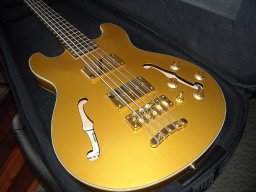
I have a mint constellation EP52 serial B184. Here’s what AI pieced together about them.

“U.S. Masters Guitar Works was a small American guitar and bass builder run by brothers Dick and Dave Regenberg in Wisconsin. They were active mainly in the late 1990s through the 2000s and built high-quality, boutique-level instruments. In addition to their own brand, they also did OEM/“ghost” manufacturing work for other companies, including Dean.

The instruments were consistently praised for excellent craftsmanship, premium materials, and thoughtful design (e.g., birdseye maple necks, high-end hardware, ergonomic construction). There is little to no criticism of their build quality—by most accounts, the guitars and basses were very good.

Despite this, the company struggled as a business. Key challenges included:
  • Inconsistent sales strategy (switching between direct-to-consumer and dealer networks)
  • Limited marketing and brand recognition compared to major manufacturers
  • Difficulty scaling a small, high-quality operation while staying profitable
  • Competition from both large brands (Fender, Gibson, PRS) and emerging boutique builders
At some point in the late 2000s or early 2010s, there were ownership or partnership changes (often referenced as involving “Young Guitars”), which did not stabilize the business. Production slowed, and the company ultimately shut down. The shop was closed and assets (tools, parts, inventory) were liquidated, marking a permanent end to operations.

U.S. Masters is a good example of a “skilled builder without a strong business engine”—a company that produced excellent instruments but lacked the marketing, distribution, and scale needed to sustain long-term success in a competitive industry.

Today, their instruments are considered “underrated boutique gear”: not widely known or highly collectible, but respected by players who are familiar with them.”


IMG_8109.jpeg
 
For a while there were "import" US Masters, but the USA-made basses were really nice. AI didn't mention their innovative neck joint. They called it a "captive" joint, that had a dovetailed design that increased the clamping force as the neck screws were tightened. You could really feel the solidity of that joint, too.

Looks like your EP52 has Kent Armstrong pickups. Is there also a dummy coil inside the control cavity on yours (it would look like 1/2 of a P bass split pickup)?
 
  • Like
Reactions: tindrum

Latest posts