So, i have been playing bass for about a year and a half now, and i play on a Epiphone Thunderbird. I have recently been looking at upgrading my backup bass (which is my first bass, a cheap silvertone). I was browsing here, and i saw a lot of people praise P-Basses. I have only played one maybe twice, and i would like to know, whats the deal about them?

Enjoy the benefits of a premium membership!
Upgrade Account
-
TalkBass has been independent since 1998. Add your voice.
Create a free account to reply to discussions, view embedded media, and browse with fewer display ads.
Join free Log in
Want zero display ads or expanded classifieds tools? Compare plans.
You are using an out of date browser. It may not display this or other websites correctly.
You should upgrade or use an alternative browser.
You should upgrade or use an alternative browser.
Whats with P-basses?
- Thread starter balton4
- Start date
More options
Who Replied?

For many, it's the quintessential bass, the first of its kind and still the most popular, for whatever that's worth.
Those who appreciate them generally agree that they produce a very useable tone that sits well in a band mix without requiring a lot of effort modifying the bass or its signal chain. And the P-Bass is easy to maintain. Of course, there are other basses that can make those claims.
You won't know for sure until you get your hands on a well-set up specimen, hunker down over it for a good long time, and play it in a real or simulated band setting with a little volume.
Those who appreciate them generally agree that they produce a very useable tone that sits well in a band mix without requiring a lot of effort modifying the bass or its signal chain. And the P-Bass is easy to maintain. Of course, there are other basses that can make those claims.
You won't know for sure until you get your hands on a well-set up specimen, hunker down over it for a good long time, and play it in a real or simulated band setting with a little volume.


For many, it's the quintessential bass, the first of its kind and still the most popular, for whatever that's worth.
Those who appreciate them generally agree that they produce a very useable tone that sits well in a band mix without requiring a lot of effort modifying the bass or its signal chain. And the P-Bass is easy to maintain. Of course, there are other basses that can make those claims.
You won't know for sure until you get your hands on a well-set up specimen, hunker down over it for a good long time, and play it in a real or simulated band setting with a little volume.
+ 100,000 !
P-basses don't suck.
I never said they suck. Although, i am assuming that you are comparing them to all those other crappy basses out there. And after playing on about 2 times, i would agree, they do not suck.

There are quite a few people with the "can't beat the original" mentality. That's something I can understand and respect, although I prefer J's over P's. But that's just me. There are pros and cons to P's (as well as EVERY kind of bass), so whether one would be right for you depends entirely on what you are looking for in a bass. Which by the way, what exactly ARE you looking for in a bass? If you're generally happy with your Silvertone and it's P-style, then yes a P bass would be a good replacement. However, if you're just trying to find a bass that's nicer than a Silvertone then there are a world of options.
Somebody should start logging all the posts they see that come from people who weren't impressed with Fender Precision basses....until they played one for a live performance.
P basses can be kinda 'meh' on their own but in a band setting....well...you just need to find out for yourself.
P basses can be kinda 'meh' on their own but in a band setting....well...you just need to find out for yourself.
There are quite a few people with the "can't beat the original" mentality. That's something I can understand and respect, although I prefer J's over P's. But that's just me. There are pros and cons to P's (as well as EVERY kind of bass), so whether one would be right for you depends entirely on what you are looking for in a bass. Which by the way, what exactly ARE you looking for in a bass? If you're generally happy with your Silvertone and it's P-style, then yes a P bass would be a good replacement. However, if you're just trying to find a bass that's nicer than a Silvertone then there are a world of options.
I did enjoy the silvertone, it was just a crappy bass. I then upgraded to the thunderbird, and absolutely love it. After a few months i picked up the silvertone to mess around with, and realized how much thinner the neck was on it. Are P bass necks fairly thin?

I did enjoy the silvertone, it was just a crappy bass. I then upgraded to the thunderbird, and absolutely love it. After a few months i picked up the silvertone to mess around with, and realized how much thinner the neck was on it. Are P bass necks fairly thin?
Read post #2, repeat, repeat, repeat.
Are they thick, thin, heavy, light, etc., etc., etc. Opinions differ. Try one and you will know.

I agree with the herd here. Was never really a fan of a solo'd Pbass. I then bought one, and played a few gigs with it, and I must admit I am a convert. I still use my Cirrus as #1, but the Pbass can/will go with me and pull off most of my gigs if I wanted it to. It has a great ability to sit "in" the mix, rather than in front or behind. It is also very simple. One volume and one tome knob and passive for most. No worries about which pick-up is turned on/volume up, or which song needs the bridge vs. the neck pick-up.
With any bass you are thinking of buying, you have to play it, as it will speak to you in different ways compared to other players.
With any bass you are thinking of buying, you have to play it, as it will speak to you in different ways compared to other players.
Troll?
Quite possible. This site is fertile ground for that.
Read post #2, repeat, repeat, repeat.
Are they thick, thin, heavy, light, etc., etc., etc. Opinions differ. Try one and you will know.
Yeah, I'm going to a local music store tomorrow to check out some guitars and basses. Ill see if they have a p bass i can test out.

I used to think P basses suck because they dont sound so good played solo but after playing one in the mix with a band i realised that it cuts through the mix better than any other pick up, youv got to try it to believe it. J pickups and modern humbuckers sound great by themselves but nothing sits in the mix like a P bass pick up...

bassbombs84 said:Troll?
Why would you say that?
It's a legitimate question for someone inexperienced.
It took me 30 years to play a p that I loved. Before that I couldn't understand the appeal. I was prejudiced because of a guy I played with in high school who had the worst p bass tone you ever heard.
I am still primarily a jazz player, But I love my p, especially the neck.
Troll?
Not a troll, just an inquisitive bassist looking to expand his tonal range. Also just looking at getting a good bass and don't wanna waste my cash on cheap gear.
The thing that makes them still the favorite is that they are just perfectly understated in not being too bassy, trebley, zingy, or any other quality. They sound kind of nasal and honky when you play them solo to practice. But they just sit and fit in the mix right, without stepping on anyone else's sonic space. I can turn down my amp and still be heard with a P Bass. Through a tube head, they just seem to ride underneath the music like a cushion.
This Fender ad from the 70s says it all:
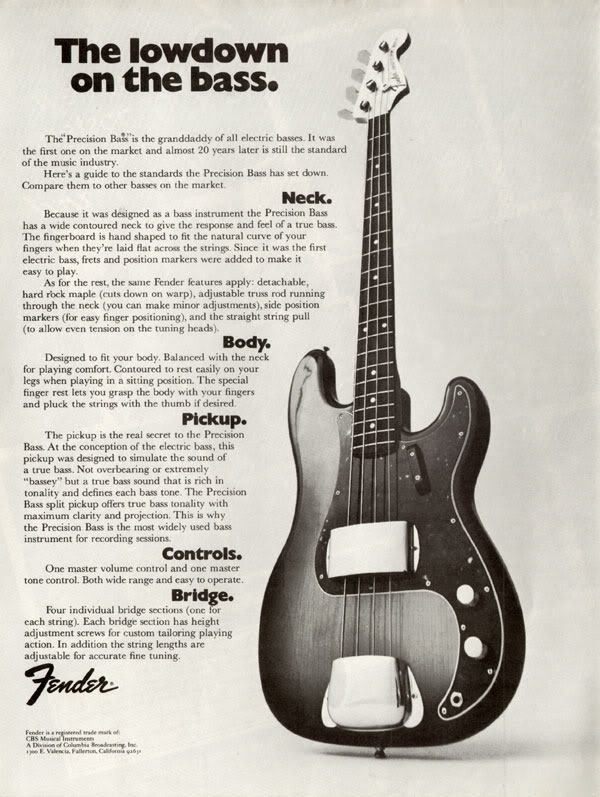
This Fender ad from the 70s says it all: