• TalkBass has been independent since 1998. Add your voice.
    Create a free account to reply to discussions, view embedded media, and browse with fewer display ads.
    Join freeLog in
    Want zero display ads or expanded classifieds tools? Compare plans.

When is a fretless not a fretless?

I have played de-fretted basses only, and for decades. To me the dots are exactly where they should be—the same as for a fretted bass. I do have lines from the filled fret slots but they are dark and blend into the fretboard so not that easy to see anyway.

Tried a fretless where they had put the dots at the “frets” and i hated it.

I never understood how side markers would be helpful because of parallax error: unless you’re looking perpendicular to the neck right at that spot, the marker won’t line up with the “fret”.

How does anyone play a fretless without staring at their hands, or how can a blind person play fretless? Just use your ears. Or make some kind of non permanent fret markings.

Crazy looking bass! Hard to believe it’s so heavy with such a small body.
 
And no, I have no idea why each photo now appears twice!

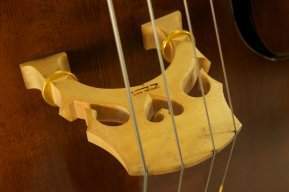
however you come to terms with the dots is up to you. Most double basses don't have markers at all unless they are built in on custom request.
Most of us make pencil marks in the beginning, eventually you realize you don't need them anymore.

In any case congrats, thats one of the cleanest looking Magnums I've ever seen.
 
  • Like
Reactions: Haroldo
I bought an Ovation Magnum III last year, the first I've ever played or owned, and I loved it so much that I decided to go looking for an Ovation Magnum II - that's the one with the strange body shape and the 3-band EQ for a tone control.

I found one in a pawn shop in Louisiana and, astonishingly, it appeared to be a factory fretless with a macassar fingerboard. So I bought it.

I've just finished cleaning it up (it needed it, it really needed it) and re-stringing it, tuned it up, tried to play it, and my intonation was all over the shop.

It didn't take me long to realise that the dots on the neck were in the fretted positions so - crudely - about a quarter tone out for a fretless. Ah, so it's a de-fretted bass then?

Well, no. There's not a blemish on the fingerboard, absolutely no evidence that frets have been removed at some point or that any work has been done to it. OK, it's been shaved then?

Well, no. Not unless someone managed to source exactly the right dot markers for the newly-shaved fingerboard, and then installed them in the wrong (i.e. fretted) positions!

I have to say that I am completely baffled. The only theory that seems to fit would be that someone abducted a neck from the Ovation production line after it had received its dots but before it had the frets installed (Was that the production sequence? Damfino.) and used that to create an unofficial fretless.

That makes no sense to me at all, and I wouldn't have taken the trouble to type it out if I could think of any other explanation.

The bass works well, plays beautifully, and sounds magnificent. I've used permanent Sharpie to black out the misleading side dots and I can't see the fingerboard dots when I'm playing, so there's no actual 'problem' here.

But I'm curious. What on earth has gone on here?

Any ideas?
I have a Yamaha fretless and the dots are in the "between the frets" positions and then the fret positions are marked. I think this might be industry standard.
 
I bought an Ovation Magnum III last year, the first I've ever played or owned, and I loved it so much that I decided to go looking for an Ovation Magnum II - that's the one with the strange body shape and the 3-band EQ for a tone control.

I found one in a pawn shop in Louisiana and, astonishingly, it appeared to be a factory fretless with a macassar fingerboard. So I bought it.

I've just finished cleaning it up (it needed it, it really needed it) and re-stringing it, tuned it up, tried to play it, and my intonation was all over the shop.

It didn't take me long to realise that the dots on the neck were in the fretted positions so - crudely - about a quarter tone out for a fretless. Ah, so it's a de-fretted bass then?

Well, no. There's not a blemish on the fingerboard, absolutely no evidence that frets have been removed at some point or that any work has been done to it. OK, it's been shaved then?

Well, no. Not unless someone managed to source exactly the right dot markers for the newly-shaved fingerboard, and then installed them in the wrong (i.e. fretted) positions!

I have to say that I am completely baffled. The only theory that seems to fit would be that someone abducted a neck from the Ovation production line after it had received its dots but before it had the frets installed (Was that the production sequence? Damfino.) and used that to create an unofficial fretless.

That makes no sense to me at all, and I wouldn't have taken the trouble to type it out if I could think of any other explanation.

The bass works well, plays beautifully, and sounds magnificent. I've used permanent Sharpie to black out the misleading side dots and I can't see the fingerboard dots when I'm playing, so there's no actual 'problem' here.

But I'm curious. What on earth has gone on here?

Any ideas?

No offense, but it's an ovation.
 
That would be an affirmatory to both. Imagine a standard fretted bass, then wave a magic wand and make the frets go away without leaving any trace they were ever there.

Now that's what I'm talking about.

As luck would have it, I installed a FretFX LED strip on my Mike Lull T5 just last week - love it to bits. So I'm already thinking along those lines.

Thanks. :)

Yeah is a sign of the factory thing I mentioned where they just grabbed a standard fretted neck and left the frets off to make a fretless bass not thinking about how the markers need to be different!
 
however you come to terms with the dots is up to you. Most double basses don't have markers at all unless they are built in on custom request.
Most of us make pencil marks in the beginning, eventually you realize you don't need them anymore.

In any case congrats, thats one of the cleanest looking Magnums I've ever seen.

The problem is that on a double bass you have "positions" that help you achieve muscle memory as to where notes are. But on a bass guitar with a long skinny neck and one hand position finding a quick reference is not so simple. This has been pointed out here on TB many times. So no, in general as one gets fretless skilled you certainly are not staring at the markers all the time, but they are useful and you don't want to be sliding into notes to find them. I'm sure with practice (like in all things) you could learn to deal with dot markers in the fretted position, but since dots on the fret positions has become more or less fretless standard, it will make life difficult for you if you try to play another bass with markers in the standard position.
 
I have a Yamaha fretless and the dots are in the "between the frets" positions and then the fret positions are marked. I think this might be industry standard.

Absolutely not. It's just a manufacturing thing. Some mfrs are choosing to pick fretless fingerboards from inventory after the dots are inlaid. Think about it...inlaying the dots is extra labor and materials that are not needed for a fretless bass. Perhaps one of the builders here at TB could comment on why a mfr might want to do this.

The vast majority of mfrs do not do this. Even lines are in the minority...Pedulla was the first mfr to offer lines as standard. My first fretless, a 1982 BC Rich didn't even have side dots, just like a DB.
 
  • Like
Reactions: TomB
Pedulla has been at it for quite a while... I don't see a problem.

97391-7c1a48a68d8fb5890f106c388143c1b0.jpg
 
  • Like
Reactions: Lance Bunyon
A fretless is not a fretless if it has frets. Hence the expression - fretless.

On a more serious note, I find that side dots are (almost) always misleading. I'm sure that the ones on mine are spot on in theory. In practice they would rarely guide you to the correct position on the fingerboard, simply because you look at most notes at an angle, so closer to the nut what you see is flat and higher up what you see is sharp. This is of course more noticeable for the higher strings and what's more it varies depending on your playing position.
 
  • Like
Reactions: bassbenj and BAG
I have a very high-end fretless 5 string which had the fingerboard replaced at some point before I owned it. I never played this bass with a band until recently. At first I thought the side dots were way off because it was creating intonation problems with the guitars in the band.
My guitar tech found that the intonation was off almost half a step!!! At least a centimeter and a half. This bass has a removable bridge piece so what he did was build a plastic shim which pushed the bridge piece back that (almost) 1.5 centimeters. The bass is perfectly intoned with the side dots now AND with other in tune instruments.
Blows my mind how the original luthier replaced the fretted fingerboard with a fretless and never bothered to check intonation...
 
It depends on the maker, or the make.
My first (lined) fretless was a Hohner PJ-FL, that had the dots at the same reference point as your Ovation.
My 4 string and 5 string fretless also have dots that way.
But My Hohner B2A FL has the dots on the finger position.
Which was confusing in the beginning.
In the end you have to trust your ears and get used to the way the dots are positioned.
A double bass hasn't got any dot on the side.