• TalkBass has been independent since 1998. Add your voice.
    Create a free account to reply to discussions, view embedded media, and browse with fewer display ads.
    Join freeLog in
    Want zero display ads or expanded classifieds tools? Compare plans.

Where to start?

I’m new to playing an instrument, so I don’t read music or understand what a music sheet is telling me do to. I know there are tabs we can follow. I’ve been watching a lot of beginners video on YouTube while I wait for my bass to arrive some time this month.

My question is: As a beginner, where should one start? Would it be learning where the notes are on the neck, learning scales, arpeggios? There is so much to learn that I don’t want to create bad habits for myself just to come back and fix my mistakes.

Any advice is appreciated. Thank you.
 
+1

. . . you could also start here . . .

Free Online Bass Lessons - Talkingbass.net - Lesson Map

. . . start from "Beginner." There's enough lesson material here to keep you busy for a very long time.

And equally important, learn some songs!

Enjoy the ride . . .
Right. I was looking at some videos on YT. A lot of beginner lessons start off with different lessons, that’s why I asked what should I be looking for. Thanks.
 
  • Like
Reactions: FatStringer52
Where to start? First is getting to know your bass. How to tune it, how to hold it, how to get sound from it. Will you be using a pick, your fingers or just your thumb to sound the strings, all three will get sound. For all that I recommend the book "Bass Guitar for Dummies" as all that is covered in the first few pages of the book.

Next is what will you use as sheet music. Tab, standard notation, fake chord, or Nashville numbers are some ways you might go. Ask Google to pull up examples of the above mentioned ways so you have some idea what they are.. As you are new to sheet music I recommend you start with fake chord and pounding the note named in the fake chord sheet music - to the beat of the song. If you can chew gum and walk you got it made. Yes it will take a couple of weeks if not a month or so, but, is a start.

Taking lessons have been mentioned and it is here you would save a lot of time if you had another human sitting knee to knee with you. Telling you what to do and giving instant feed back on what you just did. But, as that is out of the question one of the "How to books" and start on page one is my recommendation. Bass Guitar for Dummies for example.

The Getting Started Sticky (How to get started?) has a wealth of knowledge in it, and I recommend you spend some time there. However, it does take for granted you already know how to hold the bass, how to tune it and all the other basic skills that must be learned first. So get a copy of Dummies. It is an e-book and you can have a copy tonight.

This monster is best eaten one bite at a time, don't try to eat the whole thing at once as you will get sick of it and stop. The following are examples of what you will need to know beyond where the notes are on your bass neck.

Scale tones for the Major and Natural minor scale and where those notes are on your bass neck. The Getting Started Sticky will help with that. This will get your fingers moving over your neck, so we do scales tones first, however, we will not be using scale tones to play songs for several years. This is just an exercise that gets you ready for -- Chord tones. Chord tones The notes of the harmonizing chord are what we use right at first. See, or hear, the chord then play it's root note (it's name) to the beat of the music is what we end up doing first. Later we add more chord notes into our bass line, for example R-3-5-8. The get started sticky goes into detail on all those numbers...

When you know where to notes are located - in first position (first 5 frets of your neck) and you can run the C, G and F major scale come back and ask specific questions. Someone will answer.

Good Luck.
 
Last edited:
Looking back at my own journey (self taught), I strongly recommend you learn “ theory” right from the start. It will help you understand “why and when” to play what, and free you from just copying others or learning scales without knowing what to do with them.


I just recently completed Ariane Cap’s Music Theory for the Bass Player and could not recommend it more strongly! Some of it may be too advanced for you at first, but a lot of it will be perfect for you to establish good technique and a good foundation in theory. And you can always circle back to the harder stuff later.


Her book is about $30 and if you are serious and disciplined, you will be making a great investment in yourself. She also has an online course, which is more money, but something you can wait on until you get more comfortable playing and ready for the next step. Here are both links. Best of luck and welcome to the Club!


Book: http://bit.ly/CapBassTheoryBook

Online Course: Steady Track Music Theory for the Bass Player - The Course
 
Thank you so much for the time you took to help me out. This is what I was trying to figure out. I already printed out the notes on the neck so I can see what it is I’m playing and where to place fingers. I had a bass at my home for a few months and I learned some things about it. My brother in law moved to Jersey so he took it back with him.

I will refer to the things you mentioned in your post. Thanks again.
 
Looking back at my own journey (self taught), I strongly recommend you learn “ theory” right from the start. It will help you understand “why and when” to play what, and free you from just copying others or learning scales without knowing what to do with them.


I just recently completed Ariane Cap’s Music Theory for the Bass Player and could not recommend it more strongly! Some of it may be too advanced for you at first, but a lot of it will be perfect for you to establish good technique and a good foundation in theory. And you can always circle back to the harder stuff later.


Her book is about $30 and if you are serious and disciplined, you will be making a great investment in yourself. She also has an online course, which is more money, but something you can wait on until you get more comfortable playing and ready for the next step. Here are both links. Best of luck and welcome to the Club!


Book: http://bit.ly/CapBassTheoryBook

Online Course: Steady Track Music Theory for the Bass Player - The Course
Right. Certainly that was what I was thinking, learn theory. While I have watched videos on some of my favorite songs on YT, following the tabs isn’t that easy for me. I don’t want to get into any bad habits so I’ll start with the fundamentals.
 
All good advice. Make sure you get your fretting hand in position correctly. Don't bend your wrist too much, if at all. You also don't have to fret notes on the very tips of your fingers, but rather more down into the flat part. That is, you don't have to bend your f8ngers as much as a guitarist does.
 
  • Like
Reactions: RayPaganJr
I'm completely self-taught too. Been playing 8 years.
The bass playing for dummies mentioned earlier was the first book i bought.
Also there are free lessongs at studybass.com. Lots of info there.
And like someone mentioned learn some songs. Keep it fun along with the "work" of learning your fretboard, theory, and practicing proper form, etc.
 
Everyone’s response was useful and exactly what I was looking for. I didn’t just want to figure out songs I like, but rather the theory and fundamentals do playing the bass so that I won’t have to go back next year and practice what I should have in the first place.

I’m stoked that I found this forum. People here have been great.
 
  • Like
Reactions: fearceol
Youtube can be a great source. Wish it existed when I was learning. This is not bass, but is music, and is very applicable here. Don't let video instruction pull you in 7 different directions that could lead to frustration and, perhaps even giving up.

Essentially, if you try to serve too many different aspects at the same time, your progress in each area will be small to the point of you not being able to feel like you are getting anywhere. If you focus on a specific skill, your muscle memory and ear will improve, and you will feel that your time spent learning and practicing is paying off, which should leave you wanting more. Repeat, and continue to do so until you are amazing at bass. - Welcome to the club by the way....
 
Right. Certainly that was what I was thinking, learn theory. While I have watched videos on some of my favorite songs on YT, following the tabs isn’t that easy for me. I don’t want to get into any bad habits so I’ll start with the fundamentals.
This is an excellent site for learning the music theory basics: www.musictheory.net. Start with the lessons, then move on to the exercises.
 
  • Like
Reactions: RayPaganJr
Youtube can be a great source. Wish it existed when I was learning. This is not bass, but is music, and is very applicable here. Don't let video instruction pull you in 7 different directions that could lead to frustration and, perhaps even giving up.

Essentially, if you try to serve too many different aspects at the same time, your progress in each area will be small to the point of you not being able to feel like you are getting anywhere. If you focus on a specific skill, your muscle memory and ear will improve, and you will feel that your time spent learning and practicing is paying off, which should leave you wanting more. Repeat, and continue to do so until you are amazing at bass. - Welcome to the club by the way....

Yes. I’ve been a court reporter since 1984. We learned the keyboard by muscle memory and we increased speed throughout the years, so I understand and concur with what you’re saying. So I plan on taking a similar approach to the way I learned how to write. When we hear a word, our fingers automatically goes to the exact keys. We don’t have time to think, or else we will lose the speaker and of course we wouldn’t last long in this profession. Thank you.
 
  • Like
Reactions: Wfrance3
Where to start? First is getting to know your bass. How to tune it, how to hold it, how to get sound from it. Will you be using a pick, your fingers or just your thumb to sound the strings, all three will get sound. For all that I recommend the book "Bass Guitar for Dummies" as all that is covered in the first few pages of the book.

Next is what will you use as sheet music. Tab, standard notation, fake chord, or Nashville numbers are some ways you might go. Ask Google to pull up examples of the above mentioned ways so you have some idea what they are.. As you are new to sheet music I recommend you start with fake chord and pounding the note named in the fake chord sheet music - to the beat of the song. If you can chew gum and walk you got it made. Yes it will take a couple of weeks if not a month or so, but, is a start.

Taking lessons have been mentioned and it is here you would save a lot of time if you had another human sitting knee to knee with you. Telling you what to do and giving instant feed back on what you just did. But, as that is out of the question one of the "How to books" and start on page one is my recommendation. Bass Guitar for Dummies for example.

The Getting Started Sticky (How to get started?) has a wealth of knowledge in it, and I recommend you spend some time there. However, it does take for granted you already know how to hold the bass, how to tune it and all the other basic skills that must be learned first. So get a copy of Dummies. It is an e-book and you can have a copy tonight.

This monster is best eaten one bite at a time, don't try to eat the whole thing at once as you will get sick of it and stop. The following are examples of what you will need to know beyond where the notes are on your bass neck.

Scale tones for the Major and Natural minor scale and where those notes are on your bass neck. The Getting Started Sticky will help with that. This will get your fingers moving over your neck, so we do scales tones first, however, we will not be using scale tones to play songs for several years. This is just an exercise that gets you ready for -- Chord tones. Chord tones The notes of the harmonizing chord are what we use right at first. See, or hear, the chord then play it's root note (it's name) to the beat of the music is what we end up doing first. Later we add more chord notes into our bass line, for example R-3-5-8. The get started sticky goes into detail on all those numbers...

When you know where to notes are located - in first position (first 5 frets of your neck) and you can run the C, G and F major scale come back and ask specific questions. Someone will answer.

Good Luck.
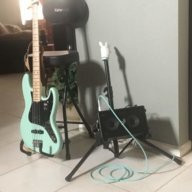
Just ordered the book through Amazon. Thanks for the recommendation.
 

Latest posts