• TalkBass has been independent since 1998. Add your voice.
    Create a free account to reply to discussions, view embedded media, and browse with fewer display ads.
    Join freeLog in
    Want zero display ads or expanded classifieds tools? Compare plans.

Which laminate neck woods?

I see all types of woods used in laminate builds, which makes me think with that type of construction maybe the lamination itself is really what's important, not the wood choices? Any thoughts on the this? Is grain orientation much of a factor either?

I'm going to do a 5 piece most likely with maple and....something lol. Maybe something more exotic like purpleheart, canary, padauk, bubinga, etc. Any thoughts on any of these or other wood choices?

Thanks!
 
Use what looks good to you. I have a preference for tapered laminations though as I think it looks better.
IMG_6309.JPG
 
Laminations alone won't inherently make a neck stiffer. Although it's arguable if stiffness is really a serious problem with most typical bass neck designs.

Laminations have a few advantages:

- Visual impact. You can get a really cool look. It gives you another design variable in terms of getting an overall appearance you like.
- Stability. If you carefully choose a one piece neck blank, it can be stable. But with laminations, you have the chance to make a REALLY stable neck. Laminating a neck blank can let you use wood choices that people may be hesitant to use in a one piece blank, since you can mix them with something known to be typically more stable. (for instance, you can use a stripe of flame maple, even though flame maple is often less stable than straight grained wood.)
- Blending characteristics of wood choices. This one is probably a little more of a gray area, but if you associate certain sounds with certain wood choices, laminating your neck gives you the chance to mix different qualities.

If you are building for stability, you need to keep a couple things in mind:

- Regardless of if you're doing laminations or not, you need to make sure you have good wood stock without a lot of runout or other issues. And it needs to be stable in terms of moisture content.
- Most laminated necks feature a symmetrical design. You neck will be most stable if you cut the strips accounting for this. For instance, if you are going to build from a 1" thick blank, and you want a 3/4" wide maple stripe on either side of a center accent stripe, you can start with a 3/4" thick maple board, and cut two 1" strips from it, then turn each on it's edge to get your 1" thick, 3/4" wide strips. If you cut the strips from the same rough board, and you cut them adjacent to each other and then rotate them "towards" each other (left strip clockwise, right strip counterclockwise) you will position them such that any natural instability in the board will cancel itself out. For instance, if that board had a tendency to bow upwards, you've now got two strips oriented such that their tendency to bow will "fight" each other end (usually) end up with a blank that doesn't move at all, instead of a single-piece blank cut from that same board that may have bowed.

That last part is key, you don't want to just stack up a random bunch of strips from random stock, or you'll end up with a crapshoot in terms of the stability of the blank. But if you cut strips and orient them carefully, you can use this cancelling-out to ensure the blank is more stable than the stock you cut it from.

I know that others may disagree with this, but grain orientation (flat vs quartered) isn't important, if you start out with well dried stock and you orient your parts correctly. Quartered wood is just flat wood turned on edge after all. I do like the look of quartered wood in a neck, so I do usually try for it.

In terms of what species to use, that's really up to whatever will look good in your design. You mentioned maple, which is a good choice (it's not the stiffest in the world, but clearly it's plenty stiff enough for a normal bass neck). I like thin walnut laminations between maple, or thick cherry strips alternating with maple, with thin walnut strips in between them. Purpleheart looks really good next to maple as well, and it's super super stiff. Some people use Wenge next to maple - I have a bass like that, it looks good but I'm not super fond of the difference in texture.

I've been doing a lot of building with only domestic hardwoods lately so my last few necks were mostly maple, walnut, and cherry:

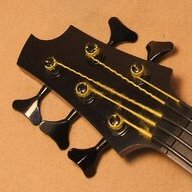
IMG_20200318_154856.jpg


IMG_20200318_154731.jpg


IMG_20200318_154709.jpg


IMG_20200318_154807.jpg


IMG_20200207_171139.jpg
 
I have zero empirical evidence to back up my opinion, but given the strength of modern adhesives, I believe laminating a neck does result in greater strength and stiffness. It sure as hell works for Engineered Lumber, like LVL beams, which are MUCH stronger and stiffer than an equivalent solid wood member. I'd like to try purpleheart, though it's become almost a cliche' in multi-piece necks. I have read that it loses that purple color pretty quick though, and fades to brown. It's probably true that the most "boring" wood with not much figure is often the most stable, but Lord, I'm a sucker for flame maple and walnut on my own builds:
eD58o1j.jpg
 
@Beej
In the little diagram you drew, which side is “up” fingerboard? I’ve done alternating grain orientation like that, but I know one “up” orientation is better, can never remember which.

@dwizum
Same question to you, assuming alternating grain patterns, which side of wood “cup” goes up?
 
  • Like
Reactions: Beej
On the subject of Purple Heart laminations, is there any way to keep it purple long term? UV resistant finish maybe? Got an Alembic inspired build in the planning stages, I’d like to use some Purple Heart, but not if it’s just going to fade to brown.
 
I have read that it loses that purple color pretty quick though, and fades to brown

It does fade some, but not to what I would call an ugly state - especially if it has a finish on it and you keep it out of UV (i.e. don't leave it in the sun). In my experience, it tends to go more towards blackish-purple than brown, so it keeps the color but just gets darker. I have pieces of purpleheart (in other woodworking projects, not basses) that were polished with a bit of oil and wax 20ish years ago and still retain at least some purple. Different varieties seem to fade differently though. A thicker finish would probably help. One good thing about instruments is that they don't usually live in direct sunlight or other bad environments.

Same question to you, assuming alternating grain patterns, which side of wood “cup” goes up?

Honestly, I'm not sure it matters. If you choose stable wood, and the grain is even along the length without a lot of runout, it should be pretty stable as long as things are "symmetrical" across the blank in terms of how you orient the slices. And if there is a seasonal tendency to creep in one direction or the other, symmetrical from side to side means that creep would always be up or down, and a two way truss rod should keep you out of trouble no matter which direction it goes in.

Looking at the ascii art @Beej posted, I think the thing you want to avoid is ///|||/// or \\\|||\\\ or similar. Those arrangements can result in movement that a truss rod won't fix, and they don't really set up the layers to "oppose" and cancel each other out.
 
If you cut the strips from the same rough board, and you cut them adjacent to each other and then rotate them "towards" each other (left strip clockwise, right strip counterclockwise) you will position them such that any natural instability in the board will cancel itself out. For instance, if that board had a tendency to bow upwards, you've now got two strips oriented such that their tendency to bow will "fight" each other end (usually) end up with a blank that doesn't move at all, instead of a single-piece blank cut from that same board that may have bowed.
True.... but if the piece wants to bow left you end up with one side that wants to move down and the other side wants to move up.

Ultimately I think the benefit is from averaging and the more pieces you have the more likely any movement will be smaller and often directly countered.
 
My thoughts on Peltogyne.

There are many species of the genus Peltogyne sold as purpleheart. Some are mildy purple, some richly purple. It does tend to darken but can vary greatly from piece to piece. UV blocking seems to help as does a poly coat instead of an oil or other permeable finish.

What really makes purple heart stand out for me is it's abrasion resistance which I've been told is because of a high silica content. The same thing that dulls tool blades and makes it hard to work with will also resist the abrasion of stainless steel strings on a fretless.

The other feature is it's stiffness. Here's some specs comparing it to hard maple. Notice the Janka hardness is approaching double what hard maple is. And it's flexibility (Elastic Modulus) is also approaching double. This is why purpleheart is one of my favorite neck or fingerboard woods. It's lack of a pronounced grain and the ability to find very homogenous pieces make it a top choice for fretless boards. I made my fretless in '93 with an unlined and therefore unslotted fingerboard and 2 1/4" strips in the neck and it just doesn't move.


Purpleheart | The Wood Database - Lumber Identification (Hardwood)
Common Name(s): Purpleheart, Amaranth
Scientific Name: Peltogyne spp.
Average Dried Weight: 56 lbs/ft3 (905 kg/m3)
Janka Hardness: 2,520 lbf (11,190 N)
Modulus of Rupture: 22,000 lbf/in2 (151.7 MPa)
Elastic Modulus: 2,937,000 lbf/in2 (20.26 GPa)
Crushing Strength: 12,140 lbf/in2 (83.7 MPa)


Hard maple | The Wood Database - Lumber Identification (Hardwood)
Common Name(s): Hard maple, sugar maple, rock maple
Scientific Name: Acer saccharum
Average Dried Weight: 44.0 lbs/ft3 (705 kg/m3)
Janka Hardness: 1,450 lbf (6,450 N)
Modulus of Rupture: 15,800 lbf/in2(109.0 MPa)
Elastic Modulus: 1,830,000 lbf/in2(12.62 GPa)
Crushing Strength: 7,830 lbf/in2 (54.0 MPa)
 
  • Like
Reactions: goodchicken
Here are two older threads which will help with this whole discussion:

This one starts out about the pros and cons of quartersawn maple, and then we get into how to orient the grain rings in multi-lam necks. A lot of good info in this thread:

About That Quartersawn Maple.....

In this short thread, we talk about neck stiffness vs neck stability, and how wood choice and grain orientation affect it.

Noob question about neck stability on cheap bass guitar