• TalkBass has been independent since 1998. Add your voice.
    Create a free account to reply to discussions, view embedded media, and browse with fewer display ads.
    Join freeLog in
    Want zero display ads or expanded classifieds tools? Compare plans.

Which string gauge for C# G# C# F#?

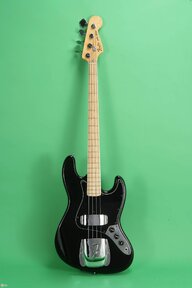
So after 10+ years of playing a 5 string exclusively I got myself an amazing American Professional Precision Bass, 4 string. And now I'm trying to wrap my head around stringing it.

My natural tuning is half-step down, which on a 5 results with: a# d# g# c# f#, which would translate to a 4 string's: d# g# c# f#. Easy.

However, in this setup dropping the E string full step down on occasion would result with: c# g# c# f#. I'm pretty sure your regular .45 set can't handle that.

Which string gauge would you suggest?

Thanks!
 
Last edited:

So after 10+ years of playing a 5 string exclusively I got myself an amazing American Professional Precision Bass, 4 string. And now I'm trying to wrap my head around stringing it.

My natural tuning is half-step down, which on a 5 results with: a# d# g# c# f#, which would translate to a 4 string's: d# g# c# f#. Easy.

However, in this setup dropping the E string full step down on occasion would result with: c# g# c# f#. I'm pretty sure your regular .45 set can't handle that.

What string gauge would you suggest?

Thanks!
050-065-090-120
In other words, a common 065 for the Db string will be plenty fine. Fatten the two at either side, and for the lowest one get a gauge that will be a little tighter than the Ab when tuned to Eb, a little looser when dropped to low Db.

And yeah, no, there's no stock set with those exact gauges.
Scour the main four European online string vendors (lordofthestrings.com, saitenmarkt.com, stringsdirect.co.uk and schneidermusik.de) or, depending on the shipping rate, general MI stores (Thomann, Gear4Music, Music Store/DV247, Musik Produktiv, Muziker, Bax Music, Woodbrass, Kytary), for single strings of a make and model that you like.
Or you could get a custom set from Newtone or Pyramid.
 
  • Like
Reactions: gordonfreemanjr
050-065-090-120
In other words, a common 065 for the Db string will be plenty fine. Fatten the two at either side, and for the lowest one get a gauge that will be a little tighter than the Ab when tuned to Eb, a little looser when dropped to low Db.

And yeah, no, there's no stock set with those exact gauges.
Scour the main four European online string vendors (lordofthestrings.com, saitenmarkt.com, stringsdirect.co.uk and schneidermusik.de) or, depending on the shipping rate, general MI stores (Thomann, Gear4Music, Music Store/DV247, Musik Produktiv, Muziker, Bax Music, Woodbrass, Kytary), for single strings of a make and model that you like.
Or you could get a custom set from Newtone or Pyramid.

Thanks. The thing is, I'd like to keep switching between C#G#C#F# and D#G#C#F#. Isn't the 120 an overkill for the latter?
 
So after 10+ years of playing a 5 string exclusively I got myself an amazing American Professional Precision Bass, 4 string. And now I'm trying to wrap my head around stringing it.

My natural tuning is half-step down, which on a 5 results with: a# d# g# c# f#, which would translate to a 4 string's: d# g# c# f#. Easy.

However, in this setup dropping the E string full step down on occasion would result with: c# g# c# f#. I'm pretty sure your regular .45 set can't handle that.

Which string gauge would you suggest?

Thanks!
I'm sure it could.
 
A half step down, my string tension calculator says that the D'addario XL nickels will give you tension in the 36 to 38 pound range with: 45, 60, 80, 105. That's a very well balanced set, with relatively low tension. If you want the same tension with the lowest string down downtuned another whole step, you want a 120 for that string. The 105 goes to only 28.5 pounds tension when downtuned - that would probably be flop city.
Adding 5 thousandths to each string (50, 65, 85, 110) brings tensions up to 47 for the F# and tension decreases a couple pounds on each lower string, arriving at 41 pounds for the D#. That set is less balanced - a 120 for the lowest string (they don't have a 115 on the calculator app I have) brings its tension to 45 pounds, which makes the set better balanced.
 
  • Like
Reactions: spatters
.105/.085/.065/.045 definitely works for me in CGCF.

If I wanted similar tension/feel/stiffness/whatever to what I would get in EADG, I would need to go with thicker and/or stiffer strings.

I prefer the sound and feel of slacker strings. You've got to ask yourself why you're detuning: do you just want to lower your range a bit, or do you want to change your feel and tone while you're at it?
 
  • Like
Reactions: gordonfreemanjr
I do a lot of drop C stuff on my five string. I find the 3 higher strings are fine in a standard set. 45, 65, 85, still plenty of tension. I went a step up on the C string to 110 instead of 105. Less floppy, tighter notes without the extensive warble. The A string is 135.
I've played drop D on four strings with a standard set with no issues, but for me, any lower than that and the low string gets a little loose. Did you try a standard set? You might not have any issues with them. Might take a little R&D to find what works best for you.
 
  • Like
Reactions: Riff Ranger
I should add, if you're gonna do a custom set, it may be more money and you'll have to weigh the pros and cons of that for yourself. Not sure if it would be cheaper to buy individual strings or buy a stock set and a heavier string for the C# and just put aside the 105.
 
For switching between Eb and drop Db (C#) I'd go 45-60-80-115.

stringjoy sells custom sets for the same price as their regular sets, assuming you like nickel-plated rounds.

If you don't want to put together a custom set, D'Addario EXL170BT gets you 45-60-80-107, and GHS Balanced Nickels will get you 44-60-80-106, which is as close as a stock set will get you.
 
Sheesh, before I'd float these loosey-goosey strings on a four-string AND go back and forth between two tunings (!), I'd be back on my five THAT fast. I REALLY hate making something complicated out of something simple.

But . . . . . I'm not you. Good Luck !
The reason why they do that is mainly to play open drone notes along with higher notes in different keys than standard tuning. It also helps those who may not know theory all that well what to do when a guitarist or bassist is demonstrating how to play a song.

Brave new world :D
 
A half step down, my string tension calculator says that the D'addario XL nickels will give you tension in the 36 to 38 pound range with: 45, 60, 80, 105. That's a very well balanced set, with relatively low tension. If you want the same tension with the lowest string down downtuned another whole step, you want a 120 for that string. The 105 goes to only 28.5 pounds tension when downtuned - that would probably be flop city.
Adding 5 thousandths to each string (50, 65, 85, 110) brings tensions up to 47 for the F# and tension decreases a couple pounds on each lower string, arriving at 41 pounds for the D#. That set is less balanced - a 120 for the lowest string (they don't have a 115 on the calculator app I have) brings its tension to 45 pounds, which makes the set better balanced.

If you don't mind my asking, what string tension calculator app are you using?
 
If you don't mind my asking, what string tension calculator app are you using?

That's a good question - it's an iphone app that says "strings" on my screen, but I don't think that's the real name (String tension pro, maybe?). As it's no longer supported, I'm not sure who actually made it or the exact name. It has data from GHS, D'addario, and Kalium. It allows you to change tunings, scale lengths, etc. It's very versatile. However, as it's no longer supported, I'm afraid when I update my phone it's going to disappear.
 
  • Like
Reactions: Rocket Queen

Latest posts