• TalkBass has been independent since 1998. Add your voice.
    Create a free account to reply to discussions, view embedded media, and browse with fewer display ads.
    Join freeLog in
    Want zero display ads or expanded classifieds tools? Compare plans.

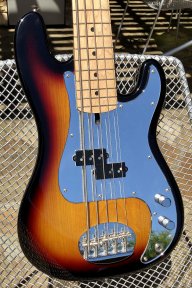
Why are 5-string P-basses so rare?

I think TB has this one all wrong.

Too much thinking going on here. We're applying reason & logic while I suspect few bass buyers do.

I say there are few 5-string basses because the market doesn't want them!

Multiple pickups, active electronics - these are the mark of the "better" basses to the average customer. A simple single-pickup bass with VT controls seems cheap, low class, old school; something only a beginner would buy.

By the time you graduate to a 5 string, you want a "better" bass and that means dual pickups plus lots of knobs because that is the quality stuff, the real, stuff. Doesn't matter that you have no idea what they do, it just stands to reason that more is better!

So, the 4-string P is relegated to the beginner category (or these days PJ because the J makes it "more" which is better) and the 5-string upgrade bass moves into the dual-HB, active EQ category.

Only the few who truly care about tone recognize the potential magic of 5-string P bass, and you can't build much of a business catering to the few.
 
If there are 2 coils connected the hum is gone.

If one coil is reverse-wound, reverse-polarity to the other then the hum will be reduced.
If they're balanced the hum will be completely canceled.


If it dissapears with a phantom coil, why it shouldnt with two "unbalanced" coils?

Why do you think the phantom coil is not a balanced output?
If you have two coils, one RWRP, & one is outputting 25 milliVolts of hum, it needs a reverse-polarity signal of that same noise from the other coil of 25 milliVolts to completely cancel hum.
This is not a debatable topic, it's pure fact.
 
If you haven't already, check out the D'Addario Chromes. Best B-string in the flat-world IMO/IME. ErnieBall's are my next fave. Haven't had much luck with LaBellas. The tension on the b-string felt flappy next to the other strings.

Thanks - I'll have to try out the Chromes. I had always heard they were kind of bright for flats, but then again, the Rotos are kind of bright in the beginning. In a perfect world, La Bella would just extend their Jamerson set with a .145 or .150 B string. In the mean time, I have had reasonably good results with the Kalium nickels and rolling back the tone knob by about half. Close, but not exactly there.
 
  • Like
Reactions: ElMon
If one coil is reverse-wound, reverse-polarity to the other then the hum will be reduced.
If they're balanced the hum will be completely canceled.


Why do you think the phantom coil is not a balanced output?
If you have two coils, one RWRP, & one is outputting 25 milliVolts of hum, it needs a reverse-polarity signal of that same noise from the other coil of 25 milliVolts to completely cancel hum.
This is not a debatable topic, it's pure fact.

So you think all 4 string P coils in the world are completely balanced? (And that is the reason 5 string P basses are not sold that much)
Because i never heard a P bass buzzing in my life and the idea of all of them being perfectly balanced is very suspicious...
The truth is both 4 and 5 string P basses have reverse polarity coils and they are both not perfectly balanced...So they reduce the hum the same..
 
That is the explanation I hear most from luthiers. Specifically, the single P pickup is placed far enough forward that the string motion above it is very substantial, compared to the string motion above a bridge pickup. You can see that by looking.

Surely, that is what gives us the chunky tone characteristic we like about P basses. It may also be a little more than a pickup can do a good job "hearing" on a low B.

The first point can be partially addressed by using a "reverse P" configuration for fives, so the bass side coil is closer to the bridge. I know this takes it away from vintage territory, but these still sound like P-basses IMO. I've tried some Ibanez models with this configuration, and they sound great.

But I also think five strings place an even higher premium than fours on solid construction, especially on having a rock-solid neck. I therefore suspect a P5 with a conventional pickup and less-than-rock-solid neck will probably have a muddy sounding B string.

Ibanez and Yamaha use multi-piece necks, which in theory should help with this, and of course the high-end makers like Mike Lull and Sadowsky won't release an even slightly floppy neck into the wild. I used to have a 2008 MIA Fender Jazz V, and its neck, while good, seemed like a wet noodle compared to the quartersawn beast on my G&L USA M-2500. Guess which had the better B string. (For this reason, I would always specify a quartersawn neck on a G&L five.) I recently tried a StingRay 5 with one of those roasted necks, and...wow. It felt even more solid than my G&L, and the B string was unbelievably tight.
 
  • Like
Reactions: Monterey Bay-ss
Two reasons - P basses appeal to the traditional player and that player usually wants four strings. Also, the P pickup placement isn't ideal for getting a great sounding B string. You may find a few, but usually they'll have onboard electronics. PJ usually sounds better with the low low notes.
 
Last edited:
All this talk about unbalanced PU sections on 5 string P basses got me curious.

I got out my Squier Vintage Modified Precision 5 (it has all Fender USA electronics...American Standard PU) and sure enough it does hum when I put the body of the bass within 6 inches or so of my Genz Benz Shuttle 9.2.

That got me even more curious so I got out my Fender Player Precision 4 string and it has the same amount of hum as the 5 string...again only when the bass is unreasonable close to the amp.

So then I took my G. Gould ggi6 which has EMG preamp and humbuckers which are known to be some of the quietest electronics made and they exhibit exactly the same level of hum when the bass body is placed within a few inches of the amp.

I have never noticed any hum from any of these basses on a gig.

So much for unbalanced sections of 5 string Precision PU's causing hum.

Also for note, My Squier P 5 has TI flats and the Fender Player P has LaBella flats. The basses sound remarkably similar and the B string on the Squier is good....about what you expect from any 34" scale bass. Yes, there are some 34" scale basses that have killer B strings (my Bongo 6) but most are somewhere between passable and good. The Squier is good, my Fender Roscoe Beck 5 is just a little gooder.

Why are there so few 5 string P basses? I don't know. I believe Fender stopped the production of the Squier Vintage Modified Precision 5 because they were so good that the Fender American Standard Precision 5 was not selling in sufficient numbers. If there was sufficient demand other manufacturers would surely build 5 string Precision style basses. The Fender Pro is priced too high for many players IMO.
 
P pickup placement isn't ideal for getting a great sounding B string.

This is how Ibáñez has solved that issue:

J18880000001000-00-500x500.jpg


reversing the position of the coils

Nordstrand also solved the coil mismatch by making the D&G coil as long as the BEA coil.
 
If there are 2 coils connected the hum is gone. If it dissapears with a phantom coil, why it shouldnt with two "unbalanced" coils?

Remember, two passive coils (magnetic pickups) working together will only cancel hum if they are wired out of phase with each other (turns going in opposite directions). Wire them in phase and you will have more hum! So it is not necessarily true that if there are two coils connected, the hum is gone. It depends on HOW the two coils are connected.

Theoretically, the thinking would be that all other things being equal, the coil with the greater number of turns will be more sensitive to stray magnetic fields (hum) than its counterpart with fewer turns. The concern, then, would be that with an unbalanced split pickup, the smaller coil used for the D and G strings might not have enough soup to cancel any hum also picked up by its larger brother employed on the B, E and A strings. So for (passive) hum bucking pickups, traditionally, the two coils comprising the pickup are just ordinarily designed to be more or less the same (with the exception of being wired out of phase with each other).

I think many, if not all the set ups employing phantom coils are active designs. So it then becomes possible to electronically balance the relative sensitivity (to stray magnetic fields) of the phantom coil to its counterparts used to pick up vibrations from the strings. So with electronic pre-amplification, the relative size of the phantom coil probably isn't as important. Size matters. Until it doesn't.

In the real world, my Fender AS P5 doesn't seem to have any hum problems. Tone wise, I don't necessarily always pluck or pick the B string in the same place relative to the pickup as I do the other four strings. Also, the B string sounds considerably different on stage or in rehearsal in conjunction with a group of players than it does solo. Just like being with your SO isn't the same as.... Oh, well. Never mind. You get the picture.

PM Agedhorse if you want a highly credentialed answer.
 
I asked a similar question some years ago and the majority of answers ended up being the following:
  1. P bass is a "traditional" bass, therefore 5 string variants are not as in demand.
  2. 5 string players are typically applying more modern techniques, so most 5s are some kind of jazz variant.
  3. Most 5 string players prefer a smaller neck to allow for agility vs the chunkiness of a Precision style neck.
  4. Most players interested in a 5 want an abundance of tonal options, something a passive single pickup bass is seen as lacking.
  5. Aftermarket really hasn't supported P-style 5 string. Especially the Fender offset version of the P5 pickup.
As for me, I played an American Standard P5 for the first time around 2008 and knew that's what I wanted. In 2015 I finally managed to obtain one. It's been my #1 ever since. Yeah, the B string isn't the best in the world, but it's plenty usable. The string through the body option and a .135 B string help it a lot in my opinion. My major frustration, and probably only real frustration, is the lack of aftermarket support for the Fender offset P5 pickup. To my knowledge only Duncan and Nordstrand make direct replacements, and the Duncan versions are custom shop orders costing $250 and up. That very minor annoyance aside, I love mine.
 
I asked a similar question some years ago and the majority of answers ended up being the following:
  1. P bass is a "traditional" bass, therefore 5 string variants are not as in demand.
  2. 5 string players are typically applying more modern techniques, so most 5s are some kind of jazz variant.
  3. Most 5 string players prefer a smaller neck to allow for agility vs the chunkiness of a Precision style neck.
  4. Most players interested in a 5 want an abundance of tonal options, something a passive single pickup bass is seen as lacking.
  5. Aftermarket really hasn't supported P-style 5 string. Especially the Fender offset version of the P5 pickup.
As for me, I played an American Standard P5 for the first time around 2008 and knew that's what I wanted. In 2015 I finally managed to obtain one. It's been my #1 ever since. Yeah, the B string isn't the best in the world, but it's plenty usable. The string through the body option and a .135 B string help it a lot in my opinion. My major frustration, and probably only real frustration, is the lack of aftermarket support for the Fender offset P5 pickup. To my knowledge only Duncan and Nordstrand make direct replacements, and the Duncan versions are custom shop orders costing $250 and up. That very minor annoyance aside, I love mine.

In terms of a replacement pickup, I'm not sure if it's a direct fit, but the Lakland 55-64 has a Neo-Punch pickup in it that, to me, delivers more of a rock P sound (kind of bigger/bolder - thinking late 60's-70's P) vs. the classic Motown P. Lots of output and a good balance between highs, mids and lows. I think you might be able to get one from Lakland or Hanson.
 
First, it's fashion. I've been around long enough to remember when it was a PBass world in the 70's, and Jazzes were not the ticket. Les Pauls ruled then, and then the era of Strats and the modified 'Super Strats' took over. Time and taste come and go. These days, a Jazz bass layout is the preferred platform.

Another is there's no real consensus as to what the pickup standard should be in terms of shape: Look at the pictures above, and there's a real division among the suppliers in a 5-string P where the shells are either 3-wide on both shells, or it's a 2-wide + 3-wide layout. The 'easy out' is just to use a soapbar shell, but then it doesn't look right to many in a traditional PBass look.

I've owned several 5-string PJ's (BB5000's and an Alembic) and they worked just fine. I also own the much-missed 5-string VM Squier Precision ( . . . . one more great axe on the 'why did Fender discontinue this? list . . . ), which is an absolute steal of a bass. 80-90% as good as the Cali-built P5 for not much money.

And for all intents and purposes, it's simply a 5-string Precision bass. Idiot simple with a volume and tone, string it up with flats or ground-wounds, cue up a round, fat tone on your amp, and you're in the 60's right quick. Put in a foam mute if you're really fussy. Sure, to get really empirical about it, there are better low B's by a little, but in the real world, it's just fine, you could gig with this axe no problem. Like all P's, you need to play around a little with the pickup height and angle after you get your action set, but that's really part of a proper setup anyway.

OK, now what key was 'Standing in the Shadows of Love' in ?
 
I believe Bart mk1s that came on a whole lot of 5 string basses are split coil.

Who knows what coil configuration could be lurking under a soap bar cover. I bet PJ fives are more common than you think, but without the Fender look.

Yeah, Bartolini soaps come in all sorts of configurations under the cover.

MK5P_CoilsStrings.png
M45S-B_CoilsStrings.png
M45CBC_CoilsStrings.png
M452J_CoilsStrings.png
M45J-B_CoilsStrings.png
 
I recently put together a Fender 5 P ('08 neck, '18 body/electronics), I'm loving it, no complaints about the b string, it sounds like a P bass should...still assessing it on gig, but I think its nudged my Jazz 5 out of Top Dog category for my pop/corp. gig. I'm currently anti-active for basses, just too hot & sizzly for the current me. Here's new baby...
695310fc-07ea-4c74-8808-2665d2c2ac3d-jpeg.jpg
 
I think TB has this one all wrong.

Too much thinking going on here. We're applying reason & logic while I suspect few bass buyers do.

I say there are few 5-string basses because the market doesn't want them!

Multiple pickups, active electronics - these are the mark of the "better" basses to the average customer. A simple single-pickup bass with VT controls seems cheap, low class, old school; something only a beginner would buy.

By the time you graduate to a 5 string, you want a "better" bass and that means dual pickups plus lots of knobs because that is the quality stuff, the real, stuff. Doesn't matter that you have no idea what they do, it just stands to reason that more is better!

So, the 4-string P is relegated to the beginner category (or these days PJ because the J makes it "more" which is better) and the 5-string upgrade bass moves into the dual-HB, active EQ category.

Only the few who truly care about tone recognize the potential magic of 5-string P bass, and you can't build much of a business catering to the few.

Totally! I mean, its such a damn shame that beginners like Geddy, Jaco, Wooten and others weren't skilled enough to "graduate" and didn't have the talent or vision to see the magic of 5 string basses and stuck to their cheap 4 strings!


I hope your post was satire because its truly laughable.