• TalkBass has been independent since 1998. Add your voice.
    Create a free account to reply to discussions, view embedded media, and browse with fewer display ads.
    Join freeLog in
    Want zero display ads or expanded classifieds tools? Compare plans.

Why Are 70s Fenders So Pricy Now

Because Donny the nutcracker got one last year! :p

Here's my '78 jazz (natural heavy ash body, maple neck) that weighs 12 pounds!:

'78jazzbass.jpg


Seriously, this bass plays and sounds amazing. I'll never understand why so many people hate Fender basseses from the '70s - except for their weight! :D
ps.i've owned a bunch of other '70s jazz bases, '82 walnut precision special (same Fullerton factory) and a '77 precision bass in the past and they were all fantastic sounding basses as well.
 
Last edited:
Simply because the people who grew up playing them can afford to buy them with the retirement money they have saved. Granted I know many people don't have that money but not many younger guys will make the connection to the older instruments considering many have never experienced them. It's a nostalgia thing. The same reason all the same movies from the 80s and 90s just get remade over and over again today because all the kids who grew up watching them are now adults with money. Same reason comic books, star wars action figures and pokemon cards all sell for crazy money today. We want what we can't have and to many happiness is hard to achieve. Taking a trip down memory lane and making that nostalgia connection with our wallets is the price some pay to be happy like a kid again.
 
Because Dony the nutcracker got one last year! :p

Here's my '78 jazz (natural heavy ash body, maple neck) that weighs 12 pounds!:

View attachment 5430842

Seriously, this bass plays and sounds amazing. I'll never understand why so many people hate Fender basseses from the '70s - except for their weight! :D
ps.i've owned a bunch of other '70s jazz bases and a '77 precision bass and they were all fantastic sounding basses as well.
Was the hernia included in the sale?
 
Simply because the people who grew up playing them can afford to buy them with the retirement money they have saved. Granted I know many people don't have that money but not many younger guys will make the connection to the older instruments considering many have never experienced them. It's a nostalgia thing. The same reason all the same movies from the 80s and 90s just get remade over and over again today because all the kids who grew up watching them are now adults with money. Same reason comic books, star wars action figures and pokemon cards all sell for crazy money today. We want what we can't have and to many happiness is hard to achieve. Taking a trip down memory lane and making that nostalgia connection with our wallets is the price some pay to be happy like a kid again.

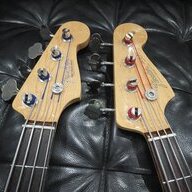
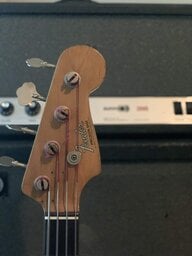
In fairness - I think you have a good point there, personally speaking. The allure of the 70's Pbass was for me, a result of growing up as a punk in late 70's Britain, watching Jean Jaques Burnell, Paul Simonon, Glen Matlock, Bruce Foxton and others play the P Bass. While only aesthetic, there is something about that 70's TV logo that screams out to me. Would never have afforded one in my younger days. Glad and lucky to have this now. And I just joined a punk cover band! Full circle!
 
70's Fenders are not valued based on their capabilities as great musical instruments - some of them may be good, but their real value is based on nostalgia at this point. 50's Fenders are rare pieces of musical history - their value reflects that. 60's Fenders are similar, but not quite as rare or valuable. If you were alive in the 60's (I was) you might recall not really seeing bass guitars much, except on TV now and then - there really weren't many made back then. Once those all got bought up, the collector/nostalgia money began chasing the next oldest thing, and that's 70's Fenders. All of this is built on demographics and assumptions - once the boomers are gone, we're not really sure if that market will hold up. Is it a bubble? It might be, noone can say for sure.
 
70's Fenders are not valued based on their capabilities as great musical instruments - some of them may be good, but their real value is based on nostalgia at this point. 50's Fenders are rare pieces of musical history - their value reflects that. 60's Fenders are similar, but not quite as rare or valuable. If you were alive in the 60's (I was) you might recall not really seeing bass guitars much, except on TV now and then - there really weren't many made back then. Once those all got bought up, the collector/nostalgia money began chasing the next oldest thing, and that's 70's Fenders. All of this is built on demographics and assumptions - once the boomers are gone, we're not really sure if that market will hold up. Is it a bubble? It might be, noone can say for sure.

There is certainly the nostalgia element as I will testify. However, nostalgia alone didn't motivate me personally, to buy what is an incredible specimen of an instrument. Light, resonant, well made. Great sound, great materials. If it was a 70's P Bass that looked good but weighed like a boat anchor and sounded horrible, the nostalgia alone wouldn't have pushed this over the line. I'm a bass player first and foremost and I want a quality instrument.
 
Well, instead of being 20-30 years old theyre now 40-50 years old and a lot of them have been bought up and the supply of all original examples is dwindling. FWIW, they're amazing instruments WHEN THEYRE GOOD. I've had a 76 P with an A neck, a 73 P, and a 72 P all AMAZING instruments. I've played 70's jazzes that weigh 14 pounds as well.
 
As time marches on, good specimens survive, poor specimens get modified and eventually destroyed. Scarcity comes into play. The mystique of the era builds. They pass from just "old" to "classic". As the older ones become increasingly unattainable, the line of desirability moves up. We'll be talking about 80s era basses like this in 10 years. Is it really a mystery?