
Enjoy the benefits of a premium membership!
Upgrade Account
-
TalkBass has been independent since 1998. Add your voice.
Create a free account to reply to discussions, view embedded media, and browse with fewer display ads.
Join free Log in
Want zero display ads or expanded classifieds tools? Compare plans.
You are using an out of date browser. It may not display this or other websites correctly.
You should upgrade or use an alternative browser.
You should upgrade or use an alternative browser.
Why are Carvin Basses sooooo HEAVY?
- Thread starter Mike Sorr
- Start date
More options
Who Replied?



Isn't the stock page full of instruments that were ordered and made but 1) not paid for or 2) returned? Perhaps the average of instruments on that page is skewed by instruments that were returned due to being heavier than expected?
Some are returns. Some are made specificially for in-stock or as experiments in combinations of options; to see what it looks like.
Handyman is right, it didn't used to be this bad, at Carvin. Regarding weight.
However, have been quietly offering Empress wood. A TB'er got a 5 string Vanquish with empress, under 8 pounds. There's also one in-stock with empress, under 9 pounds.
and now that they offer graphite rods, mahogany or white limba necks shouldn't be a strength concern. Let alone a multi-piece such as white limba with walnut or mahogany with maple. Necks like that should be lighter than maple or walnut necks.and their basses built with necks like that, seem to come in a bit lighter.
I haven't weighed it, but the Icon 5 I built last year, feels around 9 pounds. It feels light. I'm not a big guy, so ten pounds would be borderline, for me.

We weighted our previous bassist bass and it came out just under 13 lbs. It was a 5 string spec'd out with all the exotic body woods, neck and fretboard. I wish I could remember exactly the woods that were in it. All I remember was something was walnut and it had 2 stripes down the back  He eventually got tired of the weight and swapped it for a MusicMan 4 stringer.
He eventually got tired of the weight and swapped it for a MusicMan 4 stringer.
Does that equate to "attractive"Could it be that some Carvin basses are simply more sensitive to gravity?
M. M.
![[skyraider]](/data/avatars/l/270/270200.jpg?1620016349)
I would think that it has a lot to do with how the manufacturer is sourcing woods. They probably get a whole bunch of billets from the same tree, making runs with those woods heavier or lighter depending on the density of the tree.
I can handle up to ~10lbs for a few hours, depending on the show. That wasn't always the case-- there was a point where I couldn't hardly tote a Steinberger L2 for a three-hour show, but I'm pretty sure that was because I was getting really out of shape. For the past few years I've been exercising a lot more and so they don't kill me like they used to. It really helps to stay in shape, but since I'm a computer programmer by trade I tend to not get much exercise.
I can handle up to ~10lbs for a few hours, depending on the show. That wasn't always the case-- there was a point where I couldn't hardly tote a Steinberger L2 for a three-hour show, but I'm pretty sure that was because I was getting really out of shape. For the past few years I've been exercising a lot more and so they don't kill me like they used to. It really helps to stay in shape, but since I'm a computer programmer by trade I tend to not get much exercise.

As strange as it seems, this is actually a true statement.Could it be that some Carvin basses are simply more sensitive to gravity?
M. M.
I've noticed that weight seems to be Carvin's weak spot, too. For a company that caters to semi-custom requests, I'm surprised they don't push several "light weight" options more than they do.

My trio of passive 4-string Carvins weigh 8.5, 9.0, + 8.5 respectively.
The overhead of the extra 5th string, batteries and active circuitry can only add to these baselines.
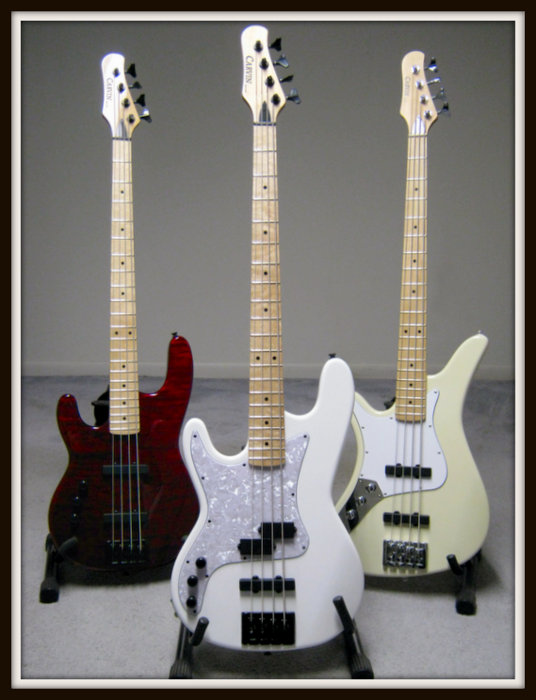
The overhead of the extra 5th string, batteries and active circuitry can only add to these baselines.

I would really like to buy a Carvin 5 string. I've owned a few Carvins in the past and love their sound and options...but I always found them a bit heavy to play on long gigs. My B40 was over 9 pounds, which isn't so bad I guess, but for my bad back and shoulders it's a bit much. Other manufacturers can put out quality instruments at 9 pounds and under, why can't Carvin? They seem to be going in the opposite direction. Here's a link to their in stock page. [Invalid or Expired Link Removed] Most of their 5ers are over 10 pounds and one is 12.5!! That's a little crazy if you ask me. Gorgeous instruments, and they could be the greatest sounding instruments on the planet, but at that weight I could never use one. Too bad really.
Discussing the weight characteristics of Carvin basses in general isn't like discussing the general weight characteristics of Warwick basses, or Spector basses, or most any other make of basses. Because very few other companies allow anywhere near as much customer customization of instruments as Carvin does. There are so many different factors that can affect the ultimate weight of any given Carvin bass, that speaking about their weight only in the abstract just isn't very meaningful or useful.
MM
I'm surprised they don't push several "light weight" options more than they do.
Well that's the trick, isn't it? How to ensure light weight. The only way that seems to work, is to heavily scrutinize their wood sources or to design slimmer and/or smaller guitars. I'm sure they could scrutinize the wood, but it would certainly drive up costs. How much though, I wonder?
Swamp Ash is generally thought to be lighter weight. Yet, heavy loads of swamp ash are the reason Carvin started doing a chambered option on the SB basses, in the first place. Although, it seems that maybe their chambering isn't aggressive enough.
another thing they could do is to offere lighter bridges and tuners. Both of their bridges are quite heavy. Their tuners are NOT anchors, but their are lighter options. with an aluminum hipshot and lightweight tuners, I bet you could save half a pound. Maybe more. Especially if it were a B-style hipshot. They offer several different bridges and a couple of different tuners, for their guitars. Seems like the bass side could stand to have choices for that stuff, too.
Last edited:

I don't think that the real issue is so much what Carvin does or doesn't do to make their basses lighter or heavier than others, but more how we, as players, can adapt or adjust to a particular instrument's weight. The manufacturers probably don't give much consideration as to an instrument's weight in the design of a new product, being more concerned with tone, performance, playability and price. The weight comes out as a consequence of the materials chosen and the manufacturer probably assumes that the customers will find a way to deal with it. If I had joint or muscle problems I might have a different take on the weight issue but with a wide and soft leather strap, my less than light mahogany and walnut bass is not a problem to manage for extended standing times. I believe that a rigid and massive platform for a vibrating string instrument contributes beneficially to the tone, and I'd hate to sacrifice any of that tone to save some weight. Maybe I'll go back to the gym and start working out again so that I can maintain a long term relationship with my bass, kind of like what my girlfriend wants me to do for bettering our relationship

Discussing the weight characteristics of Carvin basses in general isn't like discussing the general weight characteristics of Warwick basses, or Spector basses, or most any other make of basses. Because very few other companies allow anywhere near as much customer customization of instruments as Carvin does. There are so many different factors that can affect the ultimate weight of any given Carvin bass, that speaking about their weight only in the abstract just isn't very meaningful or useful.
MM
I was speaking from experience, from asking TB and eBay sellers what their basses weigh and from what I see on their "in stock" page. While there are Carvin owners that have replied that their basses are lighter than I describe, I've noticed that they're mostly referring to four strings. Having said that, my experience in searching for Carvins of both the four and five variety, and having had them make me one that is currently available on their stock page, is proof enough to me that this particular manufacturer produces quite a lot of heavy ass basses. Just an observation. It's not a knock on them. I think they make a high quality product. But for my particular situation the ones I've had experience with (5 strings especially), and there have been more than a few, have been a bit unwieldy in my opinion. I was just curious to see if anyone else thought the same. As I mentioned, and I believe someone else commented with a similar experience, even selecting what would normally be expected to be lighter weight woods can be a crap shoot. I worked with someone in their sales department and put together what we both thought would be the lightest bass possible without chambering, but I was advised that there were no guarantees that the finished product would be in the 9 to 10 pound range. It wound up being an 11.5 pounder.
I've been wondering the same thing and changed my mind about ordering because I was told that with paying extra (granted,only $50), I couldn't be given an approximate weight or range. Bummer for me because I play for three hours a night and I'm 45 (sigh). If I were showcasing originals ,I wouldn't care.
Discussing the weight characteristics of Carvin basses in general isn't like discussing the general weight characteristics of Warwick basses, or Spector basses, or most any other make of basses. Because very few other companies allow anywhere near as much customer customization of instruments as Carvin does. There are so many different factors that can affect the ultimate weight of any given Carvin bass, that speaking about their weight only in the abstract just isn't very meaningful or useful.
MM
Nice try , MM. I like their stuff but you sound a little bias.
Nice try , MM. I like their stuff but you sound a little bias.
My intent was only to be factual and accurate. If my remarks came across as promotional in any way, maybe that's just because there are aspects of the customization process that are inherently attractive.
MM
I think his point is that you can pretty much bank on a stingray 5, being about 10 or 11 pounds. Because Most stingrays are made with the same wood types and components. It's a standardized product. whereas with Carvin, you can see a range of weights in the same model, due to thousands of possible component and wood combinations. So, you can't really talk about a Carvin PB in terms of a predictable average weight. Even though Carvin themselves, tries to do just that.(albeit that is probably based on the base spec of alder body, maple neck).Nice try , MM. I like their stuff but you sound a little bias.
It is attractive. I just wish that it was an option with Carvin seeing as they can be made to order. It's something I look for with any manufacturer. Both of my Stingray 5's are at the below the 10lb. range which I feel is an attractive feature. I wouldn't order one with such a mystery.My intent was only to be factual and accurate. If my remarks came across as promotional in any way, maybe that's just because there are aspects of the customization process that are inherently attractive.
MM
I think his point is that you can pretty much bank on a stingray 5, being about 10 or 11 pounds. Because Most stingrays are made with the same wood types and components. It's a standardized product. whereas with Carvin, you can see a range of weights in the same model, due to thousands of possible component and wood combinations. So, you can't really talk about a Carvin PB in terms of a predictable average weight. Even though Carvin themselves, tries to do just that.(albeit that is probably based on the base spec of alder body, maple neck).
Makes sense.

I got lucky with my Carvin JB4- it is about 9.3 lbs (but that is without the batteries in it, which I took out , since I don't use the active tone)


