• TalkBass has been independent since 1998. Add your voice.
    Create a free account to reply to discussions, view embedded media, and browse with fewer display ads.
    Join freeLog in
    Want zero display ads or expanded classifieds tools? Compare plans.

Why can't I use a small radio or speaker for practice???

When listening to a finished song or album there is a lot of processing on it. Instruments are compressed and EQ’d individually. The mix is compressed and EQ’d. Then it is mastered with more compression/limiting and EQ. There is a lot going on to control transients and bandwidth so it will sound good on all sizes of speakers. A raw bass signal is very dynamic and somewhat unruly and needs to be tamed somehow. Small speakers are fine at low volumes. Can even be fine at loud volumes with a properly processed signal. But not a raw bass signal. A hpf and compressor would definitely help.
Bass amps are designed to work with a raw bass signal. Besides the electronics in them the speakers have more mass, thicker paper on the cones, and some dampening from the cab itself.
Quite a few records have been mixed on tiny speakers at low volumes. You can actually hear better and are able to tell tone and balance better in a mix at low volumes. Should check out Bob Clearmountain. He has mixed and produced a lot of very big records ( Toto, Bryan adams, Bon Jovi, the list goes on and on),on a 20$ pair of apple computer speakers from years ago. Why? Cause that is what mist people listen to music on.
I always use a cheap mixer and a set of headphones or my IEMs to practice. I also bought a cheap headphone extension cable so I can run the headphone cable down my back so I don’t have to get tangled in it while I play.
 
Yes!!
I also had a 50's Philips tube radio as my first practice amp using the turntable input. Very nice tone at bed room volume...

What a coincidence:laugh:, my first guitar amp when I played guitar was an early 50's RCA console TV with a 12" speaker, that thing sounded excellent, same thing, plugged into the phono jack. I got a lot of miles out of that thing, used to also hook up my old tube radios to the speaker. This was when I was 12, 13 years old. I used to lie on the floor behind the TV because there was more bass.
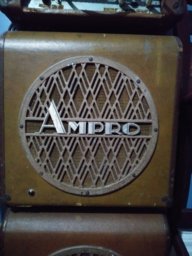
 
Yeah me too, Magnavox console with ~15s (cone measured like 13, basket 14.5?)

I soldered the leads from the phone channel to the (disconnected) headphone jack. I, too was like 12, 13. Lol.
 
Those speakers are designed to reproduce RECORDED music which has been through many studio processes to make it smooth, balanced and 'tame'. You are trying to use it for a LIVE instrument without the benefit of any studio trickery to 'tame' it. On top of this, recorded music uses all sorts of distortion-related tricks to make you THINK you are hearing full, deep bass notes on your little speaker when you are often only hearing higher harmonics of the very lowest notes and your clever old brain is filling in the blanks. The string that buzzes it probably just aggravating a 'mode' within the speaker itself that's size relates to the frequency size of the note, resulting in a resonance at a particular frequency that shakes the poor thing. You may have more luck running your bass through a drive pedal then a compressor pedal then something like a little mixer to convert the signal to something more like line-level. You might find plugging into a POD (or equivalent) might smooth get thing over enough for this to work better, and there are very cheap copies on eBay and Wish etc. Or just get yourself a tiny practice amp! It's a great idea though, if you manage to get it working better, please post the solution!
 
Last edited:
yeah but rigs come and go, a HPF is forever.
When listening to a finished song or album there is a lot of processing on it. Instruments are compressed and EQ’d individually. The mix is compressed and EQ’d. Then it is mastered with more compression/limiting and EQ. There is a lot going on to control transients and bandwidth so it will sound good on all sizes of speakers.
Actually compressors and limiters both are tools which may enhance the level of sub transient noise.

A HPF is the proper tool to protect loudspeakers from any kind of low frequency content (sub harmonics content and also sub transient frequency content)

edit, @LowFactor I hope you know that sub harmonics content and (sub) transient frequency content is not the same and therefore must not be mismatched.
Here you are
Transient noise and what it means to woofer excursion
 
Last edited:
I don't think this is a good idea because it encourages you to pluck too hard in order to be heard. I suppose that's okay if you like to play that way anyway, but I'm a believer in turning up the amp and playing with a light touch -- and you just can't do that unplugged. I'll occasionally spend a few minutes practicing unplugged with a pick, but never fingerstyle.
 
I don't think this is a good idea because it encourages you to pluck too hard in order to be heard. I suppose that's okay if you like to play that way anyway, but I'm a believer in turning up the amp and playing with a light touch -- and you just can't do that unplugged. I'll occasionally spend a few minutes practicing unplugged with a pick, but never fingerstyle.


Well, I like to play hard. That's part of my style. In fact, it's easier to play with a light attack when the default one is strong than to play with a hard attack when the endurance for that is not there.

That said, I always heard myself without any problem plucking the unplugged bass with a lighter touch. My ears became trained to that, I suppose.
 
I've been using a vox bass amplug into a JBL xtreme for a while now and I'm really happy with the sound! Fully battery operated and lasts about 8hrs playing with a cajon and acoustic guitars. I think these speakers have a built in compressor which helps. I've had many compliments on the tone from other people too. For studio and live I use a 2x10 rumble or markbass, but this is my main practice set up now
 
I checked with my sis in Branson and she still has all my Dad's huge expensive home rig/theater/etc. She says all still works. Heavy though, the Empire speakers are a bugger to even scoot across a floor. All tube amps and pre-amps. I still have doubt as to if it could deal well with my active Warwick $$. I have blown speakers with that ax. Don't want to mess up Dad's pride and joy.
 
Doing this is a big risk. You may get away with it but it is not always smart to do. Playing bass through anything that is not designed for a bass instrument can blow up the input stage of the preamp of that device. They are not designed for the transient peaks and lows contained in the output of a live instrument. That's not frequencies I'm talking about it is voltage output. Other recorded sound sources are processed to be within certain limits. Your bass as you play it, is not! Especially if you slap!
 

Latest posts