• TalkBass has been independent since 1998. Add your voice.
    Create a free account to reply to discussions, view embedded media, and browse with fewer display ads.
    Join freeLog in
    Want zero display ads or expanded classifieds tools? Compare plans.

Why choose one fingering over another? (with a specific example)

I was looking at Friedland's reggae bass book and found something I didn't understand. (Well... there is a lot in there I don't understand since I am still super new.)

The book includes this rhythm and fingerings. The E is written as the second fret on the D string... but I found it much easier to play that note on the A string as highlighted.

Why was it written the way it was? I am sure the author had a reason for choosing that fingering.

I may be overthinking it, but I want to make sure I am not overlooking something important.
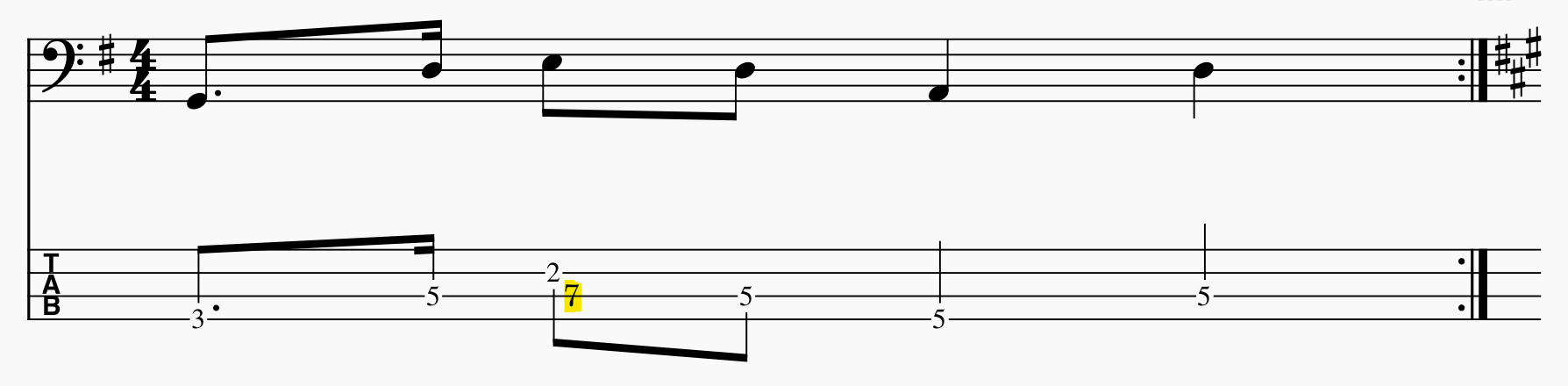
upload_2021-3-25_10-37-7.png
 
@Horseflesh
@Acidic Pool is right here - the point is to play in position using a 'one-finger-per-fret' fingering method. That said, you could play the G and E with your index, using a backwards extension to get at the E, in a 1-2-4 approach.
That said, I can see the attraction of your idea - using 1 or 2 for the barre at 5 is more inviting than pinky...
 
They can both be right, but from my listening at the time, I must have felt it was played on the 2nd fret. The phrasing of the line changes depending on where you play it. See which you prefer.

Last night I tried it both ways and I saw what you're talking about, @edfriedland.

Thanks for the great book, by the way. The history in there was really interesting, and a lot of the examples are just what I need at my skill level. I always liked ska, but I turned into a big dub-head when I got a bass last year and I'm opening up to reggae more and more.
 
I was looking at Friedland's reggae bass book and found something I didn't understand. (Well... there is a lot in there I don't understand since I am still super new.)

The book includes this rhythm and fingerings. The E is written as the second fret on the D string... but I found it much easier to play that note on the A string as highlighted.

Why was it written the way it was? I am sure the author had a reason for choosing that fingering.

I may be overthinking it, but I want to make sure I am not overlooking something important.
View attachment 4215894
There are so many options here depending on how you will phrase it. I t would be a good idea to do a hammer-on between that D and E on the A string. You can also slide that E back to D. You can then play the A on E and then slide up and down to that last D or just drop.

For a reggae sound you want to favor the lowest strings as possible for a rounder sound.
 
Last night I tried it both ways and I saw what you're talking about, @edfriedland.

Thanks for the great book, by the way. The history in there was really interesting, and a lot of the examples are just what I need at my skill level. I always liked ska, but I turned into a big dub-head when I got a bass last year and I'm opening up to reggae more and more.

Good for you! Noticing the difference is all you need. It's still YOUR choice where to play it, but phrasing is definitely one of the factors in this decision.
 
  • Like
Reactions: SteveCS
The line feels and sounds a little different depending on where you place the notes. You can play the same line with several fingerings - but the way they lay out on the neck makes them sound different. When I transcribe, I also try to hear where on the neck something might have been played.

This is a good point. 95/100 times folks will emphasize economy of motion/efficiency when deciding on a fingering. IMHO and IME it is better to let the music decide.
 
I think the idea is probably that you can play the whole line in one position that way, with your middle finger on G (fret 3 of the E string), hit the 5s with your pinky. Gotta have tough pinkies, tho!

Yeah that's kind of a beast of a fingering, and my hands are yuge. Keeping it on the A string would be easier for me, and gives me more ways to shape the sound of the note. I see how a beginner would find it easier to limit position moves, though.