
Incorrectly installed "shielding" can act as an antenna. But then it isn't shielding, it's an antenna.

TalkBass has been independent since 1998. Add your voice.
Create a free account to reply to discussions, view embedded media, and browse with fewer display ads.
Join free Log in
Want zero display ads or expanded classifieds tools? Compare plans.

Exactly.Incorrectly installed "shielding" can act as an antenna. But then it isn't shielding, it's an antenna.
Also important to note, all cavities must be connected to ground. So, either all cavities are connected then one wire to the electronics ground, or each individual cavity connected to electronics ground. If an area is covered in shielding material, but not grounded, it is not a shield, it's copper wrapping paper.Just so the OP Knows what everyone is talking about. The overlap at the control cavity is for contact with the control plate.

Like everyone else said, the noise that stops when you touch metal/strings/bridge indicates RF interference that requires shielding to resolve. If it was grounding, the noise would get louder with touch. Your techs must be old to be anti-shielding. You don't have to go too far back in time to a world that thought shielding was pointless. Most of that old guard is gone though, even Fender shields all their instruments these days.Basically the title.
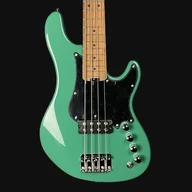
True single coils have 60 cycle hum. A bass with a split coil pick up, like a Precision bass or this JMJ Mustang bass, does not have 60 cycle hum. But this JMJ hums in a different way. In some venues and practice spaces, it's bad. In others, it's completely fine. In the places where it's bad, it goes away a little when I touch the strings, and much more when I touch a tuning peg.
I just got home from 2 shops where 2 very knowledgeable owners each confirmed that the bass is grounded correctly. Of course, they had good power in their shops, and it did not hum much in either. I know a lot of people here have had good success with copper shielding. However, interestingly, each shop owner said that they could do copper shielding for me, to the tune of a few hundred dollars, but they did not feel comfortable saying it would help. They are both skeptics about that.
I've searched and found a few threads with noisy JMJs, but I didn't get a clear answer to my q.
I can't remember ever having a split-coil bass that hummed like this. It's a great bass, I'm just stumped - what makes this different than your average P bass? What makes this bass noisy?


The roll I bought on Amazon was thankfully not sharp on the edges. It is a soft foil. This might have made for an uglier job because it creases and tears easily, but I've never been cut working with it.This is not an uncommon issue with the JMJs - I shielded mine in an hour or two and it fixed the issue. It's very easy!
Yeah, there are several MIM basses they don't do any shielding on, and it might be the period-correct thing like how the JMJ is mimicking a 60s Mustang. But it's the only necessary mod I'd make to a JMJ.This is not an uncommon issue with the JMJs - I shielded mine in an hour or two and it fixed the issue. It's very easy!

This is what I used (at Amazon, Elk brand) but there are others; the important thing is that the adhesive backing is conductive. That way, you can overlap pieces (more on that later)I appreciate this, but I bolded the parts I don't know how to do/am afraid I am going to mess up. I have been doing setups for 25 years but I really know nothing about electronics. Is it worth doing if I just apply tape and do nothing else?
I would say they may not be set up to deal with shielding paint, because it requires a lot of PPE and ventilation - at least the good stuff does. I got a small container of MG SuperShield paint to do the pickup cavities on my SR and as it contains *serious* solvents, it was pretty intense! not something to do indoors, they recommend working outside and let it dry there overnight.A shop charging two+ hours labour on a tape job isn't unreasonable. That being said, I don't know why a professional wouldn't charge an hour and do it with paint.
Ask one to show you how. It would be a great experience.I will ask 2 handy guitar players about it, too. If they are willing, I could ask them to do it for a fee.

Shielding paint doesn’t have to be sprayed, and nowadays it’s mostly water based so toxicity is way reduced.I would say they may not be set up to deal with shielding paint, because it requires a lot of PPE and ventilation - at least the good stuff does. I got a small container of MG SuperShield paint to do the pickup cavities on my SR and as it contains *serious* solvents, it was pretty intense! not something to do indoors, they recommend working outside and let it dry there overnight.
It’s definitely faster, but it’s probably a headache for small shops that don’t have the space to do it correctly or safely. For most people DIYing at home, copper foil is slower, but safer.
Yes. Like I mentioned, it depends on what type.Shielding paint doesn’t have to be sprayed, and nowadays it’s mostly water based so toxicity is way reduced.
I would say they may not be set up to deal with shielding paint, because it requires a lot of PPE and ventilation - at least the good stuff does. I got a small container of MG SuperShield paint to do the pickup cavities on my SR and as it contains *serious* solvents, it was pretty intense! not something to do indoors, they recommend working outside and let it dry there overnight.
It’s definitely faster, but it’s probably a headache for small shops that don’t have the space to do it correctly or safely. For most people DIYing at home, copper foil is slower, but safer.
Honestly, if you get two-sided conductive tape, you could just tape the connection down. That being said, I would strongly recommend a quick dab of solder over tape. Probably the easiest solder job you could do.I want to return here to say (1) thank you to all you chimed in and (2) I'm still not comfortable doing it myself. Respectfully, I can carefully apply tape, but when we get to words like solder, properly grounded, test the polarity, test the connectivity, &c., I really feel that even with the guide someone kindly posted, I do not have any confidence in doing it right myself, which defeats the purpose. You're telling me it's "very easy", but also linking to a very long guide, and telling me that if not properly grounded, there would be no effect at all. If I can't properly do that last, crucial step, then I don't feel it's worth me attempting at all.
I am asking 1 more shop about it. If they will do it for a reasonable fee, I will let them.
I will ask 2 handy guitar players about it, too. If they are willing, I could ask them to do it for a fee.
In the meantime, I will play 2-3 more gigs with it.
If none of that works, and especially if it's noisy at the gigs, I am going to re-sell it.
I think another takeaway for me is, all instruments can have a bit of a hum, some more than others, even with split-coil pickups. Best to consider that with any purchase.
Did you try it with rounds?Hey all, another update for anyone curious. I'm reselling the bass but not really because of the hum.
The hum was bad at a practice space but nice and clean at 3 venues, so in a small sample size, I guess it's fine.
However, the tone of the bass is not what I want. Similar to some other short-scales I've owned, it doesn't have a lot of the high frequencies, even with the tone knob all the way up and EQ boosted on the amp. No harm done; my Junior Collection Jazz Bass has plenty of highs.
If it doesn't sell locally soon, you may see it listed here!


