I'm a little different. I love my PJ ('87 Jazz Bass Special). It got me stuck on Jazz Bass necks, but also in love with the P pickup sound. Then I bought a Jazz Bass. Oh, but it did other things I like, too. Now, I have to have both sounds to satisfy me. The only reason I don't have P is due to the fact that I already have a PJ, and that I can't tolerate the extra 1/8" of nut width that a P has over a Jazz. If I had to keep just one sound, though, I'd keep the P sound.

Enjoy the benefits of a premium membership!
Upgrade Account
-
TalkBass has been independent since 1998. Add your voice.
Create a free account to reply to discussions, view embedded media, and browse with fewer display ads.
Join free Log in
Want zero display ads or expanded classifieds tools? Compare plans.
You are using an out of date browser. It may not display this or other websites correctly.
You should upgrade or use an alternative browser.
You should upgrade or use an alternative browser.
Why such fanatical love for the Precision bass?
- Thread starter David Sutkin
- Start date
-
- Tags
- j bass precision bass
More options
Who Replied?

I avoided getting a Pbass forever. One son wanted a Jazz the other wanted a Precision. My son quit playing after 6 months so I inherited his Pbass and Peavey combo amp. I have to admit....the Precision is easy to play and sounds right with my band (and easier to dial in the sound you want w/1 pickup)

I used to be an "only 5 string active basses for me" kind of guy.
My musical projects switched up and I started looking at my expensive active 5 string thinking that, man, I am lugging around some extra stuff here that I don't need. I sold that bass and roled that into 3 less expensive 4 bangers; one of which is a new Mex P-bass. I mostly bought it as an experiment and, being honest, I liked the way that it looks. CAR with a maple board....yeah.
As others have said, it doesn't sound like much by itself. Kind of meh, actually. Yet, it does sound really nice in the mix per some recordings we have done. I was surprised how much I could do with just the volume and tone knobs. It is also simple, light, comfortable to play, and looks cool.
It arrived with some problems, but my local tech was able to take care of them in about 20 minutes, so that and a proper set-up with new strings has me in a nice relationship with it. I have decided I like the concept enough to invest in a replacement pickup for it. (DiMarzio DP122)
My musical projects switched up and I started looking at my expensive active 5 string thinking that, man, I am lugging around some extra stuff here that I don't need. I sold that bass and roled that into 3 less expensive 4 bangers; one of which is a new Mex P-bass. I mostly bought it as an experiment and, being honest, I liked the way that it looks. CAR with a maple board....yeah.
As others have said, it doesn't sound like much by itself. Kind of meh, actually. Yet, it does sound really nice in the mix per some recordings we have done. I was surprised how much I could do with just the volume and tone knobs. It is also simple, light, comfortable to play, and looks cool.
It arrived with some problems, but my local tech was able to take care of them in about 20 minutes, so that and a proper set-up with new strings has me in a nice relationship with it. I have decided I like the concept enough to invest in a replacement pickup for it. (DiMarzio DP122)
That is the way God intended for a bass to sound and look like!
(I usually say 'Ged' for 'God', but he plays a Jazz so it did not seem right in that context.)
(I usually say 'Ged' for 'God', but he plays a Jazz so it did not seem right in that context.)

Hey TB fam,
Over the years I've amassed a respectable collection of J basses as I LOVE the way they sound and play. I always went for a J if I was looking to add to the Fender collection .... I was never interested in a P bass before but after recently joining Talkbass and spending hours in the forums... it seems there is an overwhelming amount of love for the Precision.
I've never played a P bass for more then a minute or two grabbing one at a Guitar Center or a Sam Ash .... but I've never spent any decent amount of time really diving into different styles of playing with one.
What is it that makes the P bass so different from a J? .... I will probably end up buying a second hand one just to see for myself but in the meantime, can I get some of you P bass fanatics to tell me what it is you love so much about them?
Thanks
Your typical J is like a good meal of seafood and salad — crisp, lean, no fat.
Your typical P is like sinking your teeth into a thick, juicy steak — greasy, substantial, and belly-filling.
Last edited:

I'm just echoing the sentiments of the crowd here, but I am partial to P Basses for a combination of my technique, the big, oomphy sound, and the neckspacing/simple electronics. That being said, I own a P and a J for a reason. The P gives me what has been said already, the J gives me a smoother attack that I can't emulate with a P. Sometimes I want that. Its the same reason I play a Strat and a Tele on guitar. I could go all day on how I prefer passive over active, tube over solid state, lo-fi over hi-fi, etc. I say, if you can accomplish what you want better from the opposite of my preference, I think that's part of why I am a musician.

A precision bass is an it while a jazz bass is a she.

to tell that on a P- Bass thread please don't report me for trolling

man you got balls


I call every bass I have "my girl" and some of my basses are b!t$hes. A P can be a hard lovin' woman (All ladys may excuse me for that b... - word please
 )
)greetings
Wise
That's a very fundamental question with a thousand answers that have already been covered ad nauseam. That answer is already out there, and I'm not going to add to that hay stack.
I'm not a P fanatic, but I see where you are coming from. Talkbass is a strange little bubble where certain ideas are amplified far beyond the normal proportions one finds out in the wild. With that in mind, take what you read here, and in response to this question, even from me, with a grain of salt. Talkbass isn't reality.
Part of cult like mentality that surrounds specifically Fender's implementation of the "Precision Bass" has to do with demographics. The general reader and poster of TB is slightly older and tend to be either hobbyists or in cover bands\backing bands. They are very, for the lack of a more polite word, focused on music from the 60s and 70s, generally earlier rock and Motown where the P bass was very common. As the P was really the first mass produced electric bass of note, these more chronologically advanced players are understandably comfortable with something they are more familiar with.
Beyond simple nostalgia, there is also a solid recording reason for the popularity of the split single coil pickup sound. In simple arrangements with light mixes the mid focused tone sits in a very nice place. Since old standards are simple with light mix, a P works well. Unfortunately, this alligator of the bass world, while suited enough to survive, is very unevolved. On its own it sounds like a grunting pig, and it isn't very dynamic. A P is a P is a P; you get one sound that works well below the 9th fret and that's about it. As long as you don't need more than the basics, a P is fine.
Another aspect is simplicity. For whatever reason, some TB players seem to be befuddled by knobs. If there are more than 3, or any kind of switch, their brains seize up. If you are a novice or easily distracted by shiny objects, the Volume\Tone setup of a P bass is easy to work with.
All this said, I own three PJ basses, albeit none of them fenders, and generally use them in the P position. The one I use the most is a Peavey because the neck is slim; I generally can't stand the huge necks common to most P basses. I also have two jazz, one double humbucker, and one Jazz + Musicman. I'm not 100% happy with any of them, and probably will never be without a lot more money. Regardless, instruments are tools with which we make music. Some tools are carefully engineered for specific tasks, and you can't use anything else. Then you have a hammer. P basses are a hammer; simple and blunt, but when you need one, you need one.
View media item 8840
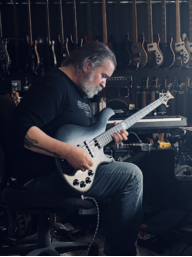
Need to open a window on this outlandishly partial thread and let some Jazz in for a minute ....

ahhhhhh, that feels good.
OK, ready for more, bring it on
ahhhhhh, that feels good.
OK, ready for more, bring it on

This thread has made me to decide to take my P in to practice this week instead of my squier J 5string. Love the sound of the J but maybe the P DOES sound better when not solo. Been months since I played it.

Yes Joe, I see that. But you know, facts are facts.LOL, @bassliner50 and me posted almost the same thing, at the same time
ready for more, bring it on
more Jazz? I thought this was a P- Bass thread?


but well it' s your thread so
)may the bass be with you
Wise(b)ass
Yes Joe, I see that. But you know, facts are facts.
@Bassliner, where on Long Island? ..... Back in the day I used to gig all around Huntington village every weekend for years.

I actually love my P and my J solo'd. I think the P is a bit more foundational when in a band mix.I think I'm in the minority in that I think the P sounds better than a J both soloed and in the mix. Just an idiosyncracy of my own pair of ears. I even like the slap tone on a P better. But then, I used to slap the crap out of fretlesses as well (still do every once in a while!), so I'm some sort of weird outlier, lol. But to me, there's just this classic mid-focused tone that you can only get from that P-pickup sweet spot. I do prefer a J neck though! But that's not a difficult swap-around.
more Jazz? I thought this was a P- Bass thread?
but well it' s your thread so
View attachment 1165189 my GF takes a shower (hidden cam
may the bas be with you
Wise(b)ass
I feel you brother...


Here are my totally unscientific findings, based on decades of unscientific playing:
1) One pickup in exactly the place you want it, not two pickups that can add in what the other isn't providing
2) Girthy, greasy whomp. I like to move the caravan from the bottom and push everything up, not diddle in the middle and bang on the windows.
3) OK, here's my theory about why it satisfies me more: if you have two pickups as far away as they are with a J, when you pluck the string they don't get the attack transient at the exact same time and don't vibrate in the same way. They do start the note/waveform close enough that it doesn't sound not like a singular attack (obviously) but there is a slight blurring caused by the arrivals of the attack transients not being in lockstep. Plus, being picked up at two different locations of the string, the vibrations at the pickup locations are not identical. They are complementary but not unified. If the two pickups are all the way to the bridge and all the way to the neck, when used together it sounds complex, like two different sounds layered together. The closer in the come the less that is apparent but not until they are exactly in the same spot does the sound lose that complexity. Using two pickups together can never completely lose that complexity, and with a J neither pickup is in a spot which gives enough attack and enough girth both.
Ha ha ha. That came to me in a dream and I'm sticking with it : )
4) One pickup. One place. One finger. One octave. One cable.
1) One pickup in exactly the place you want it, not two pickups that can add in what the other isn't providing
2) Girthy, greasy whomp. I like to move the caravan from the bottom and push everything up, not diddle in the middle and bang on the windows.
3) OK, here's my theory about why it satisfies me more: if you have two pickups as far away as they are with a J, when you pluck the string they don't get the attack transient at the exact same time and don't vibrate in the same way. They do start the note/waveform close enough that it doesn't sound not like a singular attack (obviously) but there is a slight blurring caused by the arrivals of the attack transients not being in lockstep. Plus, being picked up at two different locations of the string, the vibrations at the pickup locations are not identical. They are complementary but not unified. If the two pickups are all the way to the bridge and all the way to the neck, when used together it sounds complex, like two different sounds layered together. The closer in the come the less that is apparent but not until they are exactly in the same spot does the sound lose that complexity. Using two pickups together can never completely lose that complexity, and with a J neither pickup is in a spot which gives enough attack and enough girth both.
Ha ha ha. That came to me in a dream and I'm sticking with it : )
4) One pickup. One place. One finger. One octave. One cable.
wait i thought your gf was a person?!more Jazz? I thought this was a P- Bass thread?
but well it' s your thread so
View attachment 1165189 my GF takes a shower (hidden cam
may the bass be with you
Wise(b)ass

- Jun 6, 2012
- 4,837
- 6,859
- Disclosures
- I don't wait 30 minutes after eating, to go swimming.
There's countless thread on pretty much all topics. Should we just stop discussing and just read old threads? SMH.Oy. Threads uncounted on this topic... Really? Again?

