• TalkBass has been independent since 1998. Add your voice.
    Create a free account to reply to discussions, view embedded media, and browse with fewer display ads.
    Join freeLog in
    Want zero display ads or expanded classifieds tools? Compare plans.

Double Bass Why was this done?

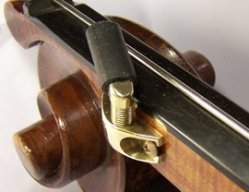
This is an old German bass on loan from a friend. I have always wondered why it has shim under the fingerboard. It starts out around 3/8" at the neck block, then tapers to zero at the nut. Over stand is about 1 1/8", string length is 43". It also looks like it has a small block under the heel of the neck.

Has any one else seen a repair like this before?
Could this be a replaced neck, then shimmed to make it fit?
Its kind of a mystery to me, would like to learn more about this bass.
 
This is a very common way of raising the fingerboard projection height without removing the neck and replacing or adding to the neck block. The fingerboard projection on an imaginary line to the f-hole nicks would be about 150mm above the taple top.
In fact looking again at your picture I can see that the neck height at the bottom of the neck above the body of the bass was too low, that's why they had to add the wedge to get the right projection and height.
 
There are a couple of reasons for this addition of a wedged shim.
The original projected angle of the neck could have resulted in a bridge that is just too low. Increasing the neck angle results in a higher bridge. we shoot for around 6.25" or 6.50" for bridge height. A higher bridge creates more tension on the bass and will some times give us more sound...some times.
The other reason for a wedged shim or any thing added between the neck and the FB is that it increases the overstand and makes the playability into thumb position easier as you pass over the shoulder of the bass.

The expensive alternative to a wedge would be to remove the neck and reinstall it without the shim. One would add a piece if wood to the the heal of the neck by the button. The neck would be reinstalled resulting in taller bridge and a healthy over stand. This is really the "correct" way of doing it and is considered part of a modern setup.

Bored yet?

Michael Hartery
 
I've installed a lot of wedges over the years because it is a relatively cheap way to raise the fingerboard height/angle. The downside is that the wedge adds thickness the the neck, especially at the heel. On some basses this can make it difficult to play in the positions near the heel.

One possible solution is to reshape the neck to it's original thickness after the wedge and fingerboard have been installed. Of course, this adds to the time, labor and cost involved, but it may still be less expensive than a neck removal and reset on most instruments.
 
There are a couple of reasons for this addition of a wedged shim.
The original projected angle of the neck could have resulted in a bridge that is just too low. Increasing the neck angle results in a higher bridge. we shoot for around 6.25" or 6.50" for bridge height. A higher bridge creates more tension on the bass and will some times give us more sound...some times.
The other reason for a wedged shim or any thing added between the neck and the FB is that it increases the overstand and makes the playability into thumb position easier as you pass over the shoulder of the bass.

The expensive alternative to a wedge would be to remove the neck and reinstall it without the shim. One would add a piece if wood to the the heal of the neck by the button. The neck would be reinstalled resulting in taller bridge and a healthy over stand. This is really the "correct" way of doing it and is considered part of a modern setup.

Bored yet?

Michael Hartery
Hey Michael:

Personnally, I'm never bored with useful information, particularly when it is related to the mysteries of acoustic bass modification-keep it coming!

I've also heard of reseting a neck on a bass with an added wood bout in an effort to reduce string tension with the goal of achieving a more woody tone (forgive my lay description of this!). I considered doing this to my bass, but the cost is somewhat prohibitive ($700-$1000). Any thoughts?
 
my luthier says that these basses can have errors that occur in their 'production' because they are in fact 'industry' basses. They are not 'luthier' basses, but basses mass-produced as 'commercial' instruments.
Most of the basses that came out of Germany were always this 'type' of instrument in that they are refered to as 'shop basses'. They are not 'Master' instruments that were made by one luthier with every detail cut to perfection. They were made by groups of luthiers in a shop or factory with the intent to be sold 'commercially' and perhaps import to North America.
Germany was known for pumping out instruments for a long time. BUT that's not to say that there aren't fine German craftsman making 'Master' quality instruments. There have been and continue to have fine German makers capable of making great instruments, Pollman for one.
 
Increasing the neck angle results in a higher bridge. we shoot for around 6.25" or 6.50" for bridge height. A higher bridge creates more tension on the bass

I've also heard of reseting a neck on a bass with an added wood bout in an effort to reduce string tension

:confused: More tension I understand, less tension I don't?
 
I Agree with MikeD.

A lot of older bass were made for a gut string set up and during a time where thumb position was not really part of the production's considerations. So you get basses with little over stand and short bridges. The bass has never been standardized so we always find inconsistencies with dimensions. Today however we are slowly finding common ground with certain measurement that result in a "modern set up" and the optimum playability for the bass. At the same time all basses are different and any modification towards a modern set up should be done on a case by case basis. I disagree with using the same solution regardless of the individual instrument.
 
:confused: More tension I understand, less tension I don't?

Lifting the neck out from the body (increasing overstand), while keeping the same bridge height, reduces the breakover angle at the bridge, and relieves some tension. This operation requires re-angling the floor of the neck. Often the bridge height is increased at the same time as increasing the overstand, and this does not change the tension, providing the breakover angle remains the same. Generally, heavier basses need more downward force at the bridge, lighter ones less.
 
Lifting the neck out from the body (increasing overstand), while keeping the same bridge height, reduces the breakover angle at the bridge, and relieves some tension. This operation requires re-angling the floor of the neck. Often the bridge height is increased at the same time as increasing the overstand, and this does not change the tension, providing the breakover angle remains the same. Generally, heavier basses need more downward force at the bridge, lighter ones less.

Thanks for your usual informative reply. The two posts I quoted seemed contradictory. In fact, they still do. If I understand you correctly, increasing the overstand while keeping everything else constant decreases the breakover angle and reduces the tension on the top. Makes complete sense. Increasing the height of the bridge from there increases the breakover angle and thus the tension on the top. Yes?
 
Thanks for your usual informative reply. The two posts I quoted seemed contradictory. In fact, they still do. If I understand you correctly, increasing the overstand while keeping everything else constant decreases the breakover angle and reduces the tension on the top. Makes complete sense. Increasing the height of the bridge from there increases the breakover angle and thus the tension on the top. Yes?
Quite right!
 
I have seen the fingerboard shim on many basses, both in US and Germany. Many late 19th and early 20th C. German shop instruments (not just basses) seem to suffer Low Bridge Syndrome, or have playability problems relating to the fingerboard being too close to the body. Many luthiers go the shim route rather then bringing out the neck and adding wood at the button. My question is why? Busting the neck out of the block is certainly some risky business, but more work than removing the FB, carving the shim, and regluing? My main man BM in NY didn't consider a neck reset a big deal, and did it for me a few times for a very reasonable price. I did it myself on my son's $100 Chinese violin.
Why shim?
Robobass
 
Many luthiers go the shim route rather then bringing out the neck and adding wood at the button. My question is why? Busting the neck out of the block is certainly some risky business, but more work than removing the FB, carving the shim, and regluing? My main man BM in NY didn't consider a neck reset a big deal, and did it for me a few times for a very reasonable price. I did it myself on my son's $100 Chinese violin.
Why shim?
Robobass
Resetting a neck that is already out of the block is not a particularly difficult job, but removing a tightly glued-in neck without damaging anything else can be a very difficult, time consuming job. On most basses, I can remove the fingerboard, make and install the wedge and have the bass ready for the customer to pickup in less time than it takes just to get the neck loose. If they used non-hide glue...
 
There's also the cost factor. A player who is not flush with cash can get their bass in good playing shape with a wedge, new fingerboard and bridge for half what that job would sell for including neck reset. Though I agree that resetting the neck is a better, more permanent solution, there are times when it is just prohibitive to the owner.
 
The answer depends on whether you will be duplicating the bridge height or raising it. If you keep the bridge height but bring the neck out (increase the overstand), then the neck angle will need to be reduced by shortening the neck a little in the front. The result will be that the string length stays about the same. But if you increase the bridge height you will gain some string length. How much? Hard to say without seeing the instrument.
 

Latest posts