• TalkBass has been independent since 1998. Add your voice.
    Create a free account to reply to discussions, view embedded media, and browse with fewer display ads.
    Join freeLog in
    Want zero display ads or expanded classifieds tools? Compare plans.

Why would I want a patch bay on a pedal board?

getBAK

Supporting Member
Sep 21, 2006
2,124
3,939
San Jose, CA
www.levijack.com
I'm in the process of revamping my pedalboard and am using a [Invalid or Expired Link Removed] as my foundation. Rockboard is very cool in that they are modular and a whole line of items are designed to work with them.
One of the big things Rockboard pushes is the [Invalid or Expired Link Removed] which snap into the back.
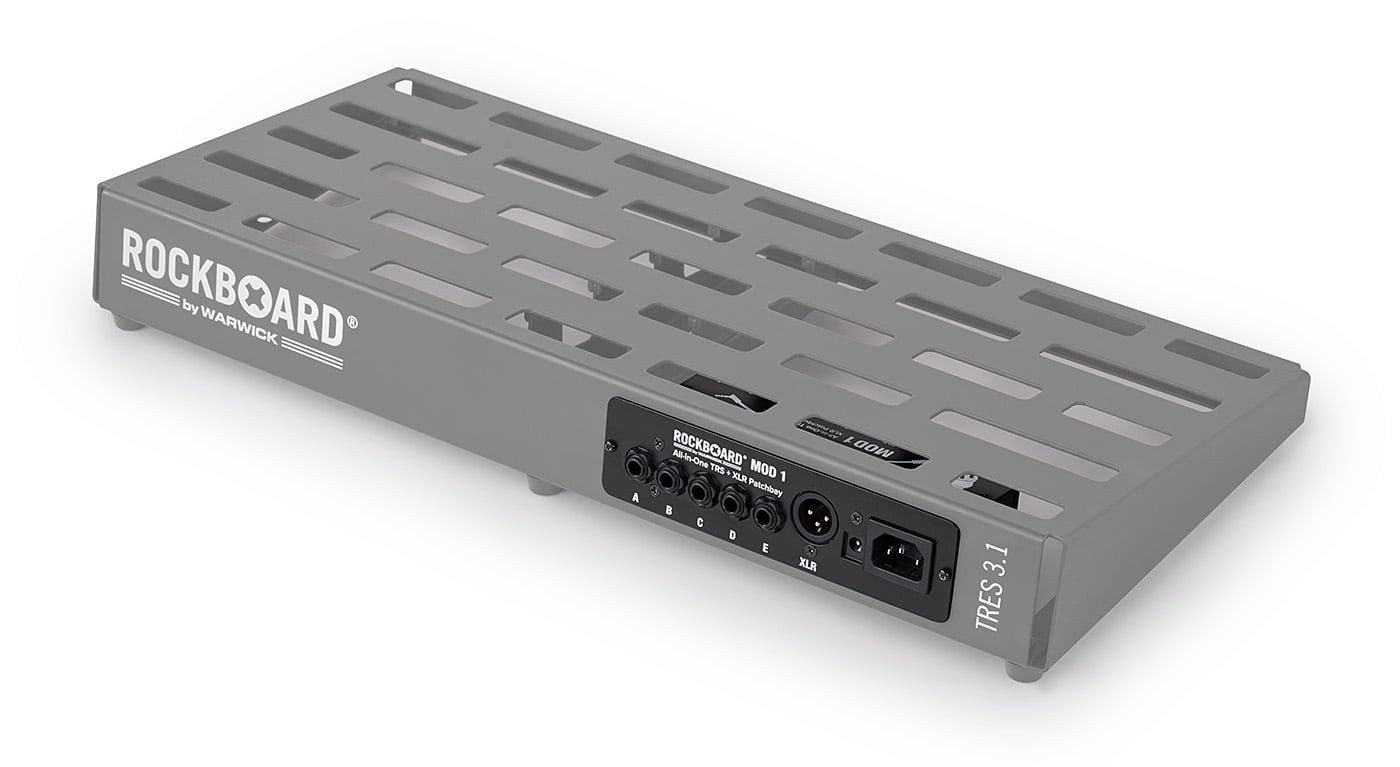
RBO_B_MOD_1_V2_07.jpg


Here's the thing: I can't for the life of me think of why I would need a patch bay. I don't need a midi interface. I can run an XLR off the back of my amp for the board.
So, sell me a patch bay
 
Last edited:
I'm in the process of revamping my pedalboard and am using a [Invalid or Expired Link Removed] as my foundation. Rockboard is very cool in that they are modular and a whole line of items are designed to work with them.
One of the big things Rockboard pushes is the [Invalid or Expired Link Removed] which snap into the back.
View attachment 4418548

Here's the thing: I can't for the life of me think of why I would need a patch bay. I don't need a midi interface. I can run an XLR off the back of my amp for the board.
So, sell me a patch bay
You don't. Many guitarists and keyboard players do.
 
I'm in the process of revamping my pedalboard and am using a [Invalid or Expired Link Removed] as my foundation. Rockboard is very cool in that they are modular and a whole line of items are designed to work with them.
One of the big things Rockboard pushes is the [Invalid or Expired Link Removed] which snap into the back.
View attachment 4418548

Here's the thing: I can't for the life of me think of why I would need a patch bay. I don't need a midi interface. I can run an XLR off the back of my amp for the board.
So, sell me a patch bay
Nah. If you can handle things without it, save your bux.
 
They act as a port saver, ie your ins and outs connect to the patch bay and not the jacks of your pedals. With my board, the back of my Boss ES-5 is deep inside my board. If I want to change the input cable from my bass, I have to flip the lid and thread the cable through. At the moment I have a long 5m cable attached and if I need to gig with this board, I coil it up under the lid. However, I've just bought a set of jacks so I can plug my ins and outs to the board and then I'll solder up a set of permanent cables from the back of my ES-5 to the jacks.
The rock board patch bays are metal clad and weigh just over 1kg, which is surprisingly heavy, considering my entire DIY marine ply board weights that unloaded. The Temple Audio patch bays are plastic clad and weigh about 1/3 of the Warwick ones. If you are running a small nano board, then there really isn't any need for a patch bay. However...if you are running something a bit bigger and more complex, then they come in handy.
Some of the more exotic pedalboard builds have switching DI's, input and output buffers built into their patch bays.
 
Basically it allows you to hardwire the pedals to a centralized access point. This can make patching/setup easier and possibly neater.

Here's the first example from the manual:
upload_2021-9-27_3-19-49.png


There is potential benefit if your pedal board has way more ins and outs than most people run. If you simply plug your bass into the first pedal and run a chord to your amp from the last pedal, you probably don't need this.
 
Sometimes the in/out connectors are not just on the side of a pedalboard, especially when you have lots pedals sitting closely.
Like GMC's example, the output jack of ES-5 is at the middle of that switcher, it's just hard to plug a big cable plug into it.

And the patch bay can be used not only for in and out, it can be also for send/return and expression pedal.
Like 4 cable method that many guitarist love, putting drive pedals first and sends to amp head, sends the preamp signal back to pedal board return. If not using 4 cable method, you can just plug a patch cable as a jump on send and return, and now all the pedals are connected together. With a patch bay all the in and out will be at same place and easy to access, no need to disconnect the patch cable between tidy pedals. As same concept, you can connect wah pedals, expression pedals .etc, depending on different gigs so you don't have to bring them every time and still pretty easy to connect everything together. Even insert another pedal board into your pedal chain could be possible.

A patch bay will give you a easy access on all the in/outs you need. If you have lots pedals and complex signal chain, it'll make your life easier. And if you don't, just leave them and save your money.
 
  • Like
Reactions: MCbizz and Wasnex
13099321_800.jpg

The Rockboard Mod 3 costs €29,90 at Thomann.
It has three 1/4" passthroughs, 2 XLR outs and one XLR in, as well as power pass through.

I have mine wired up so I have an Input and an output on the 1/4" and one output XLR, as well as the Power pass through. When I set up my board, I put my cables into the bay. I don't have the cables to and from the pedalboard connected to one of my pedals, where they wear out the plug by frequent plugging and unplugging and movement of the cable. All the wear goes to the cheap patch bay.
But the main issue is convenience. I have my PSU mounted underneath the board and it's a PITA to handle the power cable. If I roll it up just right, it fits underneath the board into the case. The alternative is to pull it out every time. In the two places I use my board most of the time - at home and in the rehearsal space, I have the power and XLR cable lying around, connected to the respective other ends and ready to go (a switchable power socket included so I don't have a live wire lying around).

For me, those two factors are enough to cough up the thirty bucks on top to have it all neat and clean.
 
Based on my experience (and years of buying/selling pedal related gear), if you're LOOKING for reasons to spend money it's almost always not necessary and probably not advantageous. That said, I've always liked the layout of those Rockboards, including the patchbays. I've been a Pedaltrain user for years with no complaints whatsoever, though.
 
Last edited:
  • Like
Reactions: HolmeBass
For ME, my large pedalboard would benefit from a patchbay In/Out setup. Personally, if I need XLR DI, I've got my trusty RNDI, and short that, my Quilter BB800's XLR line out. Both of those are better than a transparent XLR for my uses. I really only want hardwired I/O (and have a friend building a small pedalboard with Neutrik patchbay connectors for just that purpose for me).

But if I could integrate the RNDI circuitry into a modular build like that, powered by the pedalboard's power brick... now that would be an insanely awesome modular I/O solution!

Also, though: I like and support Rockboard doing this. Were I more baked into a complex setup (with extra instruments regularly plugged in or needing really unusual pathways), I'd absolutely have use for what they're doing. And in fact, I use a keyboard synthesizer for a couple songs with one group, and having even just a whole hardwired, powered separate path for it thru a couple of pedals really could be useful for me. Hrm!
 
I’ve came across this thread hoping to find some answers about the new rockboard mods. In a YouTube video tue guy says that the new v2 versions can be mounted into any pedalboard with slots.

Is this true? I mean: May I mount a mod 3 v2 into a Temple Audio pedalboard?

Why would I do that? Because temple audio does not offer any mod with xlr, instead they have the small cut offs to mount the Neutrik style xlr interfaces…but I’ve yet to understand which one is the correct one to replicate the DI xlr out of mu Darkglass Element.

and most of all: does an xlr standard connector pass through the surface holes both for Rockboard and Temple Audio?

otherwise it is simply stupid.

Any suggestion?
 
I know there are some adapters in the Rockboard catalog for mounting the bays to other brands, but that’s where my knowledge ends on that.
The catalog is kind of hard to find. I’ll post a link to it later.

for the record, i ended up not using the patch bay, but did use Rockboard stuff

EC85F65F-2BA4-4983-9D87-1A6825565437.jpeg 51C8CAE0-4FEC-4E15-9135-DA4C31197EB8.jpeg
 
I know there are some adapters in the Rockboard catalog for mounting the bays to other brands, but that’s where my knowledge ends on that.
The catalog is kind of hard to find. I’ll post a link to it later.

for the record, i ended up not using the patch bay, but did use Rockboard stuff

View attachment 4581072 View attachment 4581074
Thanks!

what about the xlr connector? Does it pass through the holes?