
Enjoy the benefits of a premium membership!
Upgrade Account
-
TalkBass has been independent since 1998. Add your voice.
Create a free account to reply to discussions, view embedded media, and browse with fewer display ads.
Join free Log in
Want zero display ads or expanded classifieds tools? Compare plans.
You are using an out of date browser. It may not display this or other websites correctly.
You should upgrade or use an alternative browser.
You should upgrade or use an alternative browser.
Why you should always check the ground in your outlet
- Thread starter mambo4
- Start date
More options
Who Replied?



I don't get it?
either the mic circuit (mic >cable > sound system >outlet) or the guitar circuit (guitar >cable >amp> outlet) was not grounded.
so all the voltage in the ungrounded circuit had nowhere to go.
when then performer grabbed the mic stand, he completed the circuit and the voltage went to ground , through him.
Last edited:

Not sure what the power is like in that country ... but in the USA most buildings have three legged 220v coming into the building and each 110v circuit is one or the other half of that 220v. So if the circuit the PA plugs into is on one leg of the 220 and the circuit the guitar amp plugs into is on the other leg (and if the plugs were improperly wired which is very common) you can get 110 or 220 volts between the ground of your guitar and the ground of the PA.
Back in the day ... I would play one place for 2-6 weeks at a stretch - I used to always take a volt meter with me to every venue the morning before our first show and I almost always found plugs on one side of the stage to be on a different leg of the 220 from plugs on the other side ... and this was the day when we all had amps with ground reverse switches and two prong power cords.
Anyway ... I used to rewire the power outlets on stages that we were going to play at and I would always measure the voltage between the grounds of all the equipment before we ever played a note. Things may be safer these days - but back in the day (three prong plugs were not common yet) I would find 110v and even 220v between chassis ground of one device and another device much more often than you would believe. Getting everything on stage so there was no voltage potential between grounds really helped reduce the 60 cycle hum too.
Back in the day ... I would play one place for 2-6 weeks at a stretch - I used to always take a volt meter with me to every venue the morning before our first show and I almost always found plugs on one side of the stage to be on a different leg of the 220 from plugs on the other side ... and this was the day when we all had amps with ground reverse switches and two prong power cords.
Anyway ... I used to rewire the power outlets on stages that we were going to play at and I would always measure the voltage between the grounds of all the equipment before we ever played a note. Things may be safer these days - but back in the day (three prong plugs were not common yet) I would find 110v and even 220v between chassis ground of one device and another device much more often than you would believe. Getting everything on stage so there was no voltage potential between grounds really helped reduce the 60 cycle hum too.
Aha, like that. Thanks for the info!
either the mic circuit (mic >cable > sound system >outlet) or the guitar circuit (guitar >cable >amp> outlet) was not grounded.
so all the voltage in the ungrounded circuit had nowhere to go.
when then performer grabbed the mic stand, he completed the circuit and the voltage went to ground , through him.

We always take one of these to a gig ... http://www.amazon.com/ELECTRICAL-RECEPTACLE-TESTER-OUTLET-PRONG/dp/B002Q3R7HI ... and don't use outlets that don't check out.
As an Amazon Associate, TalkBass may receive commissions from qualifying purchases made via links on this site.

We use circuit breakers when we set up extension cords to power our amps and PA, just in case the place has a shoddy mains installation. It's probably not necessary most of the time but it's a simple precaution.
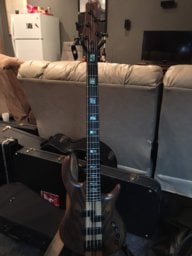
I burned up a DI once on a Genz Shuttle because the place we played did their own wiring and had the ground actually hot. I plugged the DI into the mixer channel and it burned that channel out as well. Drummer noticed a blue flame shooting out from the DI of the Genz. We stopped, and we rewired the stage power so we could do the gig.
Two amazing things. 1, the Genz amp still worked and I did the show without going to the board even though you could see the built in DI was burnt black and melted. 2, called Genz and they sent a new replacement 2 days later. I miss that company
Two amazing things. 1, the Genz amp still worked and I did the show without going to the board even though you could see the built in DI was burnt black and melted. 2, called Genz and they sent a new replacement 2 days later. I miss that company

Std. Japan is 100v and 50 cyclesNot sure what the power is like in that country ... but in the USA most buildings have three legged 220v coming into the building and each 110v circuit is one or the other half of that 220v. So if the circuit the PA plugs into is on one leg of the 220 and the circuit the guitar amp plugs into is on the other leg (and if the plugs were improperly wired which is very common) you can get 110 or 220 volts between the ground of your guitar and the ground of the PA.
Back in the day ... I would play one place for 2-6 weeks at a stretch - I used to always take a volt meter with me to every venue the morning before our first show and I almost always found plugs on one side of the stage to be on a different leg of the 220 from plugs on the other side ... and this was the day when we all had amps with ground reverse switches and two prong power cords.
Anyway ... I used to rewire the power outlets on stages that we were going to play at and I would always measure the voltage between the grounds of all the equipment before we ever played a note. Things may be safer these days - but back in the day (three prong plugs were not common yet) I would find 110v and even 220v between chassis ground of one device and another device much more often than you would believe. Getting everything on stage so there was no voltage potential between grounds really helped reduce the 60 cycle hum too.

We use circuit breakers when we set up extension cords to power our amps and PA, just in case the place has a shoddy mains installation. It's probably not necessary most of the time but it's a simple precaution.
A "circuit breaker" will not provide much protection from electrocution. (it may lessen to chance of a fire in the event of an over-current situation). A Ground Fault Circuit Interrupter device will provide a lot of protection in the event of a ground fault. A portable GFCI mounted in an extension cord can be used anywhere, (and will even protect the user on an ungrounded circuit).
My bad, thanks for the correction. I used the wrong name, it is a ground fault protection thingy we are using.A "circuit breaker" will not provide much protection from electrocution. (it may lessen to chance of a fire in the event of an over-current situation). A Ground Fault Circuit Interrupter device will provide a lot of protection in the event of a ground fault. A portable GFCI mounted in an extension cord can be used anywhere, (and will even protect the user on an ungrounded circuit).

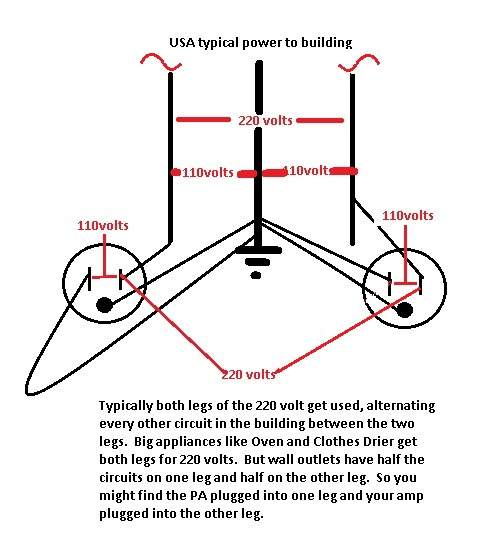
I just drew this little rough sketch to show what I meant about how in the US power outlets might have 220volt potential between two circuits in the same area. This is showing the ground wire properly going to ground on the outlet - but back in the 70's and 80's I frequently found stages with outlets miswired with the hot wire going to the ground side and using a volt meter I could read 110v or even 220v between the shield of a guitar amp (your fingers on the strings) and the shield of the mic cord (your lips on the mic)
Last edited:

I insist on using a simple plug in tester before every gig, this will check for earth/ground continuity and polarity. I also insist that all of the bands equipment is tested for continuity and plug in Residual Current Devices are used. You can't be too careful, especially here in the UK where we have the potential for 400v across phases.

I did not know about GCFI adapters. Great tip.
24 bucks at home depot:

24 bucks at home depot:


