• TalkBass has been independent since 1998. Add your voice.
    Create a free account to reply to discussions, view embedded media, and browse with fewer display ads.
    Join freeLog in
    Want zero display ads or expanded classifieds tools? Compare plans.

Wireless Bass Frequency Response

bucephylus

Supporting Member
Aug 18, 2002
12,442
18,870
Central Ohio
I’m a rookie with wireless Bass Guitar systems. One of my gigs needs me to help with mix balance during sound check and first few tunes of first set by walking around out front of the FoH.

I had been using a cheapo Lekato transmitter / receiver; which worked more or less. Except that when listening more critically to the solo bass voicings, it seemed to drastically cut lower frequencies compared to a hard cable connection.

So, I invested in the Shure GLXD6+ system; and though it seems significantly better, I still feel like I am losing lower bass frequencies with 30’ to 40’ separation.

Is that just a perception problem, or is that actually happening? Since I can’t be in two places at once, I am unsure whether I am hearing an artifact of the transmission or just the bass projection falloff itself.

Comments / Experience appreciated.

 
I have been using the updated GLXD16+ since it was released. For me there is no discernible frequency differences (high or low) because I only play using the wireless, even at home with headphones. So, my tone is consistent, other than room acoustics.
What I believe you are experiencing the is normal low end drop off as you move away from the stage. Unless you are running bass through the FOH PA system, this is pretty unavoidable.
 
The Shure is a digital device. If it changes the tone enough for you to hear (I can't hear it...) then that change won't at all be altered by the transmission distance.

When you start to lose AM/FM radio reception in your car it starts to distort and go fuzzy and drop in volume. When you start to lose DAB radio reception it just goes from perfect to silence. That's how your Shure works, it's either working well or dead, with no in between. It's to do with the way a receiver can 'guess' and reconstruct a weak signal and that reconstruction works differently with digital and analogue signals. In short, the tone shouldn't change as you walk away.
 
Is that just a perception problem, or is that actually happening?
Maybe it sounds different because when you roam you change your position relative to the monitors or your amp's speakers?

The signal processing in the transmitter and receiver can affect the audio quality but I can't imagine the distance can, setting aside interference or roaming beyond the recommended range.
 
no experience with mentioned wireless systems, but my line 6 didn’t cut lows. if yours is cutting sub-30hz, it actually does a favor for you.

everything can sound differently, even sometimes a different cable sounds differently. often a perceived bass loss is a result of signal sounding brighter. nothing to worry about, you have eq on your amp to fine-tune it.
 
I was always led to understand that with wireless audio the nature of the beast is that you will always lose some bass. You can test this for yourself by A/B’ing your wireless IEM system by inserting your earbuds directly to the headphone socket on your wireless transmitter. You may be surprised!

I have an expensive high end Sennheiser IEM wireless system but even that is not quite as good as a wired IEM.
 
  • Like
Reactions: fokof
I was always led to understand that with wireless audio the nature of the beast is that you will always lose some bass. You can test this for yourself by A/B’ing your wireless IEM system by inserting your earbuds directly to the headphone socket on your wireless transmitter. You may be surprised!

I have an expensive high end Sennheiser IEM wireless system but even that is not quite as good as a wired IEM.
Analog wireless: probably, digital wireless: impossible. 24bits are 24bits.
 
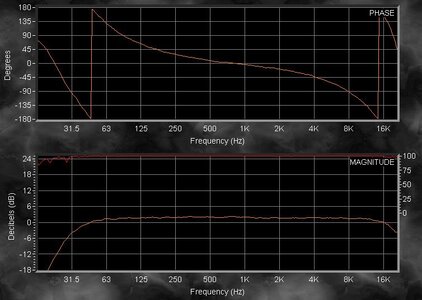
Here are are some SMAART traces of a Sennheiser IEM system response transmitter to the pack receiver. Looks like it's about -3db at 40hz. There is a high pass and low pass filter in place at 40hz and 16,000hz, you can the phase response shift due to the filters.
The green line shows my test interface flat response, the red orange line is the IEM system in flat mode, the blue line is with the pack set to high boost.

I posted this a while back but could not find it!
 

Attachments

  • interface response.JPG
    interface response.JPG
    305.7 KB · Views: 8
Last edited:
  • Like
Reactions: eniac
Going way back here. I had the original GLXD6 and a Line6 G50 at the same time.

The former cut lows and it was very noticeable. Not only that, it also seemed to "blur" the entire bottom end, sort of like my experience with the Radial SB-2.

The latter did not cut lows at all, compared to a cable connection.
 
My Mipro-909 system with 64Audio A8’s has no loss of bass, except for yesterday afternoons gig where one of the band inadvertently kept adjusting my IEM mix, minimizing my bass level and boosting lead vox. Very annoying!
 
  • Like
Reactions: bucephylus
My post up the list a few showed the response of a Sennheiser IEM system, I had already made the measurement a while back and the image was handy to grab and post!

I had a few extra minutes today and did the same test on a Sennehiser EW wireless instrument body pack system. The response is nearly flat to 40hz as the IEM system was, the 16k high frequency low pass is a little more gradual than the steep cut off on the IEM system. For what it's worth the receiver was about 20 feet away from the transmitter pack.
The purple trace is my test set up response and the orange trace is the Sennheiser system.

I don't have a digital system to test....yet!
 

Attachments

  • IEM and REF.jpg
    IEM and REF.jpg
    130 KB · Views: 10
  • IEM.jpg
    IEM.jpg
    124.5 KB · Views: 7
Just to update my last post, I tested a Shure SLXD system today.

The Shure SLX response in the orange trace, the test rig response is blue. The SLXD is basically flat to about 8,000hz.
For whats it worth the Smaart Live delay finder measured the SLXD latency at 2.83ms, I just looked up the SLXD specs and it say 2.8ms.
The Sennheiser does have a cleaner extended high frequency response.
 

Attachments

  •  IEM and REF Shure SLXD.jpg
    IEM and REF Shure SLXD.jpg
    142.9 KB · Views: 5