• TalkBass has been independent since 1998. Add your voice.
    Create a free account to reply to discussions, view embedded media, and browse with fewer display ads.
    Join freeLog in
    Want zero display ads or expanded classifieds tools? Compare plans.

Wiring independent volume and tone

Feb 11, 2023
17
4
Hi,
I have a vintage Gibson EB-0 with a bridge pickup that I want to wire with independent volumes like a jazz bass, BUT I don't want any tone control for the neck pickup, I want to keep it wide open (it's a particularly dark pickup).

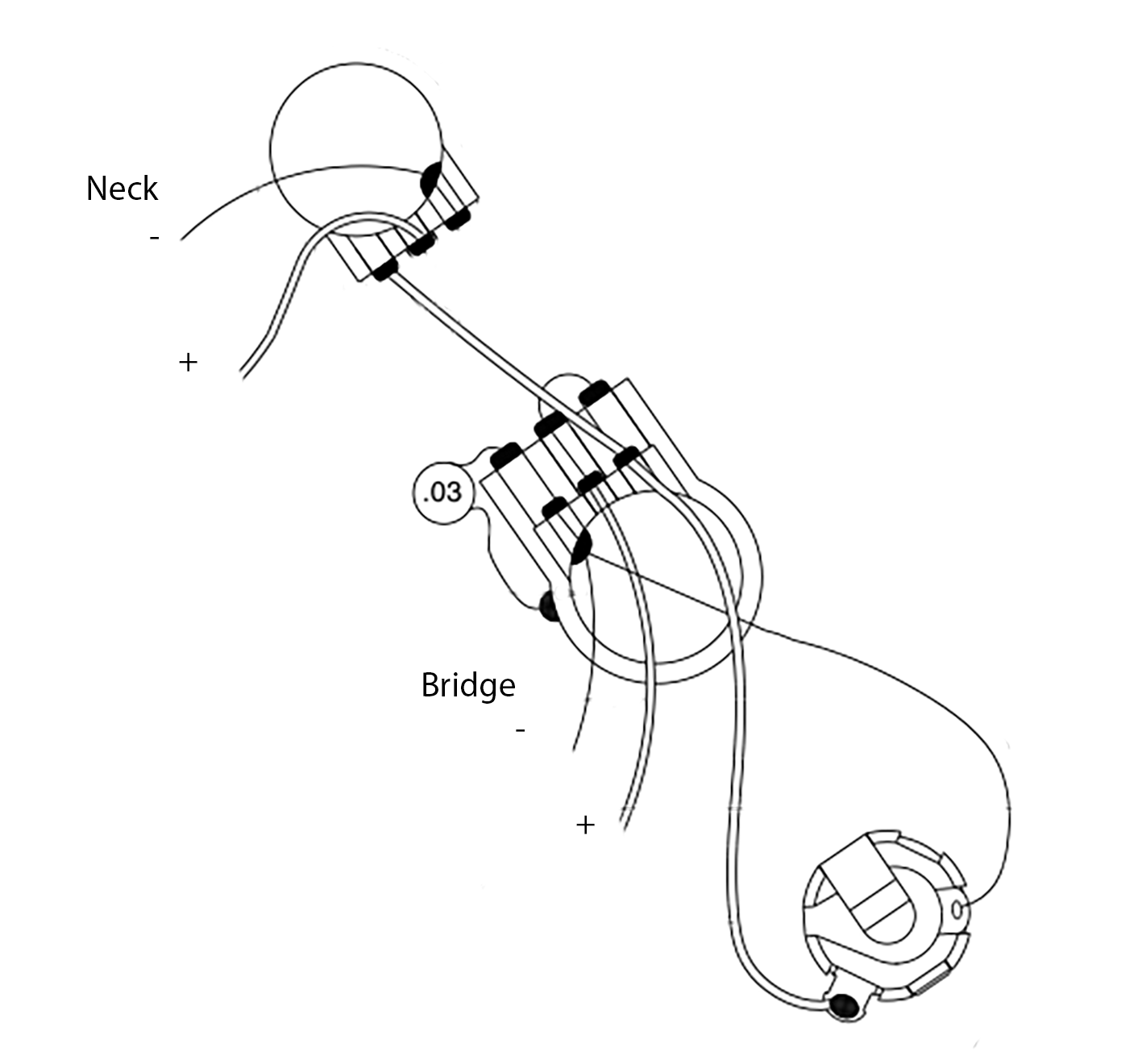
The bass has just two knobs, one is the neck volume and the other is a concentric for the bridge volume and tone. Would this diagram allow me to have the neck pickup completely unaffected by the tone and volume of the bridge?
I've been reading that it's tricky to have independent volume and tone in a circuit...
wiring.png
 
Hi,
I have a vintage Gibson EB-0 with a bridge pickup that I want to wire with independent volumes like a jazz bass, BUT I don't want any tone control for the neck pickup, I want to keep it wide open (it's a particularly dark pickup).

The bass has just two knobs, one is the neck volume and the other is a concentric for the bridge volume and tone. Would this diagram allow me to have the neck pickup completely unaffected by the tone and volume of the bridge?
I've been reading that it's tricky to have independent volume and tone in a circuit...
[
EB-0 had one neck pickup
Yours must be an EB-3

ATTACH=full]4982480[/ATTACH]
Hi,
I have a vintage Gibson EB-0 with a bridge pickup that I want to wire with independent volumes like a jazz bass, BUT I don't want any tone control for the neck pickup, I want to keep it wide open (it's a particularly dark pickup).

The bass has just two knobs, one is the neck volume and the other is a concentric for the bridge volume and tone. Would this diagram allow me to have the neck pickup completely unaffected by the tone and volume of the bridge?
I've been reading that it's tricky to have independent volume and tone in a circuit...
View attachment 4982480

Yes, it will work fine to do what you want to do!
 
  • Like
Reactions: Rhye
It’s an EB-0 modded with an added bridge pickup
I had a brand new EB-0 in 1974.
Back then the model with A large Neck pickup was called an EB-0 and the model with a large Neck pickup and smaller bridge pickup was called an EB-3 by Gibson
Gibson EB-0 - Wikipedia
Gibson EB-3 - Wikipedia

I sold my then new EB-0 within 6 months because it was muddy sounding. With the introduction of the small bridge pickup took it out of the “mud zone”. I wished Then I could have afforded the EB-3 model
 
Last edited:
  • Like
Reactions: Rhye
So the tone control won't affect the neck pickup at all?
The tone control will only affect the neck when the bridge volume pot is maxxed full on (10). That's because the tone control will now also be directly connected to the output of the neck pickup.

Dialing the bridge volume pot back from 10 to 9.5 or 9 adds some resistance which starts isolating the bridge tone control from the neck output. Yay! LOL.

So, if you normally keep your bridge volume pot maxxed (10), this won't work. If you don't keep bridge volume at 10, you're golden, man. Build it.
 
Last edited:
The tone control will only affect the neck when the bridge volume pot is maxxed full on (10). That's because the tone control will now also be directly connected to the output of the neck pickup.

Dialing the bridge volume pot back from 10 to 9.5 or 9 adds some resistance which starts isolating the bridge tone control from the neck output. Yay! LOL.

So, if you normally keep your bridge volume pot maxxed (10), this won't work. If you don't keep bridge volume at 10, you're golden, man. Build it.
Wow, interesting! Thanks for the insight.
Would that still be the case if the tone pot is at 10? maybe a 'no load tone pot' would be even better... I know it's probably very little effect, but this is a VERY dark neck pickup but it sounds great if there's no tone control.
Btw, the neck pickup is 25k and the bridge pickup 7k...
 
  • Like
Reactions: fig
Wow, interesting! Thanks for the insight.
Would that still be the case if the tone pot is at 10? maybe a 'no load tone pot' would be even better... I know it's probably very little effect, but this is a VERY dark neck pickup but it sounds great if there's no tone control.
Btw, the neck pickup is 25k and the bridge pickup 7k...
A no load tone pot would be better but tone at 10 would have little effect

Sorry I looked at the two pots solely as two volume pots
 
  • Like
Reactions: Rhye and fig
...I looked at the two pots solely as two volume pots
I almost did, too LOL

Btw, the neck pickup is 25k and the bridge pickup 7k...
Just curious, are the volumes of the two pickups about equal?

Would that still be the case if the tone pot is at 10? maybe a 'no load tone pot' would be even better...

Unfortunately, no. That's due to it's location electrically between the Brdg PU and Brdg Vol pot. Maybe the following will show why.

I took your diagram and schematicised it to show how it electrically works. Unfortunately, the Bridge Vol pot is the only spot in the circuit to keep the Brdg Tone control from draining high freqs from the neck output. (but there are two workarounds mentioned later).

Notice in the full circuit, when the Brdg Vol pot is at 10 (as shown), the wiper (arrow) is connected to the top of the pot. It's now like a straight wire connected there. Neck Vol pot output (top of pot) is now directly connected to the Brdg Tone control, which is happily removing high freqs from both outputs.

The inset shows the 'dialed back' resistance of the Brdg Vol, blocking the neck high freqs from touching the Brdge Tone control. Players are aware of 'dialing back' a volume pot to keep the tone isolation. One either accepts this in 2 vol/2 tone passive configs, or not. Yours is similar, so the same level of acceptance choice applies.:
isolate by pot.jpg


But, here's a workaround. Add a fixed resistor after the Brdg Vol output as shown in the next schematic. Neck output is not affected by this. 25kΩ (1/10 of a 250kΩ linear pot or 1/20 of a 500k linear pot) as starting point. The resistor is a permanent isolation solution, even when Brdg Vol is at 10.

25kΩ is only a starting point as value needs to be adjusted depending on how much isolation you want. Higher value = better isolation. Unfortunately the resistor drops the Brdg volume a little. Higher value = less volume from Brdg.:
isolate by resistor.jpg


There's a 2nd workaround that definitely gives you complete isolation, but it requires a battery and a small (about 1/2 size of battery) dual channel buffer preamp. Here's one from Bartolini. I have the single channel version in one bass and can recommend it for transparency. Other manufacturers make a similar item.:
Adjustable Gain Buffer - AGB & AGDB - Bartolini Pickups & Electronics

That's all I got for choices for your circuit. Others smarter and more experienced than me might have a solution we both could learn from to keep the tone control isolation you want.
 
Last edited:
Thanks Fig! Great chart, that was very clear. Thanks for taking the time to explain so clearly :)
I don't think that any of the workarounds work great in my situation since the neck is already so overpowered that having a resistor weakening the bridge pup would not be a good idea, and I don't want active electronics in a vintage bass. However, a no load tone pot would completely disappear for the circuit when at 10, right?
 
Here's another idea, would this work?
How about using a blend knob instead two volumes. Would that help separate the neck pup from the bridge tone pot? Would it make sense for pickups that have such different resistance?
 
Here's another idea, would this work?
How about using a blend knob instead two volumes. Would that help separate the neck pup from the bridge tone pot? Would it make sense for pickups that have such different resistance?
A Blend control functions electrically identical to dual volume controls and doesn't offer isolation in a passive circuit. Similar to Fig's suggestion of a resistor, you can use matching resistors (one after the bridge volume as shown in Fig's diagram and an equal one after the neck's volume) and this will keep the relative volume of the two pickups equal but offer some isolation (this was the idea used in the original stacked-knob Jazz Bass circuit to isolate the individual Tone controls per pickup used in those early models).

Also the "no-load" tone as you mentioned would indeed have no effect on either pickup when turned all the way upas it is effectively removed from the circuit (you can easily mod any pot to do this by scraping a little of the resistant strip off of the inside at one end)
 
  • Like
Reactions: fig and Rhye
Thanks for the clarification!
That would still be the same with an ungrounded blend knob right?
Yes, though a regular Blend would cut off the bridge pickup and tone control when turned all the way towards the neck side (same as turning your bridge volume down completely in your posted diagram). The dual resistor I mentioned would drop the overall output and darken the tone a bit overall dependent on the resistor values chosen as well
 
  • Like
Reactions: Rhye and fig
How about using a blend knob instead two volumes.
Here's how your circuit would be connected with a blend control.:
Rhye Blend.jpg


Like sunbeast said, a blend pot is electrically two volume controls on a single shaft. Both PU's are directly connected together when the pot is centered (both outputs at 10). This keeps the Bridge Tone control connected to both PU outputs. It stays that way for half the knob rotation when moving the wipers to the left towards contacts 1 & 4 (ccw).

While moving left, Bridge vol stays at 10, Neck vol goes down. No tone isolation. Same problem with 2 volume controls when Bridge Vol stays at 10 and you're turning Neck vol down.