• TalkBass has been independent since 1998. Add your voice.
    Create a free account to reply to discussions, view embedded media, and browse with fewer display ads.
    Join freeLog in
    Want zero display ads or expanded classifieds tools? Compare plans.

Wiring stacked volume/tone pots.

this could be a result of my favorite topic apparently, which is audio taper vs. linear taper on the volume pots. linear taper pots will allow for more control over that point where "two pickups" just begins to fade into "one pickup".

also, if you're running these without any preamp, that MM pickup may benefit from a re-wire. judging by the picture, as it came, the leads were wired for parallel operation, which is fine when you have a preamp to boost back the missing low end. you might want to reconfigure it for series, which will sound a lot fatter, especially for a passive bridge pickup. you'll have to undo both pairs, and then use a meter to determine which wires are the start and end of each coil. (that will be two wires that show a resistance of maybe 3-4kohms between them, the other two wires the same, and no connection shows between one pair and the other pair.)

once you have that figured out, attach a wire from one pair to a wire from the other pair, then use the two leftover wires as hot and ground. if it hums, reverse the wires from one pair. if the whole thing sounds thin and weird with the other pickup, reverse the hot wire with the ground wire.

the bare stranded wire always goes to ground no matter what.

Well I took a clue from this diagram from Seymour Duncan to link the bare, white, and green wires together to connect to ground and then the red and black as the hot.

[Invalid or Expired Link Removed]

I am wondering if I should take the hot output from the p-bass coming off the volume pot and connect it directly to the output jack and just bypass the link up with the MM volume pot.

 
is the pickup in question in fact a duncan? if not, there's no reason to think the wire color codes will be remotely the same. if it is, try wiring the red and white together (taping them up so they don't short on anything), using black as the hot and green as the ground.

the volume pots are in parallel with the jack, so moving where the P pickup's volume pot is attached won't change anything.
 
is the pickup in question in fact a duncan? if not, there's no reason to think the wire color codes will be remotely the same. if it is, try wiring the red and white together (taping them up so they don't short on anything), using black as the hot and green as the ground.

the volume pots are in parallel with the jack, so moving where the P pickup's volume pot is attached won't change anything.

Okay, maybe I will try going back to the way it was attached before in the pictures, white and red, black and green. My guess is the white and red would be hot.

What I am curious about though is why it would interfere with mixing the two pickups together? Shouldn't it be something wrong with the wiring between the pots and output instead of which color leads attach to the hot and ground?
 
what i meant was wiring it series, so that it had a full fat sound instead of the bright, thin sound it would get in parallel.

that means one wire is hot, the other wire from that coil goes to a wire from the second coil, and the last wire from that second coil is ground. if it's duncan codes, that means black is hot, red and white go to each other (but not to anything else), and green is ground.

if you've got two colored wires both going to hot, that's parallel wiring.

i haven't tested for this, but it may very well be that a parallel bridge pickup and a series P pickup just don't play well with each other in terms of volume blending.
 
what i meant was wiring it series, so that it had a full fat sound instead of the bright, thin sound it would get in parallel.

that means one wire is hot, the other wire from that coil goes to a wire from the second coil, and the last wire from that second coil is ground. if it's duncan codes, that means black is hot, red and white go to each other (but not to anything else), and green is ground.

if you've got two colored wires both going to hot, that's parallel wiring.

i haven't tested for this, but it may very well be that a parallel bridge pickup and a series P pickup just don't play well with each other in terms of volume blending.

So then perhaps go ahead and put black at hot and green as ground and just wrap up the red and white and set aside?
 
I also have questions for everybody here. I'm essentially doing the same thing only I'm starting with my OLP MM3. It's currently passive and wired much as above with two volumes (one for each side of the pickup) and a tone. I just ordered a Fender 5 string P-bass pickup to add to it.

The first question is has ANYONE figured out a decent passive circuit for an OLP yet? The one in there is TERRIBLE! The volumes and tone controls all interact and the pickup tone changes with volume settings and in general the thing is a nightmare to use. (We are talking electronics only! The bass itself is wonderful!)

I just finished a major shielding of the bass and it got rid of a great bit of hum (except for the single coil hum which is much lower now) I found a couple of loose wires and fixed them and now the bass tone has amazingly improved dramatically. But the interactions of the knobs still is bad.

Now a real Stingray is active which allows mixing without circuit loading and interactions. Eventually that may be an answer here.

But I"m wondering if anyone has come up with a passive circuit for the OLP that actually is usable and yet retains the ability to pull lots of different tones out of it?

OK. Now on to the next. My ultimate plan is to try to leave the bass passive and add a switch that will give the bass two modes: One would be a kind of P/J mode which would be two volumes with one for P-bass pickup (probably series) and the other for the MM pickup probably wired parallel. Tone would modify the output tone. The circuit posted in this thread would likely be the circuit for the p-bass mode (thanks guys!)

In the other mode, I'd have it revert to it's present stingray configuration with each volume controlling a side of the MM pickup and the P-bass pickup just disabled. Tone affects the output. This is why I need a passive stringray circuit that works.

If that is impossible then I could go active and add a nice preamp with bass and treble stacked in place of the hokey tone knob. This would make the bass much more like a stingray and eliminate all the nasty interactions as well. But active would be a bigger project, take batteries, and be a bigger hassle. However IF active is required I note that you can't get a stingray preamp so my question here is what active bass preamp among those you can buy have people found best to give a good stingray imitation? A real stingray circuit REALLY has a lot of boost and cut to pull the maximum tonal range out of the single pickup bass.

I've searched for information on these questions and I found everybody is asking them, but nobody seems to be answering them! Obviously a lot of OLP owners realize that is an excellent bass that just needs some kind of electronic mods to be killer. But nobody seems to have found what that is yet.

Anybody?
 
The first question is has ANYONE figured out a decent passive circuit for an OLP yet? The one in there is TERRIBLE! The volumes and tone controls all interact and the pickup tone changes with volume settings and in general the thing is a nightmare to use. (We are talking electronics only! The bass itself is wonderful!)
sure, wire the pickup in series instead of parallel.

here's a lame diagram (don't let line6man see it :smug:)

JazzBassSeriesWiringDiagram.jpg
 
that means one wire is hot, the other wire from that coil goes to a wire from the second coil, and the last wire from that second coil is ground. if it's duncan codes, that means black is hot, red and white go to each other (but not to anything else), and green is ground.

Just wired it up like this this morning. All I had to do was disconnect white and red from ground and hot and solder them together. So far the p-bass and MM are blending together. Haven't had time to fully test to find right mix before going to work. Thanks for your help.
 
Finally the finished product of my labors. It is actually mixing the pickups like it is supposed to and had a good performance at church this evening.

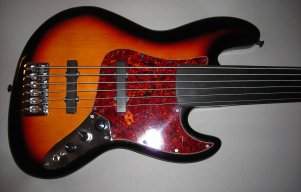
Once was a blue Squier Affinity P-Bass, now Frankenbass with:
Eden Maple Lefty neck
Rondo Tuners
High Mass Bridge
Brass Nut
Musicman copy pickup
Fender stacked knobs
Grolsch straplocks

DSC01247.jpg


DSC01248.jpg
 
you mean on the first try the pickup ended up in phase with itself, hum-canceling, and in phase with the P pickup?! and it fixed the blending issue? what are the odds of that? :D
 
you mean on the first try the pickup ended up in phase with itself, hum-canceling, and in phase with the P pickup?! and it fixed the blending issue? what are the odds of that? :D


Well I took the advice of attaching the red and white wires together and when I tried that, the pickups actually mixed. I figured I would leave it alone before I screw something else up. Maybe later on I will fiddle around with the wires and see what I can come up with.
It is pretty crazy that is worked out at the first rewire.
 
Finally the finished product of my labors. It is actually mixing the pickups like it is supposed to and had a good performance at church this evening.

Once was a blue Squier Affinity P-Bass, now Frankenbass with:
Eden Maple Lefty neck
Rondo Tuners
High Mass Bridge
Brass Nut
Musicman copy pickup
Fender stacked knobs
Grolsch straplocks

DSC01247.jpg


DSC01248.jpg

I hate to resurrect this thread, but I'm having issues with the tone control of the louder pickup behaving like a master tone in addition to the volume blending issues, and it looks like you've conquered this wiring diagram. My setup is a Lindy Fralin P with a Duncan hot stacked jazz into two Fender stacked pots. Did you end up using Line6's diagram?

All I want to be able to do is control the volumes independently and the tones independently and not have the pickups/tone controls fighting for supremacy.

I've searched and read and searched and read, and I'm just getting discouraged..

Thanks in advance.
 
I hate to resurrect this thread, but I'm having issues with the tone control of the louder pickup behaving like a master tone in addition to the volume blending issues, and it looks like you've conquered this wiring diagram. My setup is a Lindy Fralin P with a Duncan hot stacked jazz into two Fender stacked pots. Did you end up using Line6's diagram?

All I want to be able to do is control the volumes independently and the tones independently and not have the pickups/tone controls fighting for supremacy.

I've searched and read and searched and read, and I'm just getting discouraged..

Thanks in advance.

The only way to get the tone controls to work independently is to add resistors in series with the signal paths to increase the resistance between the signals. This will decrease the output/treble.

What issue are you having with the volumes?
If turning either pot down mutes the total output, you've swapped the input and output terminals on the pots. Be sure that the wiper terminal is wired as the input.
 
The only way to get the tone controls to work independently is to add resistors in series with the signal paths to increase the resistance between the signals. This will decrease the output/treble.

What issue are you having with the volumes?
If turning either pot down mutes the total output, you've swapped the input and output terminals on the pots. Be sure that the wiper terminal is wired as the input.

The trouble I was having was that the neck volume wasn't cutting the sound completely, and seemed to be doing some "interacting" with the bridge volume (this is what happens when I let someone else wire up a bass). I was pretty irritated.

After all of my consternation, I got out the multimeter and diagnosed a bad solder joint to the casing of the pot in question. It was an easy, two minute fix (warming up the iron took the most time).

Good information to know on the 1960 resistors, though. I can live with the tone controls interacting. Thanks for your help--sometimes, walking away and, most importantly, THINKING helps me solve wiring issues.
 
The trouble I was having was that the neck volume wasn't cutting the sound completely, and seemed to be doing some "interacting" with the bridge volume (this is what happens when I let someone else wire up a bass). I was pretty irritated.

After all of my consternation, I got out the multimeter and diagnosed a bad solder joint to the casing of the pot in question. It was an easy, two minute fix (warming up the iron took the most time).

Good information to know on the 1960 resistors, though. I can live with the tone controls interacting. Thanks for your help--sometimes, walking away and, most importantly, THINKING helps me solve wiring issues.

If a pot does not mute the signal when rolled all the way down, there is a grounding issue. Double check that there is a 0 Ohm path to ground, from the pickup's hot lead, when the volume pot is rolled all the way down.