
Enjoy the benefits of a premium membership!
Upgrade Account
-
TalkBass has been independent since 1998. Add your voice.
Create a free account to reply to discussions, view embedded media, and browse with fewer display ads.
Join free Log in
Want zero display ads or expanded classifieds tools? Compare plans.
You are using an out of date browser. It may not display this or other websites correctly.
You should upgrade or use an alternative browser.
You should upgrade or use an alternative browser.
Wondering if my right hand angle is ok.
- Thread starter BassApace
- Start date
More options
Who Replied?

. Here's a snapshot of the same guitarist using a support with their feet flat to the ground.
Exactly! I also studied classical guitar. I am using a similar guitar support as the player from your picture. It's called Guitarlift. It is designed for classical guitar but I use it on electric guitar and bass. I have used all kinds of other guitar supports as well. Here is a video with the Guitarlift on bass and guitar.

You have to look at the "whole picture". I have long forearms. To keep my wrist straight requires that I lift my shoulder in a way that is much more uncomfortable than anything I do with my wrist. I think the important thing is that you pay attention to how you're feeling and try different approaches to be able to make comparisons.

I was also classical guitarist as a youngster but couldn't adopt that position to bass guitar playing. Scale is very different (26" vs 34/35") and ergonomics also (shape, weight, balance) - at least for me.I'm going to chime in on this one because I was a classical guitarist before I became a bassist. Today, hardly anyone in classical guitar advocates for a footstool anymore because it causes many problems. For the last 10 years or so instructors and conservatories have been advocating for a guitar rest that elevates the guitar off your leg. In essence, the photo you posted has the correct ergos for the upper body and the positioning of the guitar but instead of the left leg highly elevated, imagine them both flat to the floor.
This posture has been adopted by some of our electric bass brethren such as Hadrien and recently Janek, among others. It puts the back, shoulders, arms, forearms, and hands in a natural, ergonomic position that reduces the possibility of injuries, particularly for those of us that put in a lot of hours. Here's a snapshot of the same guitarist using a support with their feet flat to the ground.
View attachment 7408755
I've been trying out this position with electric bass with mixed results, depending on the instrument and its dimensions. But for larger instruments like Fender Jazz and Precision basses, it works pretty well without a support of any kind. Live I usually play standing up so that's not as much of an issue but when I'm practicing at home or recording in the studio, I'm usually sitting and that's where the ergonomics can really make a difference in the long run.
Also, for me, bass angle must be more horizontal, as I found out that if I need to raise hand at or over shoulder height in order to play lower positions, arm gets tired very fast. But I get it why some bassists like it. I kept that part where body is mostly in front of my body, not to the side: less tiring to the back.
Circling back to my advice, everybody is different and so if player find comfortable relaxed position and can play easily, it's good.

Same for me. Lowering the body and raising the neck makes it much easier to keep both wrists relatively straight.I would Stand up , and lower the bass/ lengthen the strap a bit so my wrist did not bend as much. I would position the headstock higher up, angle the neck, so the left hand also was not required to bend.
Bridge down, nut up is how I roll.
The conventional wisdom is that your bass should be positioned in exactly the same way when sitting or standing, but that doesn't work for me. When sitting in a typical chair, with the bass resting on my right leg, the bass body is too high relative to my upper body: To keep the straight wrist I maintain while standing, I have to hold my elbow up and out in an awkward position. To practice while sitting I either have to kind of "half-sit" on a stool so the bass body can hang down lower, or play with a pick so this isn't an issue.

The conventional wisdom is that your bass should be positioned in exactly the same way when sitting or standing, but that doesn't work for me
Same. For me, playing while sitting is for noodling, exploring and figuring stuff out,
I never sit for serious, performance - oriented practice.
Never been able to play sitting, bass just isn't in the right position for me.Same. For me, playing while sitting is for noodling, exploring and figuring stuff out,
I never sit for serious, performance - oriented practice.
a very important point. Humans come in more models than basses.You have to look at the "whole picture". I have long forearms. To keep my wrist straight requires that I lift my shoulder in a way that is much more uncomfortable than anything I do with my wrist. I think the important thing is that you pay attention to how you're feeling and try different approaches to be able to make comparisons.
Everyone is differently shaped and will interact with different instruments , uh, differently.
That's why there's no 100% "correct" technique for all situations.
It is very important to ask yourself "is this merely awkward, or actually uncomfortable?"
as you try different approaches
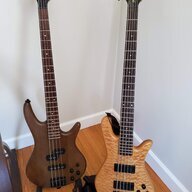
I also sit in a more classical position. Keeps my pluck/pick hand relaxed, and means I can access more of the fretboard.
If I were to have it on my right leg or in that area while standing, I have a harder time reaching the lower frets without wrist pain. Probably wouldn't be that way with a short scale though since I could do that on a guitar.
Plus, this guy does it, so that's why I tried it out:

If I were to have it on my right leg or in that area while standing, I have a harder time reaching the lower frets without wrist pain. Probably wouldn't be that way with a short scale though since I could do that on a guitar.
Plus, this guy does it, so that's why I tried it out:

Turnaround
Commercial User
I see two things that are less than ideal. First is the angle of the wrist which should be flat across the back of the hand through the forearm (as mentioned by others). The bend in your wrist can lead to carpel tunnel problems.
The second is the position of the fingers in relation to the strings - they should be close to perpendicular to the string. Stand with your arms dangling loosely at your side and completely relax your hand. Your fingers will naturally curve. If you were to hold that positoin and put your hand over your strings, the fingers will be perpendicular to the strings. That's ideal, and plucking that way will ensure that you don't get "clack" when you dig in a biit.
The second is the position of the fingers in relation to the strings - they should be close to perpendicular to the string. Stand with your arms dangling loosely at your side and completely relax your hand. Your fingers will naturally curve. If you were to hold that positoin and put your hand over your strings, the fingers will be perpendicular to the strings. That's ideal, and plucking that way will ensure that you don't get "clack" when you dig in a biit.
Last edited:
Turnaround
Commercial User
The real probelm here is not the hands but the head. The dude shouldn't have his head on backwards. His hands look good though.

Thanks for the advice. 100 pounds! congratulations that is some serious commitment.Every body (and I do mean “body”) is different. What works for some, may not work for all. In the last three years, I have lost over 100 pounds. The bass used to rest on my belly, and the placement of my hands fit very naturally. Now I have a lot less belly, and I started to get pain in my wrists, shoulders, and hands. I had to overhaul my entire approach to playing. Obviously, my straps had to shorten up, but I also had to rethink how I sit/stand, the angle of my bass, my hand placement, you name it.
The result is that I’ve changed how I start beginners to try to take into account each individual’s body ergonomics. The goal is to play with as little tension as possible. Tension kills tone and leads to pain. I also work to ensure that future technique isn’t hindered by bad body mechanics. When speed and timing become an issue, I look at hand placement to see if it is causing problems. If you have no tension and good technique, you’re golden.
I would ask your teacher if they feel that you hand placement is a tension issue or a technique issue (or something else). A conversation with a guitarist friend got me on my current path. I feel great and I have been happy with my playing. Good luck.
Honestly, comfort and lack of tension matter more than having a “perfect” angle. There isn’t one correct position that works for everyone.I have been play bass for a couple years and I decided to take a lesson. My teacher pointed out that the top of my hand was not as forward as most players. I think this is a wrist mobility thing, I always just tried to feel as comfortable as I could. Now I'm in my head about it. Is there a reason this could be detrimental? Am i over analyzing? under analyzing? should i move my therapy session up in the month?
I tried to take a picture,View attachment 7407862 I feel like sometimes it is more extreme than this. like my wrist is closer to the top of body.
raqamli ko‘ngilochar platforma
Any tips or thoughts are appreciated.
That said, if your hand angle is limiting your speed, control, or causing strain over time, then it’s worth adjusting gradually.
You’re probably overthinking it a bit — just aim for relaxed movement and good consistency, and tweak things only if you notice actual issues.


