<The surface area of the speakers is directly proportional to the square of the cone radius.>
This does not seem correct to me.
The surface area of a loudspeaker would be the area of a cone. I don’t know how to copy the formulas into the forum, but if you google area of a cone you will find that the area of a cone is Pi times the radius [of the cone] multiplied by the radius plus the square root of the height [of the cone] squared times the radius squared. This doesn’t account for the dust cap.
Taking the square of the cone radius as you suggested is half the formula for the area of a circle, but you left out Pi. The area of a circle is Pi multiplied by the radius squared. However, the area of a circle is not the same thing as the surface area of a loudspeaker cone, because a circle is not a cone.
To determine how much air a loudspeaker will move compared to another loudspeaker, you can employ what are known as the Thiele-Small parameters.
Thiele/Small parameters - Wikipedia
Vd, which is the Peak Diaphragm Displacement Volume, is the Thiele-Small parameter that determines how much air a loudspeaker will move per sine wave cycle. Peak Displacement Volume is found by multiplying Sd, the projected area of the driver diaphragm (in square metres) [which takes into account the dust cap] by Xmax, the maximum linear peak (or sometimes peak-to-peak) excursion (in mm) of the cone. This tells you how many cubic centimeters of air the loudspeaker will move per sine wave cycle.
So when we compare, for example, the Vd of the Eminence 3015 loudspeaker with the Vd of the 3015LF loudspeaker, we find:
3015 Vd 505cc
3015LF Vd 846cc
The 3015LF moves more air because its maximum linear excursion (Xmax) is 906mm compared to the 3015 whose Xmax is 5.9mm (there is a small difference in the surface area of the two cones).
To get an idea how loud a loudspeaker might play (i.e., SPL, or sound pressure level) you can use the loudspeaker sensitivity rating, i.e., the average output across the usable frequency range when applying 1W and measuring 1m away from the loudspeaker).
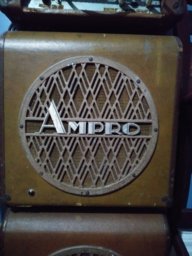
It might be hard for the OP to apply these techniques unless he is able to identify just exactly what loudspeakers are in his beautiful Fender bassman cab. Some of the early MI cabs were manufactured prior to when the T/H parameters had come into common use, or before they were published.
Maybe Agedhorse will chime in on this one.





 Pro designers may be considering specs that aren't on the datasheet, or that are based on an agreement with the manufacturer.