• TalkBass has been independent since 1998. Add your voice.
    Create a free account to reply to discussions, view embedded media, and browse with fewer display ads.
    Join freeLog in
    Want zero display ads or expanded classifieds tools? Compare plans.

Your Preferred Fret Size/Style

Given the various fret sizes available, what works for you? By that, I mean, what do you prefer to get the tone you are looking for, with minimal to no fret noise?

I know that I don't like the 'narrow tall' frets as they sound too 'clacky' to me, but I'm also a beginner, so it could be my technique as well.

Using Dunlop numbers, I don't know if vintage-style small frets (6130/6230) or medium jumbo peaked (6115) would be better, given that action must be a factor also?

I prefer low action, but there's only so low you can go, without getting too close to the pickups. Here's a chart from Warmoth.
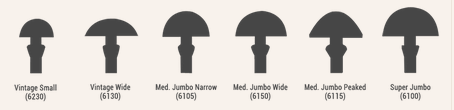
frets.png
 
-you will always have fret noise. you are tapping metal to metal as you play. technique can reduce this a bit.
-fret size, shape, height have nothing to do with action. one plays the fret, not the fingerboard.
 
  • Like
Reactions: douglasbass
I like Jescar 43080, also sold by LMI as FW74. It's more or less "medium" by modern standards. I think it looks good size-wise and I like the feel. I use it by default on pretty much all instrument sizes, uke to guitar to bass.

I would agree with @Arie X - if fret noise is your main concern, focus on technique, not changing fret size.
 
I like Jescar 43080, also sold by LMI as FW74. It's more or less "medium" by modern standards. I think it looks good size-wise and I like the feel. I use it by default on pretty much all instrument sizes, uke to guitar to bass.

I would agree with @Arie X - if fret noise is your main concern, focus on technique, not changing fret size.

Thanks, yes, it's probably impatience, and that affliction that the next piece of gear will fix everything :-)
 
  • Like
Reactions: dwizum
I wonder if these are similar to the 'mando wire' that Lee Sklar uses. (I've never played a banjo or a mandolin).

Do you find that the 'banjo size' frets make you a more precise player?

The mandolin frets are a bit smaller. Do banjo frets make me more precise? Not necessarily. They are easy to play and I've grown accustomed to them over the (fifteen) years I've been playing on them.
 
  • Like
Reactions: douglasbass
Interesting ... not a fan of 'made in China' but I am curious about Dingwall and how they play / feel

Just to clarify, the Dingwall shop is in Canada. Their handmade basses are right up there or above anybody. Fodera, Sadowsky, Wal...yes they are on that level.

They do have a line called Combustion that is Made In China, then they are finished in the Canadian Custom Shop. They do the setup, fretwork, and final assembly. The quality of these basses is pretty much the same. The only real difference is they are not as fancy and don't have many options available.
 
I think most of my basses come with 6150s. I guess I'm not that discerning on fret size as I haven't really noticed. What I do notice is the difference between traditional nickel alloy and stainless steel fret materials. I really like the feel of SS. Vibrato and bends are much smoother. They're also supposed to last longer but I don't yet have enough time with my SS fretted basses to confirm this.
 
I build my own basses with Warmoth wood. I use 2 sizes of frets - the "6230" and "6105" *. I always use stainless frets (I like things that last). Stainless frets make a bass more "clacky" (they also make it a bit harder to fret without buzz - they teach you to be more precise in your fretting). On instruments where I don't want so much of that, I use the 6230 - less metal = less clack, a bit more "wood" in the tone. On instruments where I want clack/clank, I use the 6105 stuff. Fret size makes more difference in the tone of the thing (it's about the attack of the notes; not much beyond that) than a high mass bridge - the fret end of the string has very little metal, so adding a bit more there makes a bigger difference than adding more metal at the end where there's already gobs of it.

*Warmoth's frets, while they're given Dunlop aliases, are actually Jescar wire; the dimensions are not quite the same as the Dunlop stuff.
 
I build my own basses with Warmoth wood. I use 2 sizes of frets - the "6230" and "6105" *. I always use stainless frets (I like things that last). Stainless frets make a bass more "clacky" (they also make it a bit harder to fret without buzz - they teach you to be more precise in your fretting). On instruments where I don't want so much of that, I use the 6230 - less metal = less clack, a bit more "wood" in the tone. On instruments where I want clack/clank, I use the 6105 stuff. Fret size makes more difference in the tone of the thing (it's about the attack of the notes; not much beyond that) than a high mass bridge - the fret end of the string has very little metal, so adding a bit more there makes a bigger difference than adding more metal at the end where there's already gobs of it.

*Warmoth's frets, while they're given Dunlop aliases, are actually Jescar wire; the dimensions are not quite the same as the Dunlop stuff.

Thanks, I'm interested in more "woodiness", tone-wise.