• TalkBass has been independent since 1998. Add your voice.
    Create a free account to reply to discussions, view embedded media, and browse with fewer display ads.
    Join freeLog in
    Want zero display ads or expanded classifieds tools? Compare plans.

Your thoughts on a (new to me) bass design...

Your thoughts on this would be appreciated.

I'm kicking around the idea of building a "short scale" (25-1/2", possibly longer, keep reading...) fretted bass using the bottom 4 strings that would normally be found on a 5 string bass.

If you check the notes vs. scale length of a 5 string then you can see that the 5th fret of a 5 string with a 34" scale length is indeed 25-1/2" from the nut and produces a E note. That makes it seem pretty obvious that the ultra-short scale and BIG strings would be a do-able deal. ;)

SO...

What is the downside to a 25-1/2" scale length 4 string bass tuned EADG using the string set gauges from a "normal" 5 string, the 4th string would then be .125".

One of these days I'll sneak off to the local guitar dealer and try a 5 string with a wide capo on the 5th fret. That would really tell me if the idea is feasible or not.

I'm thinking LaBella Black Tapes (my normally preferred strings) and a single MM style pickup.

Things I've thought about:

If strings need a bit more tension then I can bump the scale length up slightly.

I have an alternate plan for anchoring the ball end of the strings, so there wouldn't be any problem with the wraps ending shortly above the nut to eliminate the problem with wraps that end up around the string posts of the tuners.

I like Hipshot Ultra-lights, so the ones with the larger diameter string posts would handle the larger strings with no problem.

Do feel free to tell me if this is a wacky idea (or not). I'm totally OK with critical thought on the entire concept. ;)
 
  • Like
Reactions: Matt Liebenau
My only concern was about the tuners and wrapping the larger portion of the string around it but you’ve apparently addressed that. I’m interested to see what you have in mind. After that it all seems to come down to if you like the feel of that scale and heavier strings.
 
I just built a 23.5 inch EADG bass and it plays pretty well. A few extra inches and some lower strings probably would work.

This thread is really interesting for tiny basses, some people are building 5 strings that are as small as mine.
 
That’s a lot of string for no good reason. If you think you want fatter gauges, I’d suggest no heavier than 110 on the E, maybe a little fatter if you use tapes since the tape adds a little thickness. From my experience doing 130 and 135 on a 5 string, it’s going to sound pretty tubby to go that heavy.
 
  • Like
Reactions: BassDaddySky
Thanks for the comments so far!

The design I'm considering would end up playing and feeling exactly like a standard 34" scale length 5 string bass, but playing only strings 2 through 5 from the fifth fret and higher.

Thanks for the "Sub-short scale" topic link. That's a LOT of pages to Wade through! ;)
 
Last edited:
I've been building "sub" short scale basses for a few years now. I offer them in 25.5", and 27 5/8", in addition to 30" scale and beyond.

This is my SlimBass model, essentially a boutique travel bass. I wanted a bass that you could fly with, then be able to use it on stage or in the studio as well. The instruments are hollow, weighing just under 4lbs. In addition to the standard electronics, there is a built in, simple headphone amp with output jack/ volume control for headphones and an AUX input jack/volume control whatever source used. There is also an onboard tuner.
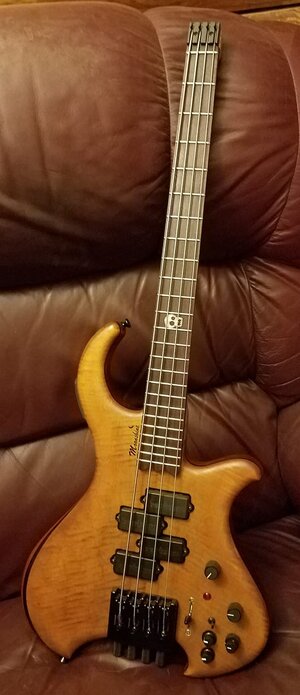
MCG SlimBass 1.jpgreceived_682406315663453 (1).jpeg

These are both early models. They are 25.5"scale, tuned to EADG (standard).

The first one is the original model, it has an early Schaller quad coil pickup (Kramer used these in some of their basses). with passive volume and tone controls. The second model is more like what I build now. it has two Nordstrand Big Blades pickups (clean & clear) with passive volume and tone controls.

The first model sounded really good, but once I went to using more modern pickups, such as the Nordstrands, it all came together. I wouldn't hesitate using one of these on stage. The sound blows everyone that has played them away. "I can't believe that much sound is coming from that little bass!" is the usual response. The earlier models used standard tuners, which I still offer as an option, but I use Hipshot headless sysytems now.

I struggled with finding a supplier for the headphone amp, I ended up having some produced in China. Quality-wise the were "okay", not exactly what I was looking for. I started building these around 2018, technology today has most types of headphone amps utilizing bluetooth, and I am working on a new headphone amp design that will do so as well.

This is another model that has a 27 5/8" scale. It uses two Bartolini P pickups with custom switching and a custom Bart preamp.
MCG Rick Travel bass.jpg

I discovered that Ernie Ball sells a 9 string guitar set. the lower 4 strings are: .105/ .080/ .064/ .046. The tension is perfect. I also use them on the 27 5/8" scale basses. $22. on Amazon.

I apologize for hijacking your thread, I just wanted you to know that you are on the right track.

Good luck with your build!
 
As an Amazon Associate, TalkBass may receive commissions from qualifying purchases made via links on this site.
Your thoughts on this would be appreciated.

I'm kicking around the idea of building a "short scale" (25-1/2", possibly longer, keep reading...) fretted bass using the bottom 4 strings that would normally be found on a 5 string bass.

If you check the notes vs. scale length of a 5 string then you can see that the 5th fret of a 5 string with a 34" scale length is indeed 25-1/2" from the nut and produces a E note. That makes it seem pretty obvious that the ultra-short scale and BIG strings would be a do-able deal. ;)

SO...

What is the downside to a 25-1/2" scale length 4 string bass tuned EADG using the string set gauges from a "normal" 5 string, the 4th string would then be .125".

One of these days I'll sneak off to the local guitar dealer and try a 5 string with a wide capo on the 5th fret. That would really tell me if the idea is feasible or not.

I'm thinking LaBella Black Tapes (my normally preferred strings) and a single MM style pickup.

Things I've thought about:

If strings need a bit more tension then I can bump the scale length up slightly.

I have an alternate plan for anchoring the ball end of the strings, so there wouldn't be any problem with the wraps ending shortly above the nut to eliminate the problem with wraps that end up around the string posts of the tuners.

I like Hipshot Ultra-lights, so the ones with the larger diameter string posts would handle the larger strings with no problem.

Do feel free to tell me if this is a wacky idea (or not). I'm totally OK with critical thought on the entire concept. ;)

Hey Rudy;

I think you are on the right track, but you don't need to go that far. If I were building a sub-short scale EADG bass, I'd go with Heavy gauge EADG strings, like 0.055-0.110. If you shorten the scale length, you want to go to larger gauge strings, but you don't need to go as big as 0.125.

When I developed my SSB model (30.5" scale), I found that putting 0105 strings on it gave it about the same feel as my 35" scale models with 0.100 strings. That's based on my experience playing it; the perceived tension and stiffness felt right.

So I think those proportions would work if you shortened the scale another 5+ inches and increased the string gauge to 0.110.

And yes, I'd design it using some kind of extended tailpiece trick, so that it could use commonly-available size strings.

Also, the shorter the scale length, the more you need to pay attention to the stiffness of the neck overall and the neck/body joint. I highly recommend the brass bar heel inserts ("BruceBars") to improve the clarity of the low fundamentals. That's the biggest factor in getting good bottom end sound out of a short scale bass.
 
  • Like
Reactions: Water buffalo
I've been building "sub" short scale basses for a few years now. I offer them in 25.5", and 27 5/8", in addition to 30" scale and beyond.

This is my SlimBass model, essentially a boutique travel bass. I wanted a bass that you could fly with, then be able to use it on stage or in the studio as well. The instruments are hollow, weighing just under 4lbs. In addition to the standard electronics, there is a built in, simple headphone amp with output jack/ volume control for headphones and an AUX input jack/volume control whatever source used. There is also an onboard tuner.
View attachment 7287466View attachment 7287467

These are both early models. They are 25.5"scale, tuned to EADG (standard).

The first one is the original model, it has an early Schaller quad coil pickup (Kramer used these in some of their basses). with passive volume and tone controls. The second model is more like what I build now. it has two Nordstrand Big Blades pickups (clean & clear) with passive volume and tone controls.

The first model sounded really good, but once I went to using more modern pickups, such as the Nordstrands, it all came together. I wouldn't hesitate using one of these on stage. The sound blows everyone that has played them away. "I can't believe that much sound is coming from that little bass!" is the usual response. The earlier models used standard tuners, which I still offer as an option, but I use Hipshot headless sysytems now.

I struggled with finding a supplier for the headphone amp, I ended up having some produced in China. Quality-wise the were "okay", not exactly what I was looking for. I started building these around 2018, technology today has most types of headphone amps utilizing bluetooth, and I am working on a new headphone amp design that will do so as well.

This is another model that has a 27 5/8" scale. It uses two Bartolini P pickups with custom switching and a custom Bart preamp.
View attachment 7287478

I discovered that Ernie Ball sells a 9 string guitar set. the lower 4 strings are: .105/ .080/ .064/ .046. The tension is perfect. I also use them on the 27 5/8" scale basses. $22. on Amazon.

I apologize for hijacking your thread, I just wanted you to know that you are on the right track.

Good luck with your build!


Cool basses. More stuff on my “build someday” list. :rollno:
 
As an Amazon Associate, TalkBass may receive commissions from qualifying purchases made via links on this site.
  • Like
Reactions: Water buffalo
Hey Rudy;

I think you are on the right track, but you don't need to go that far. If I were building a sub-short scale EADG bass, I'd go with Heavy gauge EADG strings, like 0.055-0.110. If you shorten the scale length, you want to go to larger gauge strings, but you don't need to go as big as 0.125.

When I developed my SSB model (30.5" scale), I found that putting 0105 strings on it gave it about the same feel as my 35" scale models with 0.100 strings. That's based on my experience playing it; the perceived tension and stiffness felt right.

So I think those proportions would work if you shortened the scale another 5+ inches and increased the string gauge to 0.110.

And yes, I'd design it using some kind of extended tailpiece trick, so that it could use commonly-available size strings.

Also, the shorter the scale length, the more you need to pay attention to the stiffness of the neck overall and the neck/body joint. I highly recommend the brass bar heel inserts ("BruceBars") to improve the clarity of the low fundamentals. That's the biggest factor in getting good bottom end sound out of a short scale bass.
Thanks Bruce, Your contributions are always top shelf! ;)

I play 30" scale length basses with black tape LaBella strings so I agree that it's not necessary to increase the diameter much when going from 34" to 30". My tapes are .110" I believe and the E is just at the point of flabbiness. Going down to 25-1/2" might really be pushing it, but I'm not sure about that so that's the reason for getting everyone's input here.

I do eventually want to capo a 34" 5 string and check out the response and feel for myself. I just played electric guitar in a band last weekend and the bass player is a recent acquaintance who plays a 5 string Fender Jazz bass so I could check his out. He did tell me that he just doesn't use the B string, and a couple other 5 string players have told me the same thing.

(I do remember a Les Claypool interview where he said 4 strings is too many and he really prefers three!)

All of that is part of my interest in doing the Ultra-short scale 4 string. I'm used to EADG tuning and I certainly don't need any more strings to complicate my life. ;)
 
Last edited:
  • Like
Reactions: Water buffalo
I have made a couple of basses more or less as you describe. I used the lower four strings from a 5 string set and cut off some of the outer windings on the two thickest strings. It's pretty easy, but the key is to clamp down the windings on the part you want to keep before you start unwinding. There is a risk of the rest of the windings to become loose if you don't.

I have a brief description of the process here: 25" short scale V2.0
 
The main design issue with shorter-than-conventional scale instruments is inharmonicity, the amount the partials of the vibrating string skew sharp. All strings have some inharmonicity, but increased amounts tend to make it more difficult for our hearing system to detect pitch. At really high levels of inharmonicity our hearing system would be either unable to determine pitch (doesn't happen very often) or would perceive a different pitch than is intended. Although there are a number of string construction factors involved, the main determinants of inharmonicity are the bending stiffness of the string core (stiffer = higher inharmonicity), the diameter of the string core (bigger the diameter the more inharmonicity), the shortness of the vibrating length (shorter results in higher inharmonicity), and string tension (lower the tension, the higher the inharmonicity). There is no standard way to express inharmonicity. In my work and publication I express it as the difference between the theoretical harmonic frequency of the second partial and its actual frequency, expressed as a percentage. Interestingly there is no specific threshold above which inharmonicity is problematic in musical instruments. This is a function of how adaptable our human hearing system is. We recognize a difference in tone between a typical standard scale bass and a short scale bass for example, and a difference in tone between a concert grand piano and a spinet. But we find each of these instruments appropriate in certain musical contexts.

So, to your question. My recommendation is that you perform the experiment that you mention with the five string bass and the capo. Focus your attention on what is now the E string. Is the definitiveness of pitch acceptable to you? How far up the neck can you fret before it becomes unacceptable? No right or wrong here. If it works for you then it works.

One final thing. There is a plethora of very short scale bass instruments available these days. Classical guitar family basses or extended range classical guitars, Ashbory style basses, and various so-called ukulele basses. To me these all sound fine as far as pitch definition goes. And all of these instruments use strings with very low bending stiffness cores. I bring this up only because if your experiment with steel core electric bass strings doesn't work out for you, there is still an avenue of research available for you to pursue.

Best of luck with your project.
 
  • Like
Reactions: Beej
The main design issue with shorter-than-conventional scale instruments is inharmonicity, the amount the partials of the vibrating string skew sharp. All strings have some inharmonicity, but increased amounts tend to make it more difficult for our hearing system to detect pitch. At really high levels of inharmonicity our hearing system would be either unable to determine pitch (doesn't happen very often) or would perceive a different pitch than is intended. Although there are a number of string construction factors involved, the main determinants of inharmonicity are the bending stiffness of the string core (stiffer = higher inharmonicity), the diameter of the string core (bigger the diameter the more inharmonicity), the shortness of the vibrating length (shorter results in higher inharmonicity), and string tension (lower the tension, the higher the inharmonicity). There is no standard way to express inharmonicity. In my work and publication I express it as the difference between the theoretical harmonic frequency of the second partial and its actual frequency, expressed as a percentage. Interestingly there is no specific threshold above which inharmonicity is problematic in musical instruments. This is a function of how adaptable our human hearing system is. We recognize a difference in tone between a typical standard scale bass and a short scale bass for example, and a difference in tone between a concert grand piano and a spinet. But we find each of these instruments appropriate in certain musical contexts.

So, to your question. My recommendation is that you perform the experiment that you mention with the five string bass and the capo. Focus your attention on what is now the E string. Is the definitiveness of pitch acceptable to you? How far up the neck can you fret before it becomes unacceptable? No right or wrong here. If it works for you then it works.

One final thing. There is a plethora of very short scale bass instruments available these days. Classical guitar family basses or extended range classical guitars, Ashbory style basses, and various so-called ukulele basses. To me these all sound fine as far as pitch definition goes. And all of these instruments use strings with very low bending stiffness cores. I bring this up only because if your experiment with steel core electric bass strings doesn't work out for you, there is still an avenue of research available for you to pursue.

Best of luck with your project.
Thank you much for your detailed response. As a side note I've followed your website for years, with a deep appreciation of your contributions that blend solid knowledge of instrument physics with unique and "outside the box" designs.

Your suggestion firms up my initial thought that a real world test of the physics of this particular combination might be the best way to verify if its worth doing, at least in my case. Having all of the other Talkbass folks put on their thinking caps and piping in is also a great way to end up with a much larger collective brain than the smaller mass that I possess. ;)
I'm familiar with Ashbory-style instruments and U-basses and the combination of their even shorter scale lengths and odd strings have made them less than an enjoyable playing experience for me. The U bass is particularly pleasing when amplified, but that's its single best attribute.
Taylor (probably others) did market their GS Mini bass for a few years that I remember being 25-1/2" scale length, but used a special proprietary string. That bass played and sounded good, but it was an acoustic-electric and larger and prone to feedback at higher volume.
 
Last edited: