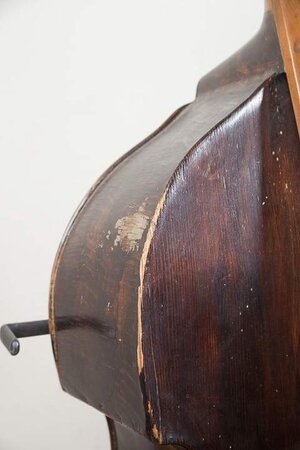
So, I posted about this bass a few years back, and am sort of revisiting the idea of having this bass fixed up (not by me).
I've taken it to several luthiers in the Midwest, and have been told by several people that it might be from the 1780-1840s, possibly from the Southern Austria or Northern Italy region. One luthier thought it might be a church bass or Prescott bass, but it doesn't look like any I've seen.
My issue, other than the mystery, is that this instrument is kind of small for me, I'm 6'3" with big hands. The instrument is 60" in full height (not including the chair-leg post), and has a rough scale length of 33-34".
And, if I did get it all set up (which would take some months and a lot of money), would I be able to sell it for what I put into it? I'm very curious to hear how it sounds, but if it's too weird to play in Viennese tuning, what the two luthiers think it was tuned in, is there someone out there who might be interested in it.
Initially, I'd think I'd restore it as a three-string just to try to maintain the integrity before I go changing it. I play roots music and a little jazz, and am not classically trained. Although I thought putting some gut strings on it and playing some "wolfy" Tom Waits-y kind of stuff with it, or putting steel strings and maybe play some variation on some Ron Carter piccolo bass.
Does anyone know any Baroque instrument groups or forums or someone who might be interested in this?
Thanks!
(More photos to come in this thread.)


I've taken it to several luthiers in the Midwest, and have been told by several people that it might be from the 1780-1840s, possibly from the Southern Austria or Northern Italy region. One luthier thought it might be a church bass or Prescott bass, but it doesn't look like any I've seen.
My issue, other than the mystery, is that this instrument is kind of small for me, I'm 6'3" with big hands. The instrument is 60" in full height (not including the chair-leg post), and has a rough scale length of 33-34".
And, if I did get it all set up (which would take some months and a lot of money), would I be able to sell it for what I put into it? I'm very curious to hear how it sounds, but if it's too weird to play in Viennese tuning, what the two luthiers think it was tuned in, is there someone out there who might be interested in it.
Initially, I'd think I'd restore it as a three-string just to try to maintain the integrity before I go changing it. I play roots music and a little jazz, and am not classically trained. Although I thought putting some gut strings on it and playing some "wolfy" Tom Waits-y kind of stuff with it, or putting steel strings and maybe play some variation on some Ron Carter piccolo bass.
Does anyone know any Baroque instrument groups or forums or someone who might be interested in this?
Thanks!
(More photos to come in this thread.)