• TalkBass has been independent since 1998. Add your voice.
    Create a free account to reply to discussions, view embedded media, and browse with fewer display ads.
    Join freeLog in
    Want zero display ads or expanded classifieds tools? Compare plans.

Double Bass High Saddle?

LouisF

Supporting Member
Apr 21, 2003
5,400
3,943
Los Angeles, CA

Attachments

  • 100_4811.jpg
    100_4811.jpg
    26.9 KB · Views: 918
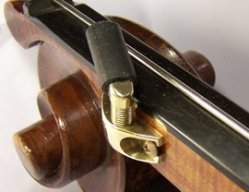
I dont have a picture handy but my Solano Klotz has a block like that to reduce the angle of the strings over the bridge. Mine is not as tall or bulky and is rosewood but it is the same idea. I could remove it but I never have so don't know how it would affect the sound. Maybe I will try it on a rainy day.
 
Gee willikers look at the size of that thing - I wonder why it wasn't painted/stained black?

I can remember back in the '90s raised saddles were the latest rage in tone improvement. Pros, please correct me if I'm wrong, but the aim was to decrease the break angle over the bridge, thereby lowering the tension and making the strings speak easier - and/or, it was also a method of wolftone control.

It's funny, because many classical guitar builders make bridge tieblocks that do the exact opposite - increasing the break angle for a louder, punchier sound. I've modified several guitars to create this effect, and it is significant. I often wonder how many basses that had raised saddles installed might sound/feel better without.

cdp
 
It's absolutely worth experimenting with saddle height, but these two examples don't represent the most elegant options available. What you're mainly doing by raising the saddle is decreasing the downforce of the bridge on the top. This will reduce wolf tones, but doesn't necessarily loosen up a "tight" bass, and can actually make it less focused and articulate. It is especially useful when you bring out the neck block or add a neck shim to provide better thumb position access, but don't want to increase bridge downforce.

I find both of these examples particularly objectionable not only because of the extreme height, but because they appear to rest on the top itself. Any saddle, screws or no, should sit directly on the block. There is a terrific amount of force here. If any of that force presses on the top plate...

There is a design out there for an adjustable saddle. It reminds me of a Schaller slab-bass bridge. Anyone know where to get it? I've been wanting to try one!
 
I can remember back in the '90s raised saddles were the latest rage in tone improvement. Pros, please correct me if I'm wrong, but the aim was to decrease the break angle over the bridge, thereby lowering the tension and making the strings speak easier - and/or, it was also a method of wolftone control.
cdp

I remember them in the '60s when steel strings with increased tension were catching on.
 
+1. Yeah Bill, me too. That's when they became popular and they do lessen the tension, obviously, and longer string life. I'm a firm believer in tension being a plus on my bass that's why I'm switching to Starks. I have heard many basses open up really nice with a raised saddle.


Paul,
Are you saying I should rethink the option?
Louis

Im unclear on your question, Louis.
 
A raised saddle is a good idea on some basses. Those built with a long upper bout and short lower one create a sharp breakover angle at the bridge. This can cause a tense feel and also lead to the bridge "wanting" to tip over toward the fingerboard. And basses that were lightly built during the gut string era may benefit from the lessening of downforce on their top tables. I build my handmade basses with an adjustable saddle which gives me another tool to adjust when optimizing the feel and sound for a particular player. I like having the ability to adjust the breakover angle; however, those players with "tinker-itis" would be advised to steer clear.
 
So to update: after several permutations of taipieces, endpins, steel shafts, strings - the ultimate solution seemed to be be a thicker sound post!!

So the final combination is: thicker post, Sonores Twine strings, Marvin tailpiece and BOTH the rosewood and 5/8th steel endpin (only 8" long).

The wooden endpin seems to bring out the bass's singing quality, especially on the top two strings; the steel pin (made by Wayne Holmes - the Swanson bass had a 5/8th pin) makes the lower strings really resonate. Maybe at somepoint I'll figure out a way of getting the best of both worlds. But for no, both the bass and I are very happy.

Thanks for all the input.

Louis

PS: Key to both pins is to take off the rubber stoppers
 
My stand partner has a Solano with the afore-mentioned giant saddle, plus the marvin TP.

I thought that raising the saddle would reduce the <perceived?> amount of force required for the left hand by reducing the break angle at the bridge, no? I.e., saddle goes up, break angle reduced, less left hand force required.
 
...
I thought that raising the saddle would reduce the <perceived?> amount of force required for the left hand by reducing the break angle at the bridge, no? I.e., saddle goes up, break angle reduced, less left hand force required.
People make this claim. Personally, I don't see how it could be true, since the tension of the strings from nut to bridge remains unchanged. Likewise for the break angle at the nut and on the playing side of the bridge. What it will do is change the response of the top, and therefore the way the strings speak and ring. You will feel this with the right hand, but unless the change has affected your action (which it could) you shouldn't notice any difference in the left hand.
 
saddle goes up, break angle reduced, less left hand force required.

everyone claims this, but the physics don't add up, nothing personal boylebass

the string tension is the same (same pitch, same string length, same string characteristics), what changes is the amount of pressure transferred onto the top

the bass will feel and react differently, and if the sound improves you will find yourself using less energy while playing, but the left hand force required will be the same