• TalkBass has been independent since 1998. Add your voice.
    Create a free account to reply to discussions, view embedded media, and browse with fewer display ads.
    Join freeLog in
    Want zero display ads or expanded classifieds tools? Compare plans.

Getting a passive HPF

Hey all!

After searching for some time now and realizing that i can't afford fdeck or micro thumpinator i decided that i will let local effect builders http://www.jamitfx.com/ build me a passive HPF in 1590a enclosure.

This is the scheme i found on net Invalid Link Removed.

Freq range is going to stay the same, from 20Hz to 200Hz, who knows... maybe i will need it somewhere else too. I decided to go passive mainly because i don't want to use batteries or power supply.

I'll probably have it around 18th this month and i'll post some results later on.
 
Frank I am sorry but I will have to let you down on this one :)

Maybe it was a bad idea posting that link for that diagram because in the end this HPF will be different. JamIT guys will keep it a secret :)

But they told me that it will have passive/active switch. Sorry if I can't deliver you more specific details I just know what i want and I am sure I will get it.
 
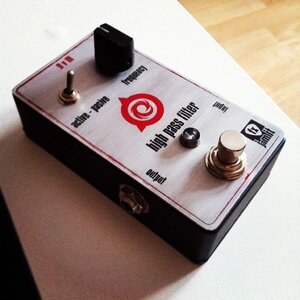
Here it is :) i will probably test it today so stay tuned for more infos!

ImageUploadedByTalkBass1363512162.416836.jpg
 
HPF cuts EVERYTHING below selected frequency, normal EQ pedal cuts/boosts only SELECTED frequency.
Well... Sort of... In both cases there is a wide curved slope of frequencies affected on both sides of the selected frequency. It depends on the specific filter design (an EQ is a filter).

Also, HPF can = shelving EQ. People like to pretend there is a difference because they want a convenient way of distinguishing between steep and shallow filter slopes, but the reality is just not that convenient. There is nothing inherent in the term "HPF" that says it will have a steeper slope than a shelving EQ.

You have to specify the slope, instead of relying on the generic names.

It is safe to assume that a typical Low EQ knob has a shallow slope that doesn't work well for cutting subharmonics only, so it makes a poor HPF in that context.
 
I know it's not passive Frank, this is just basics what we went for and we took out jfet.

Removing the JFETs still leaves you with an opamp, which is an active integrated circuit. There are generally two ways in which to create a passive HPF. One is to place a capacitor in series with the signal path, and the other is to place an inductor parallel to the signal path.

If you have a low shelf set to -12dB @40Hz, both then every frequency below 40Hz will be at -12dB.

The shape of the curve varies, depending on the circuit, but I have never heard of such a thing as a flat response below a particular frequency. It usually starts from unity gain at some frequency, and then decreases in a nonlinear fashion as you approach 0Hz.
 
I was simplifying for the sake of explanation. Once you're past the knee on the lower frequency on a shelving filter, the attenuation should be as consistent as makes no difference. It certainly won't have as much of an attenuation at excessively low frequencies.
 
I'm an electrical engineer, so I'm relatively familiar with filters. It's entirely possible I'm completely off base with respect to the common circuit architectures, though. Can you point me in the right direction or at least be more specific than "I'm wrong"? :hiding: