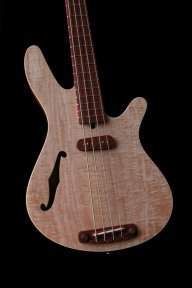
I am constantly amazed at the wide selection and good overall quality of instruments available today, most at reasonable prices.
International imports of amazing quality seem to have flooded the market, so that intermediate level basses are available at entry-level prices. When you adjust for inflation, that $300 entry-level instrument with active pickups, active pre, string-thru body, and 24-fret super-duper-neck, equates to just $39 in 1960. Imagine that!
In 1960, a brand new Fender Precision retailed for $279.50. After adjusting for inflation, that's roughly $2200 today. Think about what you can do with that kind of budget today!
And yet, even if you don't like the new imports, today you can still purchase a US-made classic design from old-pedigree entities like Fender, Gibson, Music Man, G&L, or Rickenbacker. The competition the old guard have faced from imports (e.g. early Ibanez) have forced them to improve their value proposition from their low points in the late 1970s and early 1980s, when they nearly went bankrupt. Now at least they're solvent and producing great-quality instruments once more, and in some cases, they're better than ever.
And then think of all of the modern small-output luthiers like Spector, MTD, or even smaller shops like Mike Lull, and the work they're able to do with modern manufacturing techniques, amazing electronics selection, and new tools like the PLEK machine for computer-assisted fret work. The Internet has opened up new markets for them, allowing them to sell to international markets where before their work would have remained largely regional.
Of course I can't predict whether this explosion in selection is a sustainable market trend and will continue to grow. I know that the "Great Recession" has already taken a toll on several companies who have scaled back. But I'm fairly sure that 2002-2012 has been an unprecedented decade for instrument consumers.
It's truly a great time to be a bass player... as long as you have a paying gig to fund the GAS.
International imports of amazing quality seem to have flooded the market, so that intermediate level basses are available at entry-level prices. When you adjust for inflation, that $300 entry-level instrument with active pickups, active pre, string-thru body, and 24-fret super-duper-neck, equates to just $39 in 1960. Imagine that!
In 1960, a brand new Fender Precision retailed for $279.50. After adjusting for inflation, that's roughly $2200 today. Think about what you can do with that kind of budget today!
And yet, even if you don't like the new imports, today you can still purchase a US-made classic design from old-pedigree entities like Fender, Gibson, Music Man, G&L, or Rickenbacker. The competition the old guard have faced from imports (e.g. early Ibanez) have forced them to improve their value proposition from their low points in the late 1970s and early 1980s, when they nearly went bankrupt. Now at least they're solvent and producing great-quality instruments once more, and in some cases, they're better than ever.
And then think of all of the modern small-output luthiers like Spector, MTD, or even smaller shops like Mike Lull, and the work they're able to do with modern manufacturing techniques, amazing electronics selection, and new tools like the PLEK machine for computer-assisted fret work. The Internet has opened up new markets for them, allowing them to sell to international markets where before their work would have remained largely regional.
Of course I can't predict whether this explosion in selection is a sustainable market trend and will continue to grow. I know that the "Great Recession" has already taken a toll on several companies who have scaled back. But I'm fairly sure that 2002-2012 has been an unprecedented decade for instrument consumers.
It's truly a great time to be a bass player... as long as you have a paying gig to fund the GAS.