• TalkBass has been independent since 1998. Add your voice.
    Create a free account to reply to discussions, view embedded media, and browse with fewer display ads.
    Join freeLog in
    Want zero display ads or expanded classifieds tools? Compare plans.

Shouldn't the bridge be parallel to the nut?

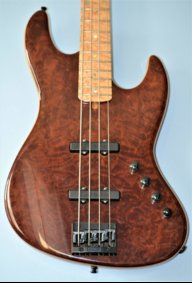
I've been checking out the design on a lot of basses lately, and a lot of basses, particularly acoustics (and others like CT's) and I've noticed that acoustic-style bridges are often mounted at a tilt, not parallel to the nut and frets. And no, I don't mean the fanned fret instruments.

My understanding of the physics behind pitch is that all of the strings should be the exact same length so the intonation of all the strings are consistent. If the bridge (or technically, the saddles) is/are not parallel to the nut and frets, won't it be impossible for the instrument to have proper intonation (i.e, the scale for each string will be a bit different)?

I have a feeling there's a pitifully simple answer to this. :rollno:

 
Dean N said:
I guess my point is, if the strings all have different scale lengths, then wouldn't the fret spacing from string to string also have to be different for each string to maintain accurate intonation?

You adjust the bridge to get each string to intonate at the twelth fret. every other fret is not exact but close enough not to notice.

Somebody bail me out of this because its getting over my head.:hmm:
 
fish man said:
It is the same reason the saddles on a properly set-up bass aren't in a straight line.
What he said. If you look at the saddles on a properly set up bass (in general, mind you) the saddles are going to more-or-less go at an angle. With the types of bridges without individual saddles, putting it at an angle is an attempt to approximate that setup in a general way. Your general (there's that word again) rule being that the thicker the string is, the more you will have to add length to compensate and make it intonate properly.
 
The bridge-nut distance can't be the exact scale length, because the fretted notes will end up sharp because you're pushing down, and therefore stretching the string, when you fret.

The difference between the necessary compensation for different strings is because the strings stretch at different rates. i think there's some other factor but i can't remember right now.
 
Some of you guys have the gist of it, but the explanation usually offered is that the heavier strings require higher action (fretboard clearance) due in part to their greater mass and the larger excursions they make after being struck/plucked (a heavy string will buzz at heights which are okay for lighter strings). Since they are higher off the fretboard, the proportionately greater increase in pitch/tension that occurs when heavier strings are pressed down to the fret must be compensated for by moving the saddles of heavier strings progressively further from the nut as their gauge (and therefore string height) increases. Luthiers call this "compensation." Electric instruments have a great advantage for achieving accurate intonation during setup due to their adjustable saddles.
 
Seekir: Unless I'm missing something, heavier strings do not have to set to a higher working height- given a constant pitch, heavier strings have more tension and a 'radius' of vibration (it's roughly eliptical, but you get the idea), so they'll actually have a tendency to "buzz" less than lighter strings will. In my experience, though, they seem to be more dependent on proper fretwork because it will be more sensitive to high frets beyond the contact point. That may be the reason why you've experienced the need for higher action? It shouldn't be true otherwise, though.

You might be confusing heavier strings for lower pitch strings (ie, an .100" string tuned to E versus an .080" tuned to A, rather than a .095" E versus a .110" E), where the higher pitch strings exert more tension on the neck than do the lower strings (B, E), thus what you had explained.
 
The saddle is a slant because the heavier strings need more compensation than the lighter strings. The is because the notes on the heavier strings play sharper due to their increased tension and usually string action.
 
Angus, the subject of the thread is:
Shouldn't the bridge be parallel to the nut?

I have a feeling you may have misunderstood my reference to string gauge. I was speaking about the gauges of the strings across the instrument, all of which are tuned differently, not to a constant pitch.
given a constant pitch, heavier strings have more tension
This is correct, but we're speaking about the strings across the fretboard within a particular set, tuned to "concert" pitch, not the behavior of different (heavy, medium, or light gauge) sets.

The mass of a particular string is a factor in its movement in response to the deflection and release of being plucked. The low B of a five-string bass will move through a greater range in response to being plucked at a given strength than the high G on the same instrument.

I think there are two things which determine the range of motion a string makes in response to a given pluck strength: the mass of the string, and the tension(pitch) to which it's tuned. Generally speaking, the mass of a string is directly related to its gauge. You could probably also add the flexibility of a particular type or brand of string as a factor determining its maximum amplitude as it vibrates. The greater the amplitude of a string's motion after it's plucked, the greater the required clearance above the frets at the nut and saddles must be to prevent the string from making excessive contact with frets above the "pitch" fret when said string is struck. Increasing the height of the saddles and nut reduces unwanted buzzing, and raises the amount of tension (and pitch) pulling a string down to a fret causes, therefore a heavy, more masive string tuned to the pitch appropriate for it will require higher action and accordingly greater scale length to approach correct intonation. That's the theory as I understand it anyway.
 
gfried84 said:
The saddle is a slant because the heavier strings need more compensation than the lighter strings. The is because the notes on the heavier strings play sharper due to their increased tension and usually string action.

The heavier strings on a bass (for instance a low B) are almost always at a lower tension than than the higher strings (lets say G). There are a few reasons for heavier strings requiring more compensation. Higher action has already been put forward. Additionally, heavier strings are generally stiffer than lighter strings, which results in a larger bending radius when pressed against a fret which will increase the change in tension due to fretting and make the note sharper.
 

Latest posts