Sorry if this has already been posted but whats the difference between a Jazz bass and a Precision bass and how can you tell which is which? Sorry for being such a n00b.

Enjoy the benefits of a premium membership!
Upgrade Account
-
TalkBass has been independent since 1998. Add your voice.
Create a free account to reply to discussions, view embedded media, and browse with fewer display ads.
Join free Log in
Want zero display ads or expanded classifieds tools? Compare plans.
You are using an out of date browser. It may not display this or other websites correctly.
You should upgrade or use an alternative browser.
You should upgrade or use an alternative browser.
Whats the difference between Jazz and Precision?
- Thread starter BlackBassPlayer
- Start date
More options
Who Replied?Oh ok, thanks! I guess theh 4 string bass I have right now is a precision bass since it looks like the first one except its black and the 5 string im getting must be a Jazz bass I guess since it has pickups like the 2nd one. Heres a pic of the 5 string:
Link Removed
Link Removed

what a great, concise, easy-to-understand explanation.
Good job, Smash
Makes a newbie want to go out and buy BOTH! (As they should...hehe)
Good job, Smash
Makes a newbie want to go out and buy BOTH!
(As they should...hehe)
BlackBassPlayer said:Oh ok, thanks! I guess theh 4 string bass I have right now is a precision bass since it looks like the first one except its black and the 5 string im getting must be a Jazz bass I guess since it has pickups like the 2nd one. Heres a pic of the 5 string:
Link Removed
That's not exactly a jazz, but definitely has a jazz pickup configuration. You will notice, however, that the body style is P-bass. The pickup configuration has way more to do with the sound, mind you. So, depending upon the electronics, you should get a more Jazz type vibe from this axe.
"I believe it's a Squier Precision Bass."
Yes. Like Outkast? Some of their last disc was cut on a bass just like yours.
And, no offense at all, but please go to Barnes and Noble or whatever bookstores are in your area and floor-read every book on bass and music they have. That's how myself and probably a lot of others learned the basics.
Good luck, and remember to have fun!
Yes. Like Outkast? Some of their last disc was cut on a bass just like yours.
And, no offense at all, but please go to Barnes and Noble or whatever bookstores are in your area and floor-read every book on bass and music they have. That's how myself and probably a lot of others learned the basics.
Good luck, and remember to have fun!

Ditto.PilbaraBass said:what a great, concise, easy-to-understand explanation.
Good job, Smash
That post should be in the newbies thread.

Polite golf clap for that thorough treatise....
(we could use a smily icon for "polite golf clap")
(we could use a smily icon for "polite golf clap")
Actually its made by Essex. Its the SX SPB-62 41 5-String Bass. And OMG I might come in the mail tomorrow! I have always wanted a 5 string for some reason. lolI believe it's a Squier Precision Bass.
Smash's post so thoroughly answers the question, so I'll just add a couple thoughts.
I have both a Jazz and Precision, and they are very different in sound, it is good to have one of each. The Jazz is a very smooth sounding bass, with quite a few tonal variations due to the two-pickup configuration. The neck is slimmer at the nut and therefore a little easier to play for me. The Precision is aggressive in its tone with the tone knob all the way up. When it is off it sounds old-style, ala Motown's James Jamerson. Its single pickup is extremely quiet, with virtually no hum or noise, even when the tone is all the way up.
Because they are the backbone of the great percentage of recorded music over the last 50 years, you can still play any type of music on either one, and the sound fits right in with what you are playing.
Both basses can become addicting to play. The necks are extemely comfortable, the sound cuts through strongly, the sustain is fantastic, the hardware is high quality, and the overall craftmanship is of high caliber. I also own a Ric and a Music Man Sterling, and the Fenders don't take a back seat to either of these.
I have both a Jazz and Precision, and they are very different in sound, it is good to have one of each. The Jazz is a very smooth sounding bass, with quite a few tonal variations due to the two-pickup configuration. The neck is slimmer at the nut and therefore a little easier to play for me. The Precision is aggressive in its tone with the tone knob all the way up. When it is off it sounds old-style, ala Motown's James Jamerson. Its single pickup is extremely quiet, with virtually no hum or noise, even when the tone is all the way up.
Because they are the backbone of the great percentage of recorded music over the last 50 years, you can still play any type of music on either one, and the sound fits right in with what you are playing.
Both basses can become addicting to play. The necks are extemely comfortable, the sound cuts through strongly, the sustain is fantastic, the hardware is high quality, and the overall craftmanship is of high caliber. I also own a Ric and a Music Man Sterling, and the Fenders don't take a back seat to either of these.

apollo11 said:I also own a Ric and a Music Man Sterling, and the Fenders don't take a back seat to either of these.
Cmon, I've owned all these basses too (except the Ric) and
the Sterling will always get the front seat . . ."shotgun".
Cmon,

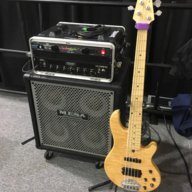
I've got one of the "Cowpoke" P-Basses and love it. I think personally the P-Bass balances MUCH better than the Jazz. The Jazz seems a little bottom heavy to me. Though the P-Bass can't touch my 6 string Tobias in sound and playablity...the 6-string is just too heavy to be playing ALL the time!!!

It is now.
SMASH said:Surprisingly, this isn't in the stickied Newbie Links. http://www.talkbass.com/forum/showthread.php?t=69903
Precision Bass, aka "P Bass" was the first Fender bass (but not the first electric bass guitar) and it's the bass design that eventually caught on, became popular, and arguably changed modern/pop music forever. Seriously - the root of most modern styles is possible via the electric bass, which at one time was called the "Fender bass" no matter what brand it was because Fenders were ubiquitous. It's called "precision" because it has frets so the notes can be made precisely, vs. the then-popular upright bass which is fretless and so the precision of the notes comes down to the player's intonation.
Note again : while the Fender was the bass that caught on with musicians and became the bass almost all others copy, it wasn't the first electric bass nor the first bass to have frets.
Precisions look like so - easiest way to discern them is the pickup, pickguard shape, and controls.
[Invalid or Expired Link Removed]
Jazz Bass, aka "J Bass", is the most popular and most copied bass and was developed years later with a smaller/thinner neck to make it easy for jazz guitarists to double on electric bass in the studio. The body is "offset", which means not as flat on the bottom, and neck is different as I said, but again the easiest way to tell is the pickups, pickguard, and controls.
[Invalid or Expired Link Removed]
Per the neck profiles, the J feels faster but it depends on what feels comfy to you. Sound-wise people say that Ps sound thicker/deeper but actually they're more in the mids, lacking the highs that the J bass has from its bridge pickup. To illustrate, the deepest tones you're likely to hear such as the bass tones in Reggae - the classic tunes are almost all done with a J bass. By contrast, the clanky middy tone of Iron Maiden's bassist Steve Harris is a P Bass.
However, the stock P sounds thicker due to the type of pickup - split coil wired in series vs. the J's dual single coils (each pickup is a single coil) wired in parallel. A popular and easy mod is to wire the J p'ups in series (for a thicker and more P-like sound - thicker sounds lower to the ear, but it isn't necessarily) and the latest Fenders come stock with the "S-1" button which toggles between series and parallel. Pickup placement has a lot to do with tone too, the P being between where the two J pickups are.
Js are said to be more versatile due to the two pickups and the tonal variations you can get when blending them but most people find one good setting - often everything on "10" - and use that. Both P and J basses can sound harsh, both can sound dubby deep, both can give a variety of tones depending how you play them (the best way to get versatile tones is via different fingerstyle techniques), what strings you use (major factor), where you set the tone knob, what pickups you install, how you wire them, what value capacitors you choose, the room you're playing in, etc. And of course there are preamps and amps and speaker cabs if you really want to shape your sound radically.
Point being that which style of bass is best for you comes down to which one comes in a colour you prefer and which neck feel you prefer.
All of this technical stuff is great, but tell him what he needs to know. A Precision Bass has a deep,full,solid sound with a strong fundamental and beautiful harmonics from every note. Kind of like the pedals on a Hammond organ. A Jazz Bass has a thin, twangy, weak sound like a heavy string banjo. A Precision Bass will give you that deep thump that will vibrate your guts. With a Jazz Bass you will be playing with your knobs all night trying to get rid of that banjo sound. 

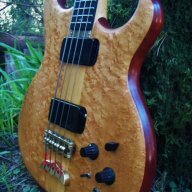
I wasn't gonna reply to this thread, but when I read what Joe Beets said. Jazz's don't sound thin and weak. Thats just giving the dude the wrong idea completely, they sound DIFFERENT. And a Jazz can thump your guts just as well as any other bass. Its all in the playing (And Volume and Active Pick-ups )
)
A Jazz Bass has a thin, twangy, weak sound like a heavy string banjo... With a Jazz Bass you will be playing with your knobs all night trying to get rid of that banjo sound...
NOT!

the P bass does have authority...but to say the jazz is weak and thin is just whacked [Invalid or Expired Link Removed]

I prefer a P-Bass myself, but...
Were it not for thinner neck, I'd get a Jazz for sure. They just sound a little different and Jazz necks are much slimmer. They both are awesome,
Jazzes sound like a banjo? Well, yeah if a banjo sounded like a P-Bass, only brighter.
Were it not for thinner neck, I'd get a Jazz for sure. They just sound a little different and Jazz necks are much slimmer. They both are awesome,
Jazzes sound like a banjo? Well, yeah if a banjo sounded like a P-Bass, only brighter.
Joe Beets said:This forum has gotten kind of boring lately. I miss the heated debates over which 12AX7 tube is best for my preamp. Or a mean thread about whether or not players who use a pick suck. A Jazz Bass is really OK if you like that sound.
But you've only been around 2 months.
Or have you been lurking prior?


