
Enjoy the benefits of a premium membership!
Upgrade Account
-
TalkBass has been independent since 1998. Add your voice.
Create a free account to reply to discussions, view embedded media, and browse with fewer display ads.
Join free Log in
Want zero display ads or expanded classifieds tools? Compare plans.
You are using an out of date browser. It may not display this or other websites correctly.
You should upgrade or use an alternative browser.
You should upgrade or use an alternative browser.
Whats the difference between Jazz and Precision?
- Thread starter BlackBassPlayer
- Start date
More options
Who Replied?Hey There are a few reasons that a J is differnt than a P
the first is that a jbass has has an offset contour in the body while the pbass contours are directly across from each other.
Second the Pbass has a split coil pick up where basically they took a single coil cut it in half rotated one side, so that the polarity is reversed, and off set it. This gives the bass a real warm bassy tone. The jazz bass has two single coil pickups each have a seperate volume knob so you can blend the tone better. This gives you, in my mind, a wider range of tone http://www.talkbass.com/forum/newreply.php?do=newreply&noquote=1&p=1837436# .
.
Third a Jazz bass has a slim neck.
the first is that a jbass has has an offset contour in the body while the pbass contours are directly across from each other.
Second the Pbass has a split coil pick up where basically they took a single coil cut it in half rotated one side, so that the polarity is reversed, and off set it. This gives the bass a real warm bassy tone. The jazz bass has two single coil pickups each have a seperate volume knob so you can blend the tone better. This gives you, in my mind, a wider range of tone http://www.talkbass.com/forum/newreply.php?do=newreply&noquote=1&p=1837436#
.Third a Jazz bass has a slim neck.

has anyone put a jazz neck on a p-body? (I think Adam Clayton - U2 did this)...
ps. I think P's look better.
ps. I think P's look better.
SMASH said:Surprisingly, this isn't in the stickied Newbie Links. http://www.talkbass.com/forum/showthread.php?t=69903
Precision Bass, aka "P Bass" was the first Fender bass (but not the first electric bass guitar) and it's the bass design that eventually caught on, became popular, and arguably changed modern/pop music forever. Seriously - the root of most modern styles is possible via the electric bass, which at one time was called the "Fender bass" no matter what brand it was because Fenders were ubiquitous. It's called "precision" because it has frets so the notes can be made precisely, vs. the then-popular upright bass which is fretless and so the precision of the notes comes down to the player's intonation.
Note again : while the Fender was the bass that caught on with musicians and became the bass almost all others copy, it wasn't the first electric bass nor the first bass to have frets.
Precisions look like so - easiest way to discern them is the pickup, pickguard shape, and controls.
[Invalid or Expired Link Removed]
Jazz Bass, aka "J Bass", is the most popular and most copied bass and was developed years later with a smaller/thinner neck to make it easy for jazz guitarists to double on electric bass in the studio. The body is "offset", which means not as flat on the bottom, and neck is different as I said, but again the easiest way to tell is the pickups, pickguard, and controls.
[Invalid or Expired Link Removed]
Per the neck profiles, the J feels faster but it depends on what feels comfy to you. Sound-wise people say that Ps sound thicker/deeper but actually they're more in the mids, lacking the highs that the J bass has from its bridge pickup. To illustrate, the deepest tones you're likely to hear such as the bass tones in Reggae - the classic tunes are almost all done with a J bass. By contrast, the clanky middy tone of Iron Maiden's bassist Steve Harris is a P Bass.
However, the stock P sounds thicker due to the type of pickup - split coil wired in series vs. the J's dual single coils (each pickup is a single coil) wired in parallel. A popular and easy mod is to wire the J p'ups in series (for a thicker and more P-like sound - thicker sounds lower to the ear, but it isn't necessarily) and the latest Fenders come stock with the "S-1" button which toggles between series and parallel. Pickup placement has a lot to do with tone too, the P being between where the two J pickups are.
Js are said to be more versatile due to the two pickups and the tonal variations you can get when blending them but most people find one good setting - often everything on "10" - and use that. Both P and J basses can sound harsh, both can sound dubby deep, both can give a variety of tones depending how you play them (the best way to get versatile tones is via different fingerstyle techniques), what strings you use (major factor), where you set the tone knob, what pickups you install, how you wire them, what value capacitors you choose, the room you're playing in, etc. And of course there are preamps and amps and speaker cabs if you really want to shape your sound radically.
Point being that which style of bass is best for you comes down to which one comes in a colour you prefer and which neck feel you prefer.
Did you get that out of one of the Total guitar bass specials. I'm comparing it and it looks word for word? Be honest.

BurningSkies
CRAZY BALDHEAD
- Feb 20, 2005
- 27,956
- 20,348
- Disclosures
- Endorsing artist: Dingwall Guitars
Smash, a question for you...I've always heard the term 'offset' applied to the waist of the Jazz bass, rather than the bottom/tail curve of the body. I always took it to mean because the body shape 'thins' after the horns, but are uneven the two concave portions are 'offset'. Fact or fiction?
IIRC "Offset" means that the bass is skewed. Skewed just like how the word skewed is italicized.

SMASH said:Pickup placement has a lot to do with tone too, the P being between where the two J pickups are.
"P" is not between where the two J pickups are.
The "P" pickup's position starts from exactly from the upper part of the jazz bass'es bridge pickup.


Munjibunga said:You can play jazz on the J-bass, but the P-bass is more precise.
LOL Sadowsky's are for Polka bands right?

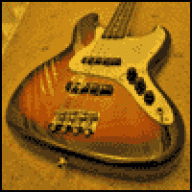
I've had my P-Bass for ooooh 13 or so years, and have twice in the past dabbled with Jazzes... first I got myself a Squier Jazz in about 1995... and it was erm... alright, then a couple of years ago I got my MIM Jazz V, and it was ok but too heavy to enjoy playing a full gig with... so the P-Bass stayed as my main bass
I dug out my Jazz V to help transcribe a Jaco tune a few weeks ago (got to get the right sound) and decided I was going to give a 4 string Jazz one more try.. so I went out and got myself a MIJ standard Jazz.. nothing fancy, it just seemed to me to be the best 'bang for the buck' option open to me
and the comment from Joe Beets earlier in this thread 'Jazzes are just twangy banjo sounding things' etc was generally always my view... but I played my new Jazz at a gig this afternoon and it was a fantastic experience that twangy, 'not as nice to listen to in isolation as a P-Bass' sound sat well in the mix a lot better than my P-Bass ever did... the lows were lower, and the highs were more cutting... in short, I had a wonderful time
so I guess my point is that although Jazzes can sound a bit weird on their own, it's how they sit in the mix with other instruments that really makes em special...
consider me a convert
I dug out my Jazz V to help transcribe a Jaco tune a few weeks ago (got to get the right sound) and decided I was going to give a 4 string Jazz one more try.. so I went out and got myself a MIJ standard Jazz.. nothing fancy, it just seemed to me to be the best 'bang for the buck' option open to me
and the comment from Joe Beets earlier in this thread 'Jazzes are just twangy banjo sounding things' etc was generally always my view... but I played my new Jazz at a gig this afternoon and it was a fantastic experience
that twangy, 'not as nice to listen to in isolation as a P-Bass' sound sat well in the mix a lot better than my P-Bass ever did... the lows were lower, and the highs were more cutting... in short, I had a wonderful time so I guess my point is that although Jazzes can sound a bit weird on their own, it's how they sit in the mix with other instruments that really makes em special...
consider me a convert
cowsgomoo said:although Jazzes can sound a bit weird on their own, it's how they sit in the mix with other instruments that really makes em special...
consider me a convert
You've converted to the religion of the jazz bass - cool bro!

I've got 3 jazzes (1 mim (very bassy, hot), one Mij (more twangy, a vintage reissue), and a mim 5-string (not half as bassy as my 4-string mim, but essentially the same sound) ) they all sound good for different gigs
Heres my basic view on how to use the pickups (feel free to correct me if I'm wrong):
If your doing rock and want a "thump" - use the neck pickup only and turn down the treble and turn up the bass a bit
if you want "clank" or "slap" then use both the pickups with the treble on full
if you want "jazz" or "funk" (barr mowtown/Jamerson stuff) just use the bridge pickup...


Both basses are standards and you have heard them on thousands of tracks.
Everyone has pretty much covered the difference in the feel of the neck. That is one main deciding factor in personal preference. P Bass feels like a Mustang, Jazz feels like a Corvette. Take your pick.
The pickup placement has also been explained, but what has not been mentioned is the abundanvce of P/J basses available and the reason for it. I'll try to explain this by describing the sound and feel of the pickups and why someone might choose P/J instead of just P or pure J.
One thing to consider is that, because it only has one pickup, a Precision can never really sound like Jazz, while a Jazz can do a pretty decent job of sounding like a P. Either the neck pup or a series rewire can give a workable P sound with a little EQing. No amount of EQ will get your P Bass to sound like a Jazz with both pup on full (THE standard slap sound IMO) or like a Jazz favoring the bridge pup (the growl made famous by Jaco...and Geddy...etc...) The second pickup is key.
The strenghts of a P: Cuts through a mix, thick sound, best bass for pick slingers bar none.
Weaknesses: One-trick-pony, it's a good trick, but not very versatile.
Strengths of a J: Fast neck, versatile tone, ridiculous amount of upgrade parts available.
Weaknesses: Can sound thin if you don't know what you're doing. (Listen to Zeppelin or Bob Marley or Audioslave and tell me all J basses sound thin!) You really need to get to know your bass and amp to get the sound you like, but if it's on a record somewhere your J can probably cop it.
Many high end basses have fancier, smoother sounding "soapbar" humbuckers (Alembic, Modulus Quantum, etc.). These are usually placed near the J positions. If you listen players that play these basses and are going for that tone a P bass will just not cut it. A Jazz with some EQ can get you reasonably close to most tones out there.
The third "standard" bass, also designed by Leo Fender is the Musicman Stingray which sports one big humbucker. This is a slightly different sound which many players prefer. Flea is the Stingray standard bearer and his Modulus is a fancy Stingray.
What you will find is that most manufacturers and luthiers choose a combination of these three Fender pickup ideas. Lakland, for example has recently popularized the MM humbucker with a J neck pup, which can nicely darken the and fill out the MM sound, and dozens have since copied that idea.
Players who want a more versatile P bass will often choose a P/J setup, where the Jazz bridge pickup is added to a stock P bass. Quite a few builders seem to prefer this setup, specifically Spector and Warwick (which are typically based on Spector's - not Fender's - template).
I have spent many years playing a G&L L-2000 which was Leo Fender's goodbye gift to bassists everywhere. It can sound like all three of his classic basses. Consider a G&L Tribute L-2000 if you are shopping for your first "serious" bass and you like a traditional look and feel.
If I had to choose between only having a P or a J, I'd take the Jazz Bass. I like the neck better and the tone versatility destroys the P. But a P through an SVT is still the essence of visceral bass. I wouldn't kick a good P Bass out of bed.
Everyone has pretty much covered the difference in the feel of the neck. That is one main deciding factor in personal preference. P Bass feels like a Mustang, Jazz feels like a Corvette. Take your pick.
The pickup placement has also been explained, but what has not been mentioned is the abundanvce of P/J basses available and the reason for it. I'll try to explain this by describing the sound and feel of the pickups and why someone might choose P/J instead of just P or pure J.
One thing to consider is that, because it only has one pickup, a Precision can never really sound like Jazz, while a Jazz can do a pretty decent job of sounding like a P. Either the neck pup or a series rewire can give a workable P sound with a little EQing. No amount of EQ will get your P Bass to sound like a Jazz with both pup on full (THE standard slap sound IMO) or like a Jazz favoring the bridge pup (the growl made famous by Jaco...and Geddy...etc...) The second pickup is key.
The strenghts of a P: Cuts through a mix, thick sound, best bass for pick slingers bar none.
Weaknesses: One-trick-pony, it's a good trick, but not very versatile.
Strengths of a J: Fast neck, versatile tone, ridiculous amount of upgrade parts available.
Weaknesses: Can sound thin if you don't know what you're doing. (Listen to Zeppelin or Bob Marley or Audioslave and tell me all J basses sound thin!) You really need to get to know your bass and amp to get the sound you like, but if it's on a record somewhere your J can probably cop it.
Many high end basses have fancier, smoother sounding "soapbar" humbuckers (Alembic, Modulus Quantum, etc.). These are usually placed near the J positions. If you listen players that play these basses and are going for that tone a P bass will just not cut it. A Jazz with some EQ can get you reasonably close to most tones out there.
The third "standard" bass, also designed by Leo Fender is the Musicman Stingray which sports one big humbucker. This is a slightly different sound which many players prefer. Flea is the Stingray standard bearer and his Modulus is a fancy Stingray.
What you will find is that most manufacturers and luthiers choose a combination of these three Fender pickup ideas. Lakland, for example has recently popularized the MM humbucker with a J neck pup, which can nicely darken the and fill out the MM sound, and dozens have since copied that idea.
Players who want a more versatile P bass will often choose a P/J setup, where the Jazz bridge pickup is added to a stock P bass. Quite a few builders seem to prefer this setup, specifically Spector and Warwick (which are typically based on Spector's - not Fender's - template).
I have spent many years playing a G&L L-2000 which was Leo Fender's goodbye gift to bassists everywhere. It can sound like all three of his classic basses. Consider a G&L Tribute L-2000 if you are shopping for your first "serious" bass and you like a traditional look and feel.
If I had to choose between only having a P or a J, I'd take the Jazz Bass. I like the neck better and the tone versatility destroys the P. But a P through an SVT is still the essence of visceral bass. I wouldn't kick a good P Bass out of bed.

remo said:has anyone put a jazz neck on a p-body? (I think Adam Clayton - U2 did this)...
ps. I think P's look better.
I have a jazz neck on my hot rod P.
Link Removed
best of both worlds, wish fender made em lefty and not just squire. it's really flexible. i got two and defretted one. solo the j pickup on the fretless and it sounds just like jaco. solo the p pickup and it sound just like a standars p. combine the two and it sounds like a p with a little more of a hard edge and more highs.
best of both worlds, wish fender made em lefty and not just squire. it's really flexible. i got two and defretted one. solo the j pickup on the fretless and it sounds just like jaco. solo the p pickup and it sound just like a standars p. combine the two and it sounds like a p with a little more of a hard edge and more highs.

FYI - Since 2004, the American Deluxe Precision and American Deluxe Jazz models have the same necks.
Ted
That's actually not entirely true. While they have what is both commonly known in Fender terms as the "Modern C", their width at the nut is different. The ADP is 1.625 at the nut and the ADJ is 1.5. When you play one right after the other you notice a fairly significant difference.


