I bought a Peavey T-40 on eBay two days ago and was wondering what other owners of T-40s thought/liked/disliked about the bass... I bought it because of the all the reviews I read said about it (they said it was built like a rock), and because of the large tonal options from a passive bass. I couldn't find any reviews of the slap quality on this bass, but I figured since it has the ability to switch over to single coils it at least has to be decent.

Enjoy the benefits of a premium membership!
Upgrade Account
-
TalkBass has been independent since 1998. Add your voice.
Create a free account to reply to discussions, view embedded media, and browse with fewer display ads.
Join free Log in
Want zero display ads or expanded classifieds tools? Compare plans.
You are using an out of date browser. It may not display this or other websites correctly.
You should upgrade or use an alternative browser.
You should upgrade or use an alternative browser.
Peavey T-40, Interesting Facts?
- Thread starter pete&petelives
- Start date
More options
Who Replied?
Minger said:I'm thinking the weight for most people is what ruins it for them.
+1 My best friend had one in the '80s, and even though we were young back then, it still broke our backs.
Built like a tank, but unfortunately, weighs like one too.

thats how my Peavey 6 string was, (looked a lot like the t-40 too, but was a guitar) either way though, sounded decent, but way too heavey for my taste
The guitar player in the band has a T-40 I play sometimes. Has a unique circuit that allows for many tone variations, and allows the same tone no matter what the volume setting is on the bass. Solid construction in spades, but, yeah, heavy. Took me a while to figure out the tone controls and get a sound I liked.
Ok, found the owner's manual from a friend's T-40 he had years ago:
"Two full humbucking pickups with single-coil capabilities made possible by Peavey's unique control circuitry. Chrome covers with glossy black mounting rings; fully shielded wiring. Peavey pickups are potted with epoxy to reduce unwanted feedback.
"Unique circuitry with automatic fade into single-coil mode with the tone control knobs; no tricky controlling necessary. (Extremely wide control range) volume controls tone compensated to retain harmonics at lowered volumes. Individual volume and tone controls for each pickup, three-position pickup selector switch, and two-position phasing switch.
"Ash body. Trussrod adjustment: hold down the first and last frets. clearance between the string at the eighth fret should be no less than 1/64" and no more than 1/32" " Well, there's a page missing from the little booklet. But there's an adjusting screw to tilt the neck, the two screws holding the neck to the body closest to the body must be loosened first. I haven't found any negatives to the bass except it's heavy, if you get the tone you like, it's great.
Ok, found the owner's manual from a friend's T-40 he had years ago:
"Two full humbucking pickups with single-coil capabilities made possible by Peavey's unique control circuitry. Chrome covers with glossy black mounting rings; fully shielded wiring. Peavey pickups are potted with epoxy to reduce unwanted feedback.
"Unique circuitry with automatic fade into single-coil mode with the tone control knobs; no tricky controlling necessary. (Extremely wide control range) volume controls tone compensated to retain harmonics at lowered volumes. Individual volume and tone controls for each pickup, three-position pickup selector switch, and two-position phasing switch.
"Ash body. Trussrod adjustment: hold down the first and last frets. clearance between the string at the eighth fret should be no less than 1/64" and no more than 1/32" " Well, there's a page missing from the little booklet. But there's an adjusting screw to tilt the neck, the two screws holding the neck to the body closest to the body must be loosened first. I haven't found any negatives to the bass except it's heavy, if you get the tone you like, it's great.

A wide variety of tones from a passive bass.Like everyone said, the weight is killer! If you are getting one of the originals made in teh first few years, it's even heavier. The T-40 is kind of a "rite of passage" for many players over a certain age

Hi
Was my first bass 24 years ago. One of the best days of my life was the day I sold it and got a jazz bass
Rob
Was my first bass 24 years ago. One of the best days of my life was the day I sold it and got a jazz bass
Rob
I owned one for over 20 years...bought it new, gave it away just a couple of years ago. The tones weren't as bad as the playability, for me. I found the weight awful, as many have said. But, I also found mine had a neck-stability issue. The action was never right...never. I'd had the bass professionally set up one time, and the neck stayed straight for about 3 days...the longest it had ever stayed straight. Overall, the bass felt clunky, and since I like to play pizzacatto runs on occasion, I found myself fighting against the neck more than I wanted to.
Another thing...about the tone controls...it sounded as if there were only 3 settings, even though the knobs were variable from 0 - 10. It was as if any given knob had "off", "middle", and "all-the-way". Yeah, yeah, yeah...passive. But, the controls just didn't have the variability I'd expect. By contrast, a MIM Jazz I owned for a couple of years had greater variability in each individual control.
Another thing...about the tone controls...it sounded as if there were only 3 settings, even though the knobs were variable from 0 - 10. It was as if any given knob had "off", "middle", and "all-the-way". Yeah, yeah, yeah...passive. But, the controls just didn't have the variability I'd expect. By contrast, a MIM Jazz I owned for a couple of years had greater variability in each individual control.

I have one. Got it from my soundguy awhile ago. It is in dead mint condition, sunburst finish. I wasn't about to say that I didn't want it--it was free.
I really don't play it. I take it along to gigs sometimes, and break it out for a song or two just for the heck of it. But then I switch back to one of my 6ers and stay with them the rest of the night.
I really don't play it. I take it along to gigs sometimes, and break it out for a song or two just for the heck of it. But then I switch back to one of my 6ers and stay with them the rest of the night.
the T-40 is a great starter bass. it was my first "real" bass.
bought mine new, in 1979. it was limited but, reliable. i played it for 5 or 6 years. sold it, after i got my first Jazz bass. i think you will like it.
bought mine new, in 1979. it was limited but, reliable. i played it for 5 or 6 years. sold it, after i got my first Jazz bass. i think you will like it.

Here's an interesting fact for you. Hartley Peavy revolutionized the guitar industry by usinc CNC machines to fabricate bodies and necks from wood. Today, most guitars are built this way, but in the late 70s they were all still made by hand. The first CNC mass produced instruments? The Peavey T-40 bass and T-60 guitar.
i love my T-40 to death....i wont replace it until i can find something with the same tone (and less weight!!!)


Very heavy, but great tone. I have a '79 that I baught a couple years ago in NOS condition (still had the pickguard film with the control instructions on it.)
In response to the issues raised here...
Most early peaveys, including the t-40 have very stable necks because they are bilaminate with opposing grain. Look on the back of your t-40 and you can see that it is two pice, and the grain goes in opposite directions. It's not as attractive looking as a nice birdseye one piece, but it makes for good solid necks. Mine is super stable and it keeps a very low action very well.
It might not be great for slap because of the position of the neck pickup, though the spacing is nice and wide.
The T-40 is not an ideal jazz/fusion bass, a long cover set would be difficult due to the wieght, and older folks may do themselves back damage. For a rock and roll bassist, however, it may well be one of the best deals out their for those in search of a quality, vintage, american made, good sounding instrument, with a wide tonal range.
I can't think of a higher quality made in america instrument that can be had consistently for under 300 dollars. (with the exception of some other early peavey's)
My t-40 was my main stage bass (over my mim pbass) but now it is my standard practice space bass, and even though I play my 55-01 most of the time, sometimes it gets out on a gig because it sounds so good. It also sounds so good recorded, that I had an offer to purchase it by the sound engineer. I have no plans to ever part with it.
Conclusion: t-40's are great instruments, but without fail, they are ALWAYS HEAVY, and since they haven't been made in over 20 years, there is always the chance that something else has gone wrong, or been damaged.
You can download the original manual at the Peavey website.
In response to the issues raised here...
Most early peaveys, including the t-40 have very stable necks because they are bilaminate with opposing grain. Look on the back of your t-40 and you can see that it is two pice, and the grain goes in opposite directions. It's not as attractive looking as a nice birdseye one piece, but it makes for good solid necks. Mine is super stable and it keeps a very low action very well.
It might not be great for slap because of the position of the neck pickup, though the spacing is nice and wide.
The T-40 is not an ideal jazz/fusion bass, a long cover set would be difficult due to the wieght, and older folks may do themselves back damage. For a rock and roll bassist, however, it may well be one of the best deals out their for those in search of a quality, vintage, american made, good sounding instrument, with a wide tonal range.
I can't think of a higher quality made in america instrument that can be had consistently for under 300 dollars. (with the exception of some other early peavey's)
My t-40 was my main stage bass (over my mim pbass) but now it is my standard practice space bass, and even though I play my 55-01 most of the time, sometimes it gets out on a gig because it sounds so good. It also sounds so good recorded, that I had an offer to purchase it by the sound engineer. I have no plans to ever part with it.
Conclusion: t-40's are great instruments, but without fail, they are ALWAYS HEAVY, and since they haven't been made in over 20 years, there is always the chance that something else has gone wrong, or been damaged.
You can download the original manual at the Peavey website.
The only annoying part about the old peaveys was the fact that you cant adjust the truss rod with a allen wrench. You have to order the proper tool from Peavey. Its only like $5 but its a cheap piece of crap, I had a Fury bass with a pretty tight truss rod and I stripped the tool trying to adjust it.
Thats my only rant about basses like the T-40. But its worth the hassle for the killer tone and value.
Thats my only rant about basses like the T-40. But its worth the hassle for the killer tone and value.
Thanks for all the awesome feedback, the bass still hasn't arrived, but judging from what you guys have said here I think I'll like it, but it seems to be split 50/50. I consider myself an intermediate player (I can play most of Claypool's or Marcus Miller's lines but I'm no Michael Manring), but I'm always low on cash and I didn't have much money to spend to replace my old fretted bass, so the $225 was a very tantalizing price, and hopefully the tone will fit my funk/primus rockish type band, and for the $250 I had, I figured this'd be the best option, even if I might need to uprgrade again soon.

heavey and i didnt like playing it finger style cus it would give my figure tips blister on my right hand so i would always have to use a pick with it.
but other then that it was a real nice bass for what it was.
but other then that it was a real nice bass for what it was.

I owed one when I was a teenager, it was the first bass that I bought with money that I earned myself.
I later traded it for an Electra Westone that was much lighter.
I started missing it a few years ago, and last year, I found one in a Music Go Round for $169, so I snapped it up.
Looks pretty good for a bass that is almost 30 years old!
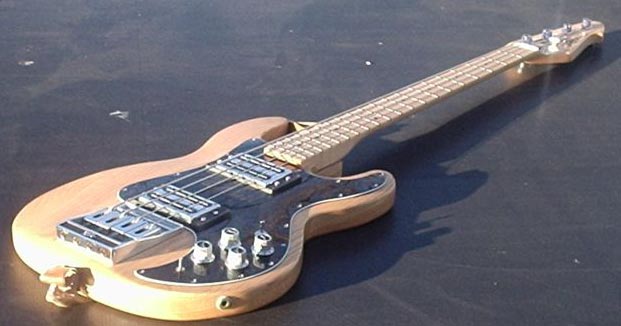
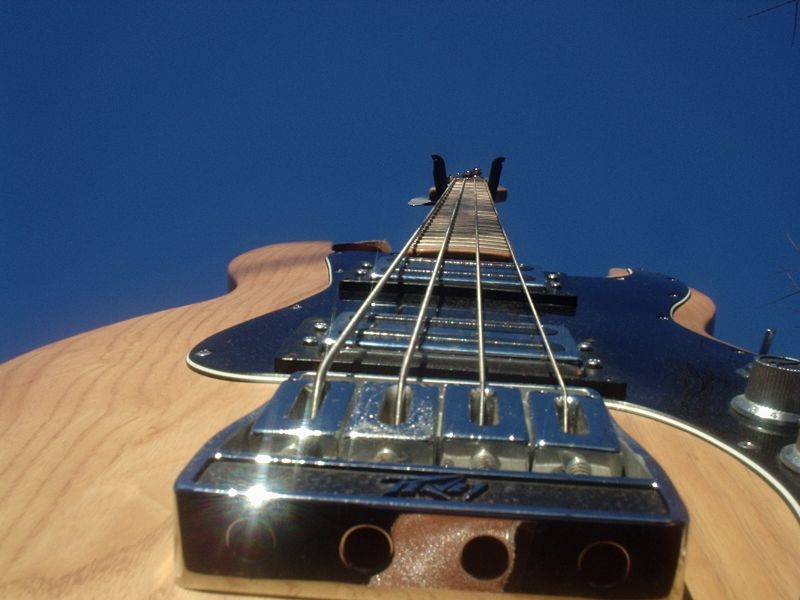
I later traded it for an Electra Westone that was much lighter.
I started missing it a few years ago, and last year, I found one in a Music Go Round for $169, so I snapped it up.
Looks pretty good for a bass that is almost 30 years old!
So, is this a museum piece? It might look good, but how does it play, and how does it sound? I would be very interested, with your experience and comparison basses, how does this stack up after all those years?embellisher said:I started missing it a few years ago, and last year, I found one in a Music Go Round for $169, so I snapped it up.
Looks pretty good for a bass that is almost 30 years old!
7flat5 said:So, is this a museum piece? It might look good, but how does it play, and how does it sound? I would be very interested, with your experience and comparison basses, how does this stack up after all those years?
I wouldn't call it a museum piece. The bass is a good, solid, workhorse, capable of a huge range of tones. It can sound similar to a P or a J, can get close to a Stingray vibe, does a fair Rickenbacker imitation, and a lot more.
I play mine occasionally at church, or at one of my oldies gigs. There are two reasons that I don't play it more.
First, it is not as playable as my Nordstrand, Zon, Cirrus, Lakland, or Fender basses.
Second, it only has four strings.
If it had a more modern neck profile, weighed a couple of pounds less, and was a 5 string with wide spacing, it would get played out a ton.


