
I know, there are too many P Bass threads around here lately  , some of you will be thinking
  . Well, my apologies to those of you who are thinking that, but you need read no further. Goodbye
  !
!
So, to the rest of you (wise people ), I just wanted to use a bit of bandwidth to tell the story and share some pictures of the latest bass in my collection .
It's a Fender Custom Shop NOS (New Old Stock) replica of a 1961 Precision Bass, in a rather splendid (and unusual) coat of LPB (Lake Placid Blue) paint . I've never seen another Custom Shop Precision Bass in this colour, but I'd be very interested to hear from anyone who has.

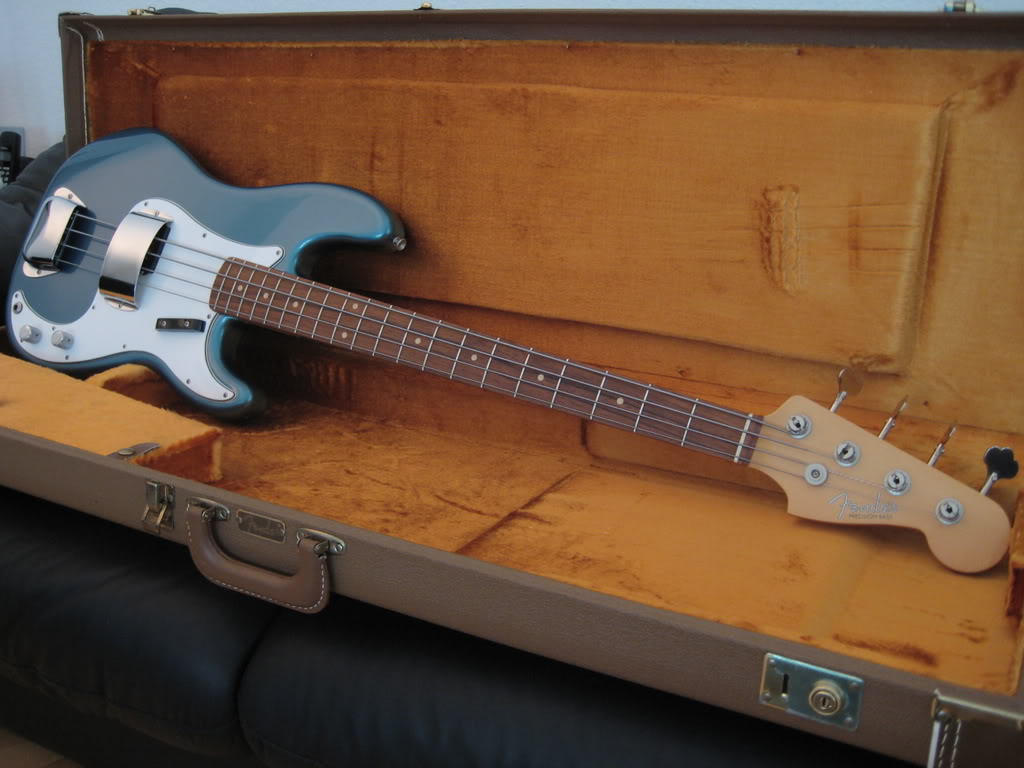
I bought it secondhand, from a Japanese guitar dealer and am very curious to find out more about the basses history. Although it is clear from the certificate that it was "team-built", I must assume that it was a custom order, as I've never heard of a production run of "Time Machines" in this colour. Also, it is listed as a "1961 Precision Bass NOS" on the certificate and (AFAIK) Fender only ever made a production run of 1959 P Basses with the rosewood 'board !?
!?
Finding this bass represents the end (hopefully) of a long journey to find the "perfect" P Bass for me. Until last year, I was quite happily playing an Olympic White US '62 Vintage Reissue bass ....
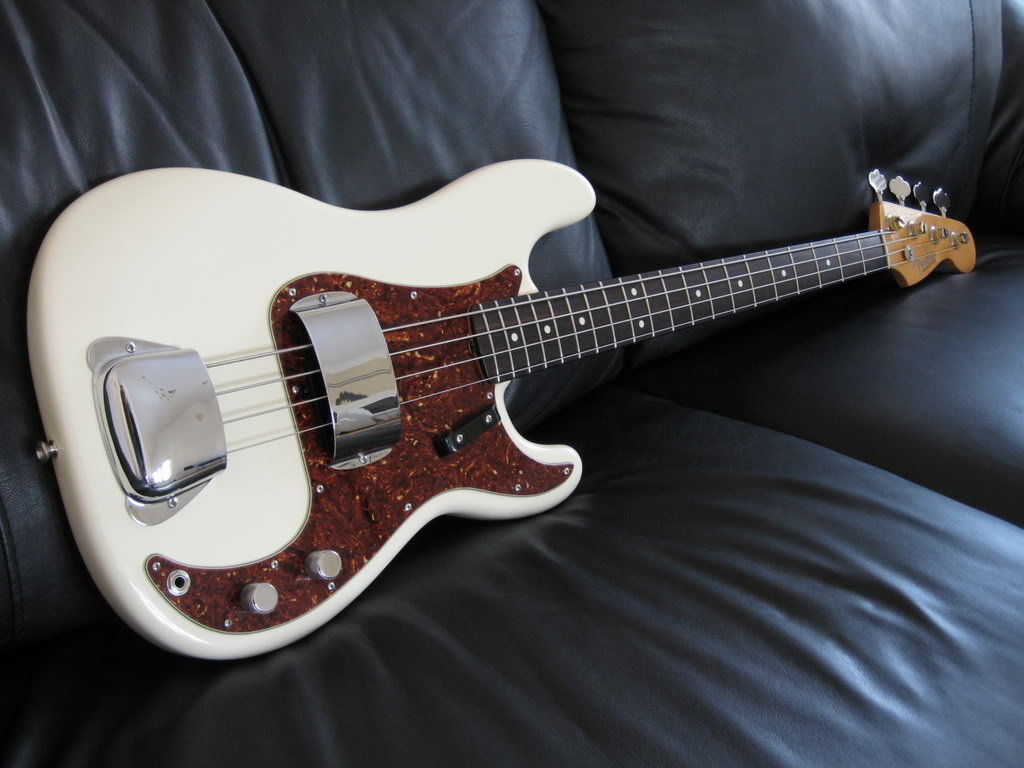
... which, beautiful though it was, didn't feel completely "right" in my hands for a number of (trivial) reasons. I took the risk of simply selling it (for a huge financial loss ) and going in search of something better.
For a while, I was content to do without a rosewood 'board P Bass in my collection, as I already had a maple neck '75 P, but the '75 was heavy and didn't really have the "warmer", '60s tones that I sometimes liked to hear.
I started to look into the possibility of buying a real, '60s vintage Fender, but soon realised that the only basses within my (limited) price range were all modified "dogs" and decided that the Custom Shop offered the best hope of me getting an authentic sounding/looking P Bass, which I could be truly happy with . However, used Fender Custom Shop basses are rarer than some of you might think, over here in Europe  . I looked around for months without seeing a single one and then, got completely carried away when I saw this one ...
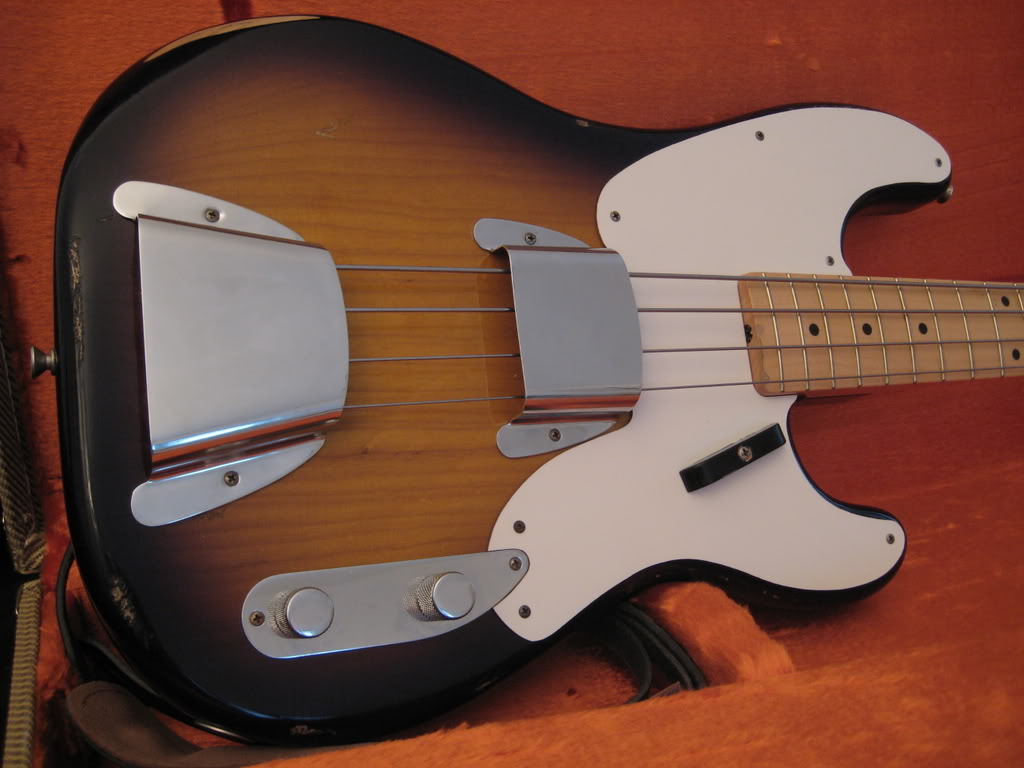
... and bought it ! That marked the beginning of my love affair with Custom Shop basses.
I strung this '55 Relic with hefty La Bella flatwounds and was back in bass heaven . But, I really wanted a second P Bass, which I could string with roundwounds and use for pick and finger-style, rock/pop-type stuff. My '75 was strung with rounds, but sounded too bright and harsh for what I had in mind .
(Fast forward a few months). After spending many fruitless hours on the Internet, looking for a used Pino Palladino signature bass, or a used Time Machine '59 P (in alder, not ash) and not finding a single one , I had pretty much come to the conclusion that I was going to have to buy a new Custom Shop bass and was putting aside as much cash as I could (contenting myself in the meantime with just looking at pictures of real, vintage P's on the Internet ).
During this time, I fantasised about how my dream P bass would look and realised that it would have to be a "custom colour", as I wasn't a big fan of 3 tone sunburst (sorry), which seemed to be the most common colour. From all of the (many) pictures that I found in books and on the Net, two colours emerged, which really appealed to me - LPB and Firemist Gold.
So, imagine my delight when I found that a local dealer had this in stock ...
...
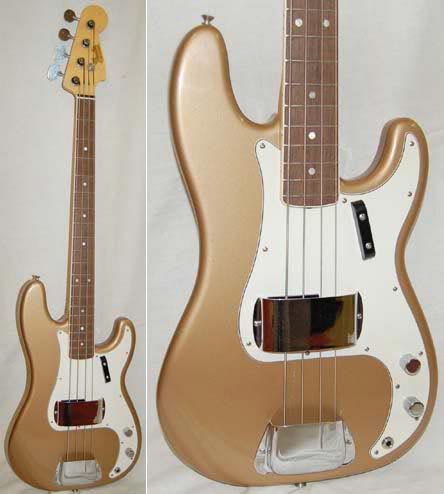
Now, imagine my horror when I discovered that it was a new, Master-Built instrument and cost €4,599 ($7,275)! End of dream  .
.
By this point, I was stumped and was starting to regret selling my US Vintage reissue - it wasn't that far off from what I really wanted in the first place. Then, out of the blue (pardon the pun ), I found these picture on a Google search under "Custom Shop Bass LPB":
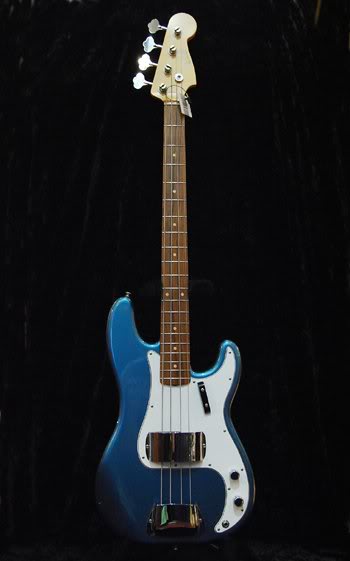
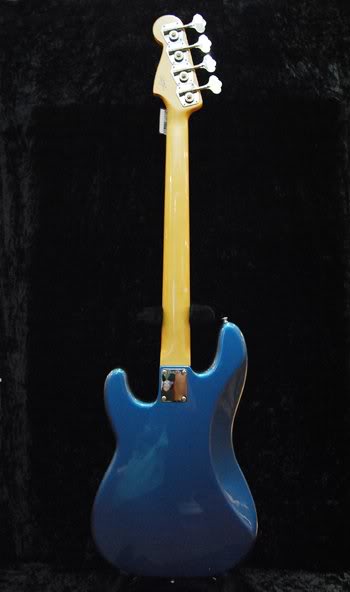
When I followed the link, I discovered that they were from a current stocklist at Ishibashi Music, Japan. I knew, within 3 seconds, that I was going to own this bass (somehow)!
As you can see, Ishibashi were as efficient as ever and within 7 days of first seeing it, it was sitting on my sofa for its' first TB photo session.
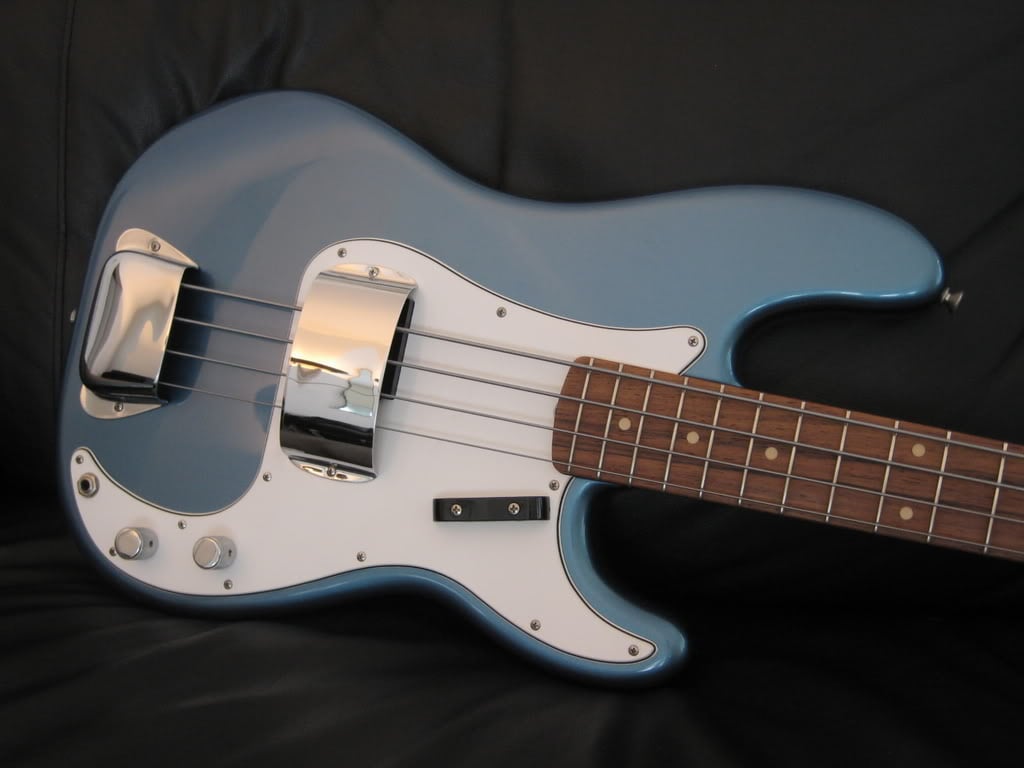
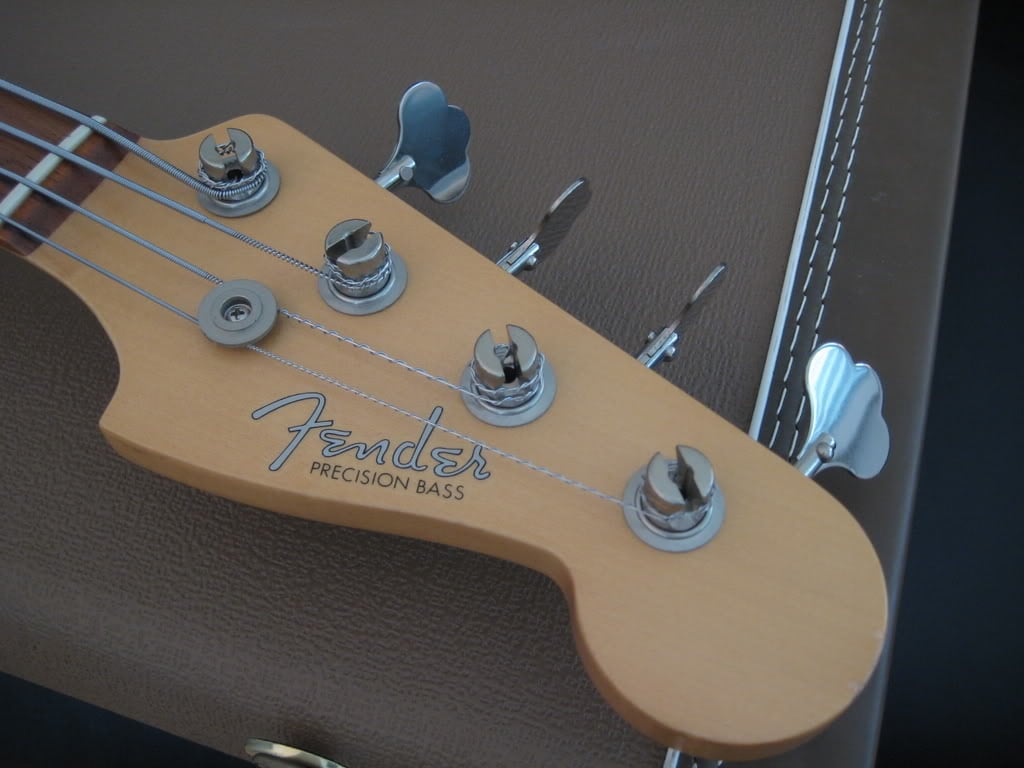
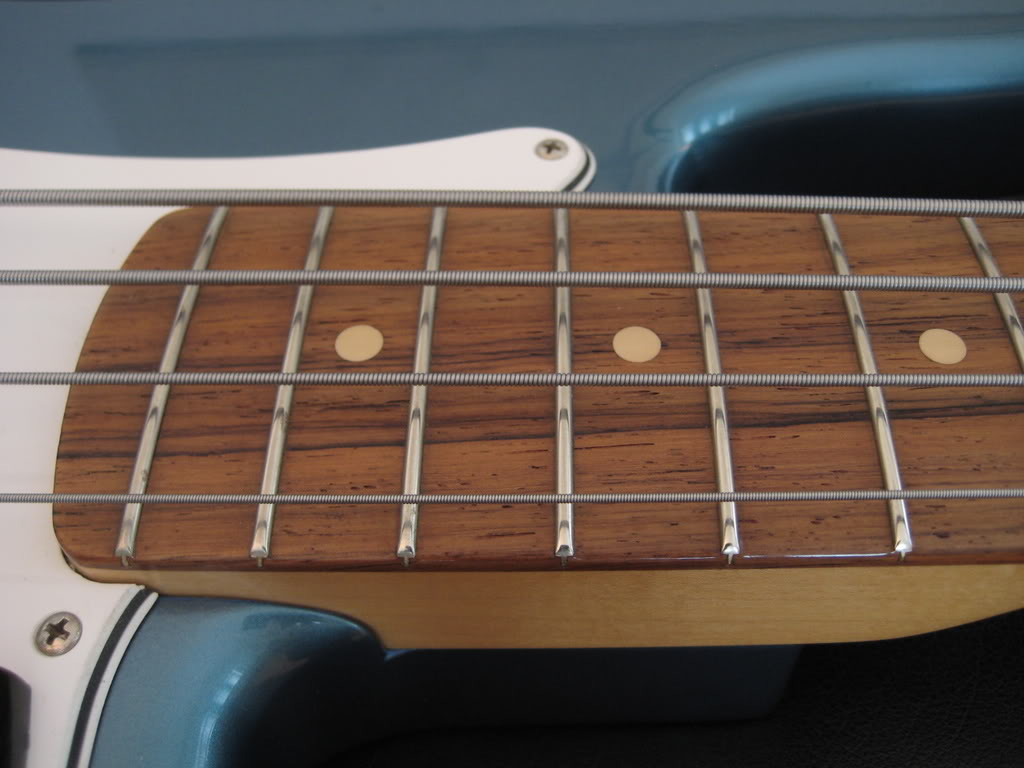
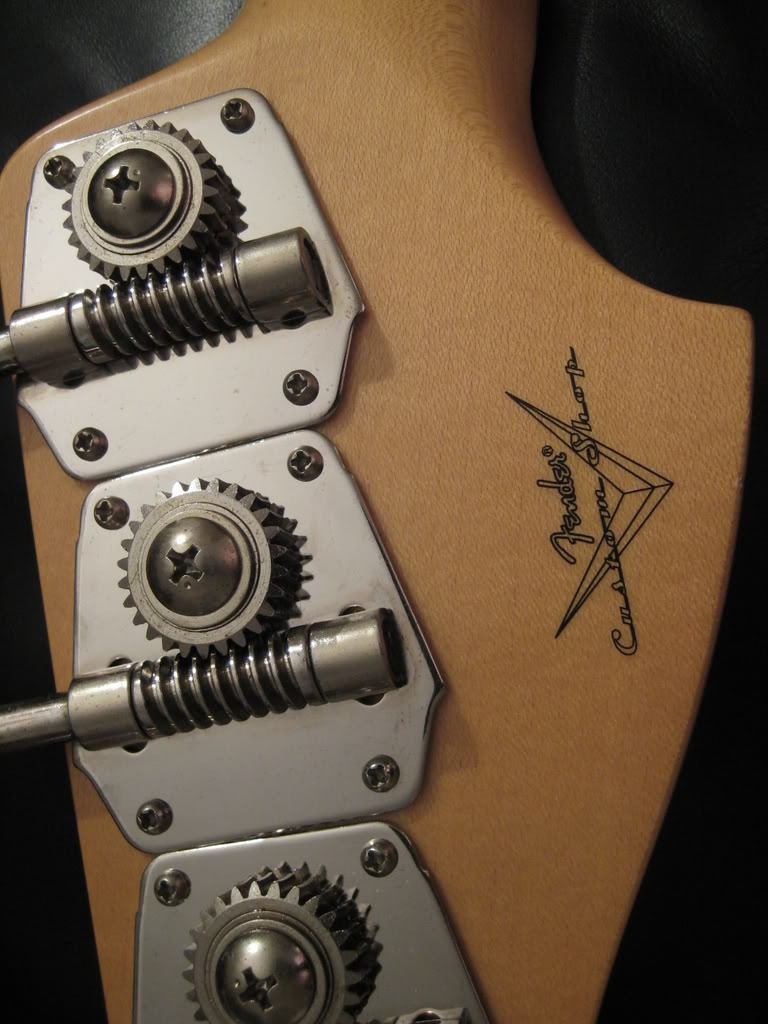
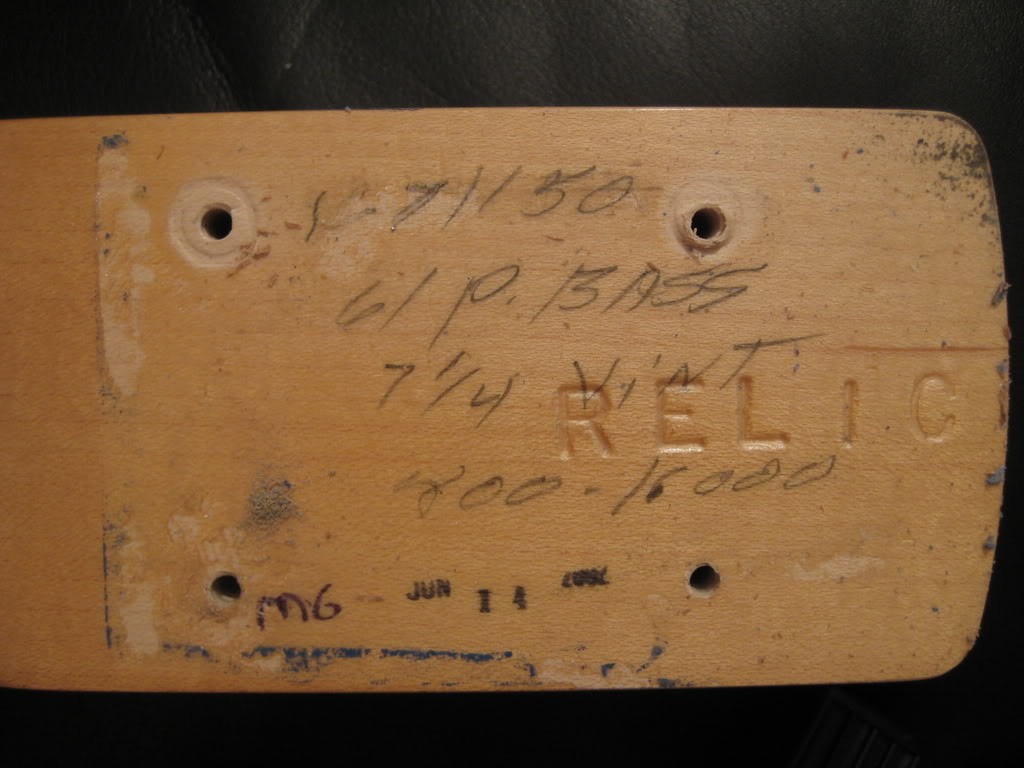
Despite being a NOS model, it's clearly been well used (abused) and the previous owner didn't seem to believe in placing it gently on its' stand, judging by the two bald patches on the bottom end of the instrument ...
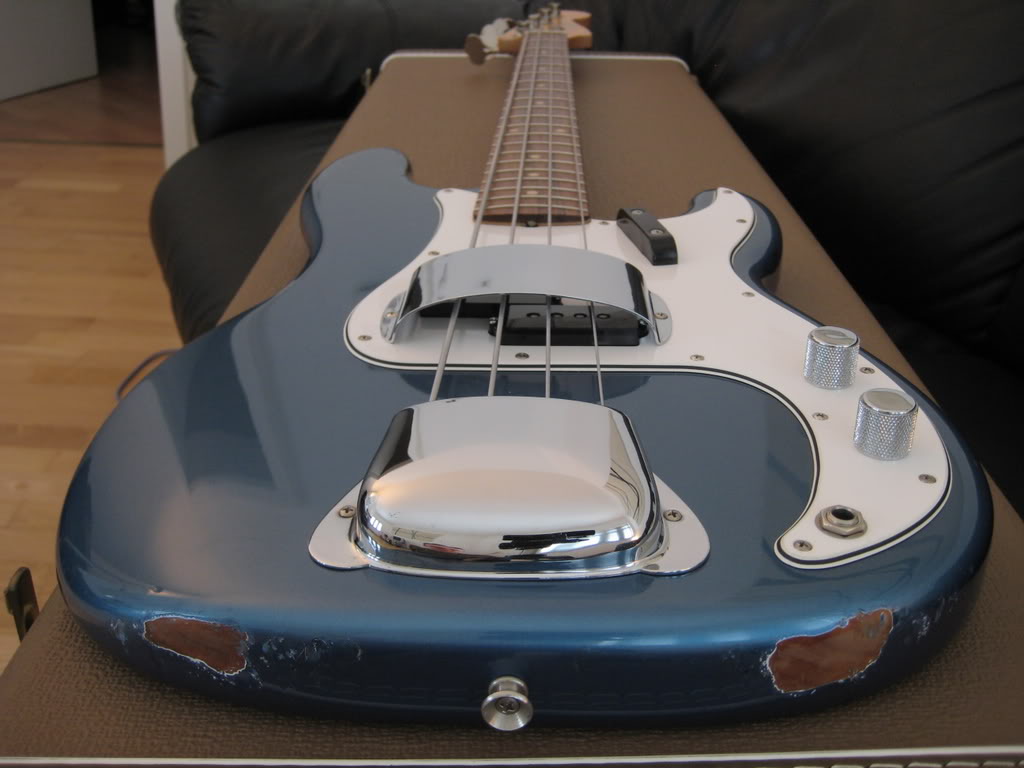
Strangely enough, having owned a lot of vintage basses prior to this, as well a Custom Shop "Relic", I really wasn't in the least bit bothered by these marks - especially as I knew that they would have contributed to the selling price being lowered.
As I've only had it for 24 hours, I'm going to resist the temptation to write pages and pages of "glowing review" on this bass, as I might look foolish in a years' time, if I come to sell it again. But, for what it's worth, here are a few quick "initial impressions":
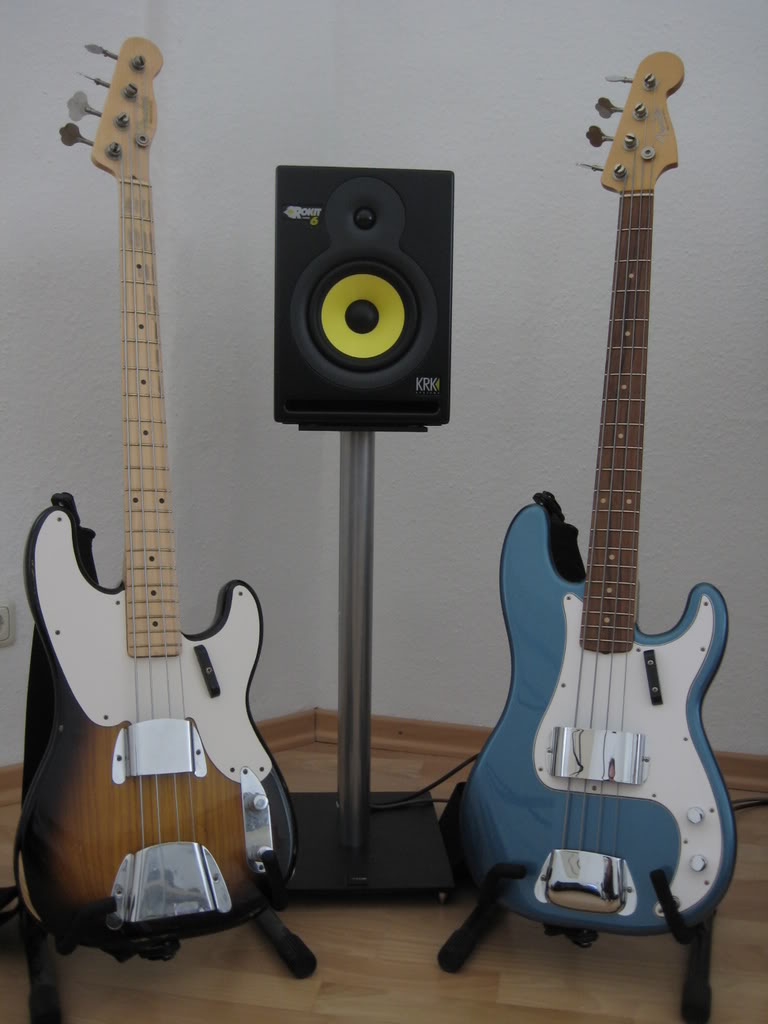
Anyway, that turned out to be a much longer post than I intended it to be. Congratulations to anyone who managed to read it all without getting bored .
If anyone has any information about the origins of this bass (i.e. is it a one-off custom order or part of series ), has a Custom Shop bass of their own that they'd like to talk about, or simply wants to air their views on P Basses in general, I'd love to hear from you .
Peace,
Andy
, some of you will be thinking . Well, my apologies to those of you who are thinking that, but you need read no further. Goodbye !So, to the rest of you (wise people
), I just wanted to use a bit of bandwidth to tell the story and share some pictures of the latest bass in my collection .It's a Fender Custom Shop NOS (New Old Stock) replica of a 1961 Precision Bass, in a rather splendid (and unusual) coat of LPB (Lake Placid Blue) paint
. I've never seen another Custom Shop Precision Bass in this colour, but I'd be very interested to hear from anyone who has.I bought it secondhand, from a Japanese guitar dealer and am very curious to find out more about the basses history. Although it is clear from the certificate that it was "team-built", I must assume that it was a custom order, as I've never heard of a production run of "Time Machines" in this colour. Also, it is listed as a "1961 Precision Bass NOS" on the certificate and (AFAIK) Fender only ever made a production run of 1959 P Basses with the rosewood 'board
!?Finding this bass represents the end (hopefully
) of a long journey to find the "perfect" P Bass for me. Until last year, I was quite happily playing an Olympic White US '62 Vintage Reissue bass ....... which, beautiful though it was, didn't feel completely "right" in my hands for a number of (trivial) reasons. I took the risk of simply selling it (for a huge financial loss
) and going in search of something better.For a while, I was content to do without a rosewood 'board P Bass in my collection, as I already had a maple neck '75 P, but the '75 was heavy and didn't really have the "warmer", '60s tones that I sometimes liked to hear.
I started to look into the possibility of buying a real, '60s vintage Fender, but soon realised that the only basses within my (limited
) price range were all modified "dogs" and decided that the Custom Shop offered the best hope of me getting an authentic sounding/looking P Bass, which I could be truly happy with . However, used Fender Custom Shop basses are rarer than some of you might think, over here in Europe . I looked around for months without seeing a single one and then, got completely carried away when I saw this one ...... and bought it
! That marked the beginning of my love affair with Custom Shop basses.I strung this '55 Relic with hefty La Bella flatwounds and was back in bass heaven
. But, I really wanted a second P Bass, which I could string with roundwounds and use for pick and finger-style, rock/pop-type stuff. My '75 was strung with rounds, but sounded too bright and harsh for what I had in mind .(Fast forward a few months
). After spending many fruitless hours on the Internet, looking for a used Pino Palladino signature bass, or a used Time Machine '59 P (in alder, not ash) and not finding a single one , I had pretty much come to the conclusion that I was going to have to buy a new Custom Shop bass and was putting aside as much cash as I could (contenting myself in the meantime with just looking at pictures of real, vintage P's on the Internet ).During this time, I fantasised about how my dream P bass would look and realised that it would have to be a "custom colour", as I wasn't a big fan of 3 tone sunburst (sorry
), which seemed to be the most common colour. From all of the (many) pictures that I found in books and on the Net, two colours emerged, which really appealed to me - LPB and Firemist Gold.So, imagine my delight when I found that a local dealer had this in stock
...Now, imagine my horror when I discovered that it was a new, Master-Built instrument and cost €4,599 ($7,275)
! End of dream .By this point, I was stumped and was starting to regret selling my US Vintage reissue - it wasn't that far off from what I really wanted in the first place
. Then, out of the blue (pardon the pun ), I found these picture on a Google search under "Custom Shop Bass LPB":When I followed the link, I discovered that they were from a current stocklist at Ishibashi Music, Japan. I knew, within 3 seconds, that I was going to own this bass (somehow)
!As you can see, Ishibashi were as efficient as ever and within 7 days of first seeing it, it was sitting on my sofa for its' first TB photo session
.Despite being a NOS model, it's clearly been well used (abused
) and the previous owner didn't seem to believe in placing it gently on its' stand, judging by the two bald patches on the bottom end of the instrument ...Strangely enough, having owned a lot of vintage basses prior to this, as well a Custom Shop "Relic", I really wasn't in the least bit bothered by these marks - especially as I knew that they would have contributed to the selling price being lowered
.As I've only had it for 24 hours, I'm going to resist the temptation to write pages and pages of "glowing review" on this bass, as I might look foolish in a years' time, if I come to sell it again
. But, for what it's worth, here are a few quick "initial impressions":- Build quality. The neck is very similar to the US '62 Vintage reissue in dimensions, but the finish is quite different. Whereas the US Vintage (shortened to "USV", from here onwards ) has a fairly thick, very "orange", gloss coat of nitro cellulose lacquer, this CS bass has a thinner, less orangey, almost matt-finish nitro coating. This instantly makes it look and feel more "authentic", IMHO. What's more, I haven't had the same problem with my hands sticking to the lacquer, that I had with the USV P (well, not to the same extent, anyway).
The fretboard is different too. Although I prefer darker rosewood (my old USV had an almost ebony-like slab 'board), the grain on this one really stands out and looks a lot like some of the real '60s Fenders in my books (I guess it's either Indian or Brazilian timber ). The frets feel ever so slightly higher too and are perfectly finished off. However, when running my hand along the bottom edge of the neck, I can feel a slight sharpness on the fret ends - I assume that there has been a tiny amount of shrinkage in the rosewood since the bass was made, nearly 6 years ago .
As for the body and the rest of the hardware, it's not really any different to a standard USV . They even use the same Gotoh tuners (with the wrong gearing and the incorrect flush fit) and their own "vintage" pickup (with the ridiculous "bevelled" magnets, which look as though they've been ground off by a pencil sharpener ). I haven't looked under the pickguard yet, so I can't really comment on the rest.
Surprisingly, there's actually a bit of "play" in the neck pocket and in order to line up the strings properly with edge of the fretboard, it's necessary to have a small gap on the upper half of the body, which in turn creates a small overhang on the underside. It really does appear that the bridge was mounted a tiny bit too far to the left . I could say that this is "unacceptable" on a bass of this price, but as I probably paid less than half of what the original owner paid, I'll think pass on that one .
- Playability and tone. OK, the important bit ! "How is it to play"? After a little tweaking, I got the action down to where I wanted it and gave it a spin. Honestly, I have to say that I've never played a Precision Bass with as much clarity and warmth (those two things don't necessarily contradict each other) right the way across the fretboard . My USV was good, no doubt about it - but this is better . It's quite hard to explain in words, but when you play the bass acoustically, you can really feel the vibrations travelling right through the whole instrument and they seem to be "in harmony" with themselves. On my '75 P Bass, by way of contrast, there seems to be a certain amount of "conflict" between the fast attack of the note and the way that it tries to resonate through the hard, thick lacquer and into the dense ash body wood, creating almost "wolf notes" in the process. OK , I sense that I'm getting a bit to ethereal for my own good here , so perhaps I'd better move on .
For me, the perfect P Bass tone, using roundwound strings, comes from a fairly heavy gauge of nickel-plated strings (I generally prefer Fenders' own brand, would you believe ?). As it is, I don't have any to hand, so I'm still using the stainless steel, medium gauge strings, which came with the bass. As these tend to sound more "detailed" than the softer, warmer nickel strings, I have high hopes for achieving my "perfect P tone", once I change the strings (IME, if a bass sounds good with steel strings, it'll sound good with anything else ).
There's a surprising amount of sustain in this bass as well. I really can't see why it should so different to other P Basses that I've had (unless it's to do with the s/s strings, perhaps ), but when you play a fat, low F (for instance), the note just rings on and on without "shaking itself out" (we're back to the ethereal, pseudo-scientific nonsense again, sorry ).
Finally, for all of you who have never played a Fender Custom Shop bass (as I hadn't until recently), I should add that these "improvements", which I'm describing here are, for the most part, pretty subtle. I'd be the first to admit that, in a full-on rock band setting, nobody in the audience is going to hear any of these subtle nuances.
So, is it really worth spending so much extra cash over, say, a US Vintage reissue or a Bill Nash relic? Honestly, I don't know! In my case, I'm extremely happy with my purchase and I will continue to enjoy playing this bass through different amp settings, in search of P Bass Perfection , but then, I only paid about twice the price of a used USV for it . New ones cost substantially more.
One thing's for sure though, however small, there are real differences in some of these Custom Shop basses, which make them stand out from most of their mass-produced cousins. Personally, I'm beginning to understand now why collectors and musicians alike make such a fuss over real vintage Fenders - it's more than just "cosmetics"!
Anyway, that turned out to be a much longer post than I intended it to be
. Congratulations to anyone who managed to read it all without getting bored .If anyone has any information about the origins of this bass (i.e. is it a one-off custom order or part of series
), has a Custom Shop bass of their own that they'd like to talk about, or simply wants to air their views on P Basses in general, I'd love to hear from you .Peace,
Andy








 ?
? . The stands that I use have foam covered "arms", which contact the bass only where the "bald patches" are, so it won't get any worse now.

