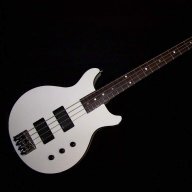
That's such an interesting bass. I've owned a Washburn Status, as well as a couple of Series II basses from the 80s, so I thought I'd throw some comments on.
I think the prototype theory sounds interesting, however, if it were a prototype for a joint-venture, I would've expected the bridge assembly to have come from Status, and my opinion is that, while it looks close, it's not a Status assembly. The tuning knobs are too small, and the saddles are too rectangular - the Status ones tended to be more square. Also, while the body shape is certainly very close, it's just a little too distant from the original shape.
Funnily enough, there's a real Washburn version available in Argentina - you could do a comparison if you wanted.
http://www.masoportunidades.com.ar/a...-1000-headless
When I saw the photos you linked to, it actually reminded me of a phenomonen that happened in Europe, and also in Australia, during the 50s and 60s. The big name brands from America, especially Fender, were not widely available, and when they were, their prices were fairly prohibitive to anyone other than pro-musicians. So what a lot of guys would do was to build their own basses, all based on pictures they cut from magazines. I can't help but get the impression that that may've been the case with the bass you've got here. The Washburn version was advertised quite a bit in a campaign using Mark King, and it's obviously the influence fot this bass. Most of the big magazines like Guitar Player would've run the adds. I can't help but think that some person has seen those ads, and been inspired to build his own, or have a luthier put one together.
Like I said, it's a pretty cool looking instrument. I'd love to know how good it is.
Have you got the link to the original auction? I'd really like to see what the head assembly looked like.