
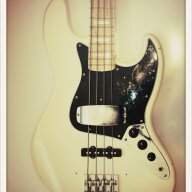
So I've got a killer road worn Jazz Bass. Sounds great but.........both volume pots are a normal volume increase to the 90% mark - the last 10% is a huge boost not only in volume but it appears to boost the aggressiveness of the tone. If I am doing my country stuff with the bridge pup almost off and the tone rolled almost all the way off it sounds great at 90% on the neck pup but that last 10% is too aggressive sounding. I just play with it on 90% volume but would love to figure out what is going on - any suggestions?

Enjoy the benefits of a premium membership!
Upgrade Account
-
TalkBass has been independent since 1998. Add your voice.
Create a free account to reply to discussions, view embedded media, and browse with fewer display ads.
Join free Log in
Want zero display ads or expanded classifieds tools? Compare plans.
You are using an out of date browser. It may not display this or other websites correctly.
You should upgrade or use an alternative browser.
You should upgrade or use an alternative browser.
Funny taper on volume pot Road Worn Jazz
- Thread starter don21480
- Start date
More options
Who Replied?
That sounds to me like a regular audio taper pot.
Perhaps you would be happier with a linear taper?
Perhaps you would be happier with a linear taper?

- Apr 18, 2008
- 16,002
- 1
- 31,690
- Disclosures
- I'm highly opinionated and extremely self-assured
Nope. The human ear perceives loudness logarithmically, not linearly; hence the use of log pots for volume controls. In other words, the logarithmic curve of the log pot should match the logarithmic curve of our ears, and the result should "sound linear". That said, it certainly wouldn't hurt to try a linear pot; it would be an easy experiment.
[relic rant mode]
Sounds to me like Don's pots are "Road Worn", just like the rest of the bass. Isn't that what you paid for, Don?
[/relic rant mode]
Don - if you like the sound at 90%, but not at 100%, you might try lowering your pickups a bit, to take off that extra edge.
[relic rant mode]
Sounds to me like Don's pots are "Road Worn", just like the rest of the bass. Isn't that what you paid for, Don?
[/relic rant mode]
Don - if you like the sound at 90%, but not at 100%, you might try lowering your pickups a bit, to take off that extra edge.
Nope. The human ear perceives loudness logarithmically, not linearly; hence the use of log pots for volume controls. In other words, the logarithmic curve of the log pot should match the logarithmic curve of our ears, and the result should "sound linear". That said, it certainly wouldn't hurt to try a linear pot; it would be an easy experiment.
I agree personally, but this is a topic of much debate around here...
Some people try linear and think they work better, others prefer the log taper.
Where is walterw at?
"nope". i've done the experiment lots and lots of times on lots and lots of instruments, and linear volume pots behave evenly on basses, while audio tapers have a volume jump at the last 10% of their rotation.Nope. The human ear perceives loudness logarithmically, not linearly; hence the use of log pots for volume controls. In other words, the logarithmic curve of the log pot should match the logarithmic curve of our ears, and the result should "sound linear".
there is a long-running debate about it here, but it seems to only be between people who (correctly) reference the logarithmic nature of the ear but haven't actually tried linear volumes, and those who've actually tried it and discovered how much more even the volume control becomes.
i can only guess that since the bass is plugged into the preamp of a bass rig rather than directly into the human ear, that it's bass rig inputs that respond better to linear volume control. (the opposite is true for overdriven guitar amps, where a linear volume on the guitar is nearly useless.)
+1 to this, though.Don - if you like the sound at 90%, but not at 100%, you might try lowering your pickups a bit, to take off that extra edge.
Don - if you like the sound at 90%, but not at 100%, you might try lowering your pickups a bit, to take off that extra edge.
Or you could just play with the volumes set to 90%. There's no rule that says you have to dime them.
Good points - I lowered the pups and it is better but while I like to dime them, I don't have to. Is there any science to the fact that the tone changes in that last 10% volume bump?
http://www.talkbass.com/forum/showthread.php?t=520484
there is a long-running debate about it here, but it seems to only be between people who (correctly) reference the logarithmic nature of the ear but haven't actually tried linear volumes, and those who've actually tried it and discovered how much more even the volume control becomes.
Of the two types of people above, I'd be the former & you'd be the latter. & no matter how sound a theory is, reality wins every time. I appreciate learning your experience, & the chance to learn from it.
i can only guess that since the bass is plugged into the preamp of a bass rig rather than directly into the human ear, that it's bass rig inputs that respond better to linear volume control. (the opposite is true for overdriven guitar amps, where a linear volume on the guitar is nearly useless.)
Perhaps I shouldn't guess into this again
 but my guess is it's in the nature of how the pot loads down the circuit, & again guess it's more about the pickup than the amp.
jeez, i have become the "linear volumes for basses" crusader around here, haven't i?I agree personally, but this is a topic of much debate around here...
Some people try linear and think they work better, others prefer the log taper.
Where is walterw at?
the thing is, i'm still looking for the post from someone who tried it on a bass and didn't prefer it.
actually, dealing with this issue on guitars has taught me that it's in fact all about the amp.Perhaps I shouldn't guess into this again
a distorted/compressed amp needs a guitar with audio taper volumes to evenly "clean up" the gain from the guitar; linear volumes (like gibson uses) have little effect from "10" down to "6" or "7", and drop off suddenly at "1".
through a clean amp, however, the linear volumes behave perfectly evenly, while audio tapers have that big drop from "10" to "8" that bass players (who use clean amps) are always complaining about.
jeez, i have become the "linear volumes for basses" crusader around here, haven't i?
the thing is, i'm still looking for the post from someone who tried it on a bass and didn't prefer it.
actually, dealing with this issue on guitars has taught me that it's in fact all about the amp.
a distorted/compressed amp needs a guitar with audio taper volumes to evenly "clean up" the gain from the guitar; linear volumes (like gibson uses) have little effect from "10" down to "6" or "7", and drop off suddenly at "1".
through a clean amp, however, the linear volumes behave perfectly evenly, while audio tapers have that big drop from "10" to "8" that bass players (who use clean amps) are always complaining about.
(OP et al; apologies for the thread-jack)
Thanks Walter. Dunno "crusader"; what I've caught is you report observed data.
Your "personal rules of thumb" are linear taper volume pots for instruments going into solid state amps & log(audio) taper volumes for tube amps? Same for bass & guitar, I presume. Do you find Actives perform similar with pots?
For shrimps & giggles, which would you put in for an instrument that did double duty; SS and Tube amps?
& while we've got this book open, I'd like to learn your preferences/observations on tone pots.
Thanks!
David
I don't know if the important difference is so much "tube vs. solid state" as "clean vs. distorted". A big muff into a GK would likely call for an audio taper volume ( if for some reason you wanted to clean it up from the bass), while an SVT on 4 will behave more evenly with a linear volume.
Tone pots need to be audio taper regardless, otherwise the tone knob does nothing until it's almost off.
Tone pots need to be audio taper regardless, otherwise the tone knob does nothing until it's almost off.
- Apr 18, 2008
- 16,002
- 1
- 31,690
- Disclosures
- I'm highly opinionated and extremely self-assured
there is a long-running debate about it here, but it seems to only be between people who (correctly) reference the logarithmic nature of the ear but haven't actually tried linear volumes, and those who've actually tried it and discovered how much more even the volume control becomes.
I've been thinking about this, and I've been re-evaluating the behavior of the volume pots on several of the basses that I've built. I always use audio-taper pots for volume, because of the "logarithmic" business; I've never thought to try a linear-taper volume pot before. I must admit that, under careful listening through a clean amp at low volume, the audio-taper pots that I use do not suddenly jump in volume at the last 90%. But I can't exactly say that they sound perfectly linear, either. They sound linear to my ear during the first half of travel, then they sound linear, but with a steeper slope, during the second half of travel.
This may be due to the economics of producing log pots. Most log pots are not truly logarithmic; it would cost too much to engineer the resistance to perfectly follow a logarithmic curve. Rather, most commonly-available log pots (according to what I've read) approximate a logarithmic curve by using two differently-calibrated linear portions. I know there's a web reference somewhere; hang on...
*shuffle google google shuffle*
Ah, here we are - have a look at Link Removed, from which the following graphic is borrowed. Notice the difference between the yellow and red lines on the graph?
Link Removed
I wonder if this could be part of the audible phenomenon we're all discussing?
That sounds right.
Also, there's audio taper and then there's audio taper. My understanding is that even among the 2-slope "fake audio" pots like you're talking about (which most people use), some have steeper slopes than others, thus having less or more of the jump at the end than others.
Also, there's audio taper and then there's audio taper. My understanding is that even among the 2-slope "fake audio" pots like you're talking about (which most people use), some have steeper slopes than others, thus having less or more of the jump at the end than others.
It was my understanding that an "audio" taper is generally not a true log taper, but usually two linear tapers sliced together to make a faux log curve, because it's cheaper to manufacture that way.
@ don21480
What you are describing sounds to me like the behaviour of a 500kOhm pot.
You got the bass used? - maybe its worth checking the pot rating.
For me personally its a standard mod on all my passive Jazz basses to replace the 250k pots with 500k pots.
It opens up nicely the sound and gives a certain agressivnes which can esily tamed with the tone knob (250k).
I love that sound ....but yes it totally messes with the taper
....but you get used to it.
What you are describing sounds to me like the behaviour of a 500kOhm pot.
You got the bass used? - maybe its worth checking the pot rating.
For me personally its a standard mod on all my passive Jazz basses to replace the 250k pots with 500k pots.
It opens up nicely the sound and gives a certain agressivnes which can esily tamed with the tone knob (250k).
I love that sound ....but yes it totally messes with the taper
....but you get used to it.
Good points - I lowered the pups and it is better but while I like to dime them, I don't have to. Is there any science to the fact that the tone changes in that last 10% volume bump?
Have you tried them at 11?


