
• TalkBass has been independent since 1998. Add your voice.
    Create a free account to reply to discussions, view embedded media, and browse with fewer display ads.
    Join freeLog in
    Want zero display ads or expanded classifieds tools? Compare plans.

"Ground point soldered to back of the pots"

(I realize this is probably a dumb question, but I know next to nothing about electronics nor do I know how to solder, so please try to bear with me...)

So, I was looking at some wiring diagrams out of curiosity and noticed how on all of them the ground wires are soldered to the backs of the potentiometers, for example:
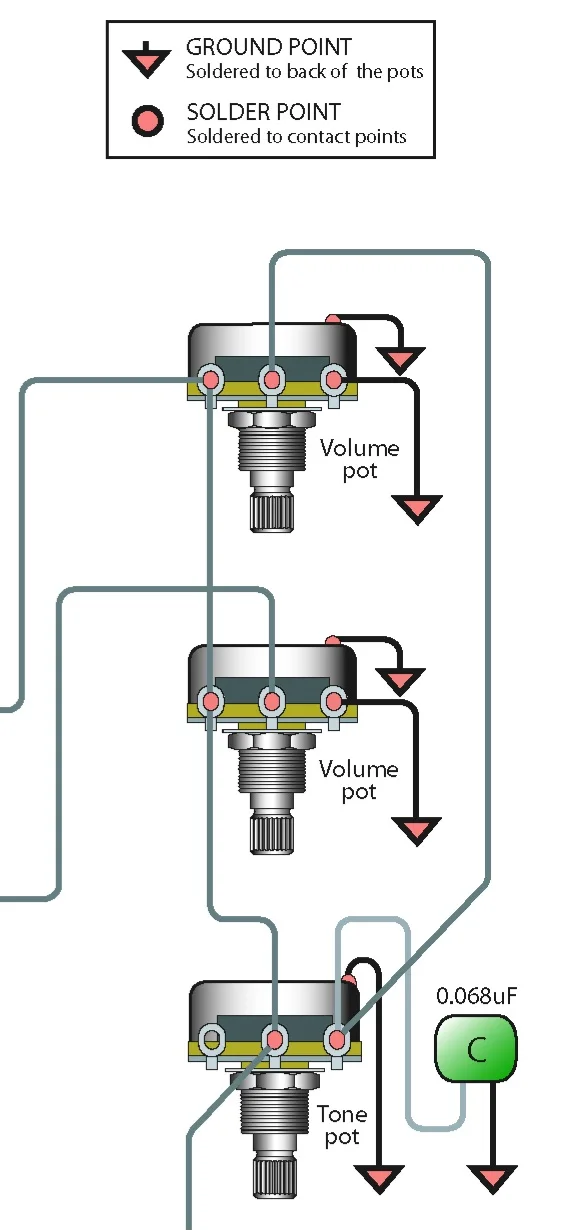
20260821_181036.webp


My question is: why is this done? I mean, (I think) I understand why the grounding is done in general, but why specifically are the backs of the pots used? A potentiometer has three terminals, couldn't they be used instead? Isn't it more difficult to solder a wire to a flat plane than a terminal you can wrap the wire around until it's soldered?

 
(I realize this is probably a dumb question, but I know next to nothing about electronics nor do I know how to solder, so please try to bear with me...)

So, I was looking at some wiring diagrams out of curiosity and noticed how on all of them the ground wires are soldered to the backs of the potentiometers, for example:

View attachment 7562302

My question is: why is this done? I mean, (I think) I understand why the grounding is done in general, but why specifically are the backs of the pots used? A potentiometer has three terminals, couldn't they be used instead? Isn't it more difficult to solder a wire to a flat plane than a terminal you can wrap the wire around until it's soldered?
You absolutely can use just the terminal ground if the circuit happens to be configured that way, as many volume and passive tone controls are. In most but not all cases you will however still want to tie the pot body to ground in some other way if you don't solder it. Classic methods include the Fender Jazz plate, a wired lock washer, or even contact with the cavity shielding, but in all those cases if the pot loosens up you then may have a problem. Ungrounded metal pot bodies make a fine antenna, unfortunately.

Soldering is not all that difficult to learn and for many players it's well worth throwing a hundred bucks or so at prosumer level tooling, or a little more at actual pro level tools. Pot body soldering often benefits from using a bigger iron tip than many of us use for general day to day audio gear soldering, so if buying a new iron it's worth it to be sure a good tip assortment is available.
 
  • Like
Reactions: Tipsukka
I bekieve the main reason is the in many instrument there are several ground wires and one small terminal doesn’t offer much room to connect them all.

I know that whenever I’m installing a volume pot I solder a lead from the ground terminal, on the right, to the back, then solder my grounds there.
Also when I plan on soldering to back of the pot I sand it a little to get tge surface prepped to hold the solder. I place a small bubble/puddle, then just heat it and insert the wires. Very easy.
 
  • Like
Reactions: Tipsukka
The terminals can't be used for ground because they are parts of the circuit. The outside terminals are the ends of the resistive element. The center is the wiper. The part that changes value as the pot is rotated.
The case is the ground.
On a volume pot, the right terminal is a ground and is normally connected to the back.