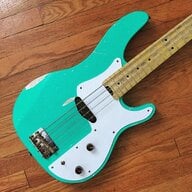
bought a "used" stingray that apart slight nail scratches in the pickguard from slapping, it is just brand new. no dents, no dust inside the screws heads, no dust in the screw joints, nothing. and believe me that the pictures are not making it justice because in the pictures i see dust that is "not there" 
from the look of it, it was left inside its case for like 99% of the time, just like the seller told me when i went met him yesterday.
the bass is almost dust free too, the dust it has now was me who caused itcsince yesterday
i am playing it non stop since i got it home and i am liking the feel of it. in the end i have made a really good deal, 1250 euros for a bass that has a recommended price point of about 2400 euros over here.
soundwise, it has a really bright sound, i believe mainly because of the maple neck of course but also because of the roundwound rotosound strings. i will string it with thomastik infeld flats, it will be killer.
the neck feel is perfect, the frets are NEW. i still do not believe that i have made this deal. sometimes i find myself thinking that the bass has zero miles, it feels like the guy (really nice guy, we talked for some time and he was really friendly) sold me after like 2 days slapping it! it is like i went to a store and bought it brand new.
the serial number is E45907, what does this mean? what are the features of that batch?
one thing that i haven't discussed with thew seller where the tools. i do not have them. if i want to change the neck relief, how can i do it? what will i need?
here are the pictures:
[Invalid or Expired Link Removed]
[Invalid or Expired Link Removed]
[Invalid or Expired Link Removed]
[Invalid or Expired Link Removed]
[Invalid or Expired Link Removed]
[Invalid or Expired Link Removed]
[Invalid or Expired Link Removed]
[Invalid or Expired Link Removed]
[Invalid or Expired Link Removed]
[Invalid or Expired Link Removed]
[Invalid or Expired Link Removed]
[Invalid or Expired Link Removed]
from the look of it, it was left inside its case for like 99% of the time, just like the seller told me when i went met him yesterday.
the bass is almost dust free too, the dust it has now was me who caused itcsince yesterday
i am playing it non stop since i got it home and i am liking the feel of it. in the end i have made a really good deal, 1250 euros for a bass that has a recommended price point of about 2400 euros over here.
soundwise, it has a really bright sound, i believe mainly because of the maple neck of course but also because of the roundwound rotosound strings. i will string it with thomastik infeld flats, it will be killer.
the neck feel is perfect, the frets are NEW. i still do not believe that i have made this deal. sometimes i find myself thinking that the bass has zero miles, it feels like the guy (really nice guy, we talked for some time and he was really friendly) sold me after like 2 days slapping it! it is like i went to a store and bought it brand new.
the serial number is E45907, what does this mean? what are the features of that batch?
one thing that i haven't discussed with thew seller where the tools. i do not have them. if i want to change the neck relief, how can i do it? what will i need?
here are the pictures:
[Invalid or Expired Link Removed]
[Invalid or Expired Link Removed]
[Invalid or Expired Link Removed]
[Invalid or Expired Link Removed]
[Invalid or Expired Link Removed]
[Invalid or Expired Link Removed]
[Invalid or Expired Link Removed]
[Invalid or Expired Link Removed]
[Invalid or Expired Link Removed]
[Invalid or Expired Link Removed]
[Invalid or Expired Link Removed]
[Invalid or Expired Link Removed]