

Below is a comparo piece I wrote that I was considering submitting to a bass focused magazine style website like No treble or Bassplayer.com. Instead I've just opted to post it here. Here it is:
I've always avoided Sire. Maybe because I was a loyalist to other brands. Maybe because having read anything negative about the brand, provided me the comfort of knowing that by not getting one, I was avoiding problems. Problems relayed from owners of a small percentage of them. The reputation for being heavy. Preamp issues with active models. It's simply seemed prudent to just look past them. Walk the other way.
But eventually, the truth comes to get you. And it can be an enlightening experience.
Several years ago, I was on the hunt for the best fretless to suit my tastes. Most important was the sound. It had to have the sound that made me want to grab it. After auditioning over a dozen different models from different brands, what came out on top? A sire V 5–24. Now don't get me wrong. It wasn't perfect out of the box. I prefer active instruments, but even in it it's OEM passive configuration, the tone was there. But on top of that, I discovered the most comfortable neck I can remember playing. The rolled edges. The slim profile. The tone that came off that neck was just wonderful. The instrument would require modifications to meet my preferences, but that's a story for another day. Point being, that instrument shattered all the apprehension regarding the brand.
When I speak about being a loyalist to another brand, that brand is Sadowsky. I have owned many of them. All either made in Japan or China. I've never owned a new NYC or German made model. But the quality and design of the instrument has been my go to for many years.
When I saw the recent review of the sire, V7 vintage ash new GEN Da-doo-da-doo-da-day on YouTube, I was immediately intrigued. It was obvious that Sire was going after Sadowsky's Chinese line marketshare specifically. The lightweight tuners, the four knob preamp layout, the updated pick ups, the thinner body reduced from 43 mm to 40 mm thickness. And most importantly the reduced weight.
The jazz bass model market is bountiful. There are dozens if not, hundreds of manufacturers making instruments in that shape/design. But to my eyes, this V7 appears to be a targeted attack on a specific competitors popular model. To anyone familiar with the bass guitar market, it has been very obvious that the sire business model is to somewhat replicate popular brands with minor changes in shape and materials, and offer them at far more competitive prices. MTD, Fodera, Fender, they're all well reflected in Sires product line. Its a common business strategy. Many companies do it.
But with the latest offering in the V7 line, Sire is absolutely focused on eating someone else's lunch. A battle for a specific market share. So,I say, let the battle begin.
Now, if we start with a quick spec on the Metro Express Sadowsky line, produced in Warwicks China facility, ( not to be confused with the legacy Japan produced MetroExpress line) we are essentially being offered an Okoume body with a roasted maple neck in an oil finish, with a pau ferro or roasted maple fingerboard. The neck is adjusted via a wheel that has a stem inserted into the truss rod at the body. Reports of the wheel coming loose from the rod insert have been reported, and Warwick support has assisted owners in correcting the issue.
The body is undersized and the instrument will likely be under 9 pounds. A variety of electronics are available from a pick up perspective. All instruments are active, with the glaringly obvious VTC option missing. The upgrade path to a VTC or VTC plus mid frequency bump preamp is part of the Warwick business model for that line. The requirement of an upgraded preamp is heavily debated. In my personal experience, I have found the VTC to be a requirement as the Sadowsky preamp does not offer a cut option. It is boost only. So rolling off the high frequencies cannot be attained with the stock Chinese preamp. But again, lotsa users find they do not need it. I do. Secondly, the upgrade includes MEC pots, and a high build quality with an extremely low failure rate. Also the renowned tone a Sadowsky pre is known for. Engineers love em. I do too.
The neck profile is a comfortable C shape and the fretwork is of good quality with semi hemispherical fret ends. The logic of this design would be to not have the fret ends protrude from the fingerboard edge, and they have succeeded in that. Weather changes be damned. No fret ends will be coming out of the edge of that board. Although the ends are not beveled flat like typical fret ends, so they are noticeable without being prominent. For reasons I cannot explain, I just want to take a file to them and flatten out the fret ends. Go figure.
Sadowsky branded Hipshot ultralite replica tuners, and the Sadowsky quick release bridge provides good tuning and setup adjustability. Although a recent reports of bridge lifting ala Rickenbacker have been posted on some forums with pictures accompanying the claim. There is also a quick release hipshot style string tree. This config makes for speedy string swaps, and can be a lifesaver if a string is broken and a backup bass is not available. I personally have installed a pre cut replacement G string on a gig in under 2 min on my Japan modern so, It works as it should. String swaps are quick.
The included adjustable nut is a unique differentiator, and passed on from Warwicks own product line. The usefulness of this feature has been debated. I personally find it a very convenient way to setup a nut. Ironically, on Rogers NYC instruments, it is not a feature.
Naturally, the tone can vary somewhat from bass to bass, but for the majority of examples that have come across my bench, the sound has been solid, and quintessential active J bass. I've always found the Sadowsky Alnico single coils to be more than adequate. I have upgraded the pre in all these models as it makes the bass more authentic to the original design, and far more versatile sonically. Point being , if I'm buying a bass that has Sadowsky on the headstock, I want it to have the features all Sadowskys have.
Of course, a strong consideration is always price point. As of this writing, a Sadowsky MetroExpress JJ in a 4 string config sells for $1135 suggested retail. This includes a high quality gig bag, adjustment tools, and a manufacturers warranty to the first owner. This is the least expensive model in the line.
Conversely, the 2026 V7 Vintage Ash retails for $899 and is smack dab in the middle of the Sire price book for J models. It is produced in Indonesia, comes in a cardboard box, with wrenches for adjustment and a manufacturer's warranty to the original purchaser. There is no case, but the multitude of cases and bags available will accommodate the sire. ( Although the "Gumby" headstock can be a challenge for Shorter designed cases. Google: Gumby)
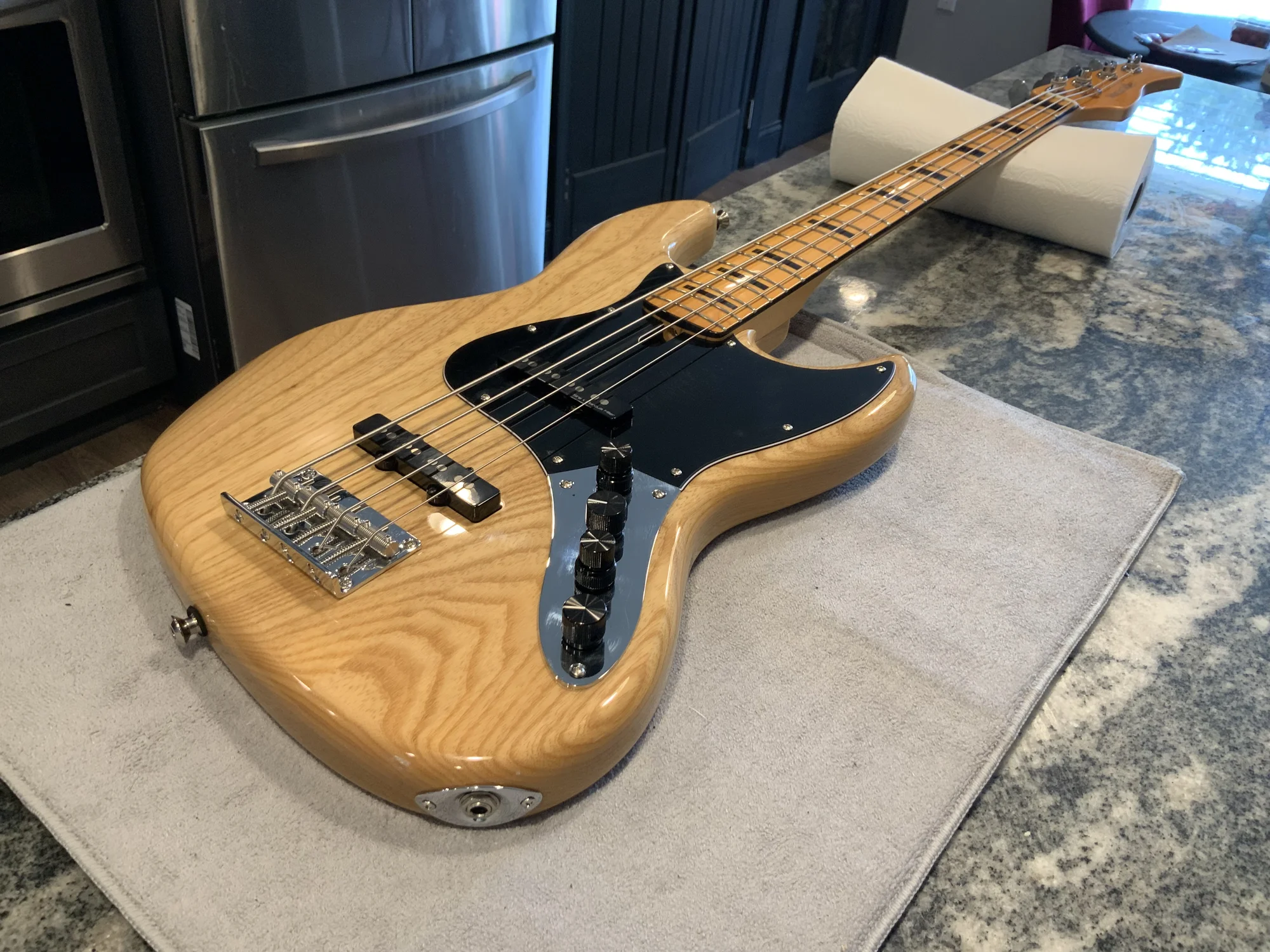
The example I received from the online retailer featured a well finished, highly polished clear coated 3 piece Ash body, a 1 piece very lightly torrified maple neck, maple fingerboard with black block inlays, black binding, and luminlay markers under a clear coated fingerboard. The profile is a small C shape, with a smooth sanded oiled finish. The truss rod is adjusted at the body using the included allen key. The body had a tooling mark under the clear and a minuscule area where the clear coat did not level perfectly with the grain. Upon notifying the retailer, I was provided a 15% discount on the purchase price.
Unlike the Sadowsky cast bridge, the Sire bridge is a chrome plated, steel, vintage style featuring splined saddles that permit shifting of the string positions. Strings can be perfectly centered over the bridge pickup pole pieces, or spacing can be widened or narrowed with a string shift over the saddle. The bridge also accommodates thru body stringing. The design is flexible, and the polar opposite of quick release. String changes will be more akin to a "vintage' exercise. But its design contributes to the light 8lb 4oz weight of the instrument, as do the guyker style lightweight tuners. The nut is bone and the width is a very slim 38mm. The frets are small vintage style and with the slim neck and rolled fingerboard edges, this neck is a standout. I learned of the excellent comfort of Sire's 4 string J style necks when I received the V5-24 fretless referred to earlier.
Aesthetically, the instrument is stunning and is truly reminiscent of a 70's highly polished ash Fender jazz. It presents as something far more expensive than it is, and I find myself looking at it….alot.
The only niggles were….first, the knobs.
The 4 knob preamp is sonically fine. It too provides an "always on" tone control, but unlike the Sadowsky's boost only design, it is a cut/boost config, and adds a mid control. But the vol/tone stack, balance, treb/Mid stack and Bass control with push/pull passive activation control will take a minute to become accustomed to. Treb/Mids on the same pot? Okay ( i'd have preferred bass/treb on one and mids/tone on the other, but thats me). And the stacked knobs are also overly large and the non stacked ones are unnecessarily small. I opted to replace them all with Sadowsky style knobs, which provided a better aesthetic in my opinion. From an audio perspective it functions well, and created a very musical tone for everything I needed it for on my most recent gig. Despite the single coil pickups I found no discernible noise for my entire gig and was only able to get an audible hum in my project studio when I placed the bass very close to my old peavey KB300.
Secondly, and a small nit picking thing….. every pick guard screw is not fully seated. The guard needs to be removed and all the holes need to be ever so slightly increased to allow for the screws to seat properly. I am looking into replacing the guard and jack plate with a custom one as a personal preference.
The bass plays beautifully, adjusts easily, and came intonated out of the box. Some simple relief and saddle height adjustments and it was gig ready quickly with my usual Elixir stainless installed.
In my in-ears it was very well seated in the mix, and the pleasing tone was very akin to my Sire fretless but a tad more…."precise" for lack of a better word. Great bubbly bridge tone, crisp J-tone, that just sounded terrific. So much so as to inspire this writing.
So begs the question: Will this new gen V7 vintage ash grab the market share I'm guessing Sire would like it to? I think i will.
With the Metro Express starting at $1135 and requiring a VTC plate upgrade of $150 to match only the tone control functionality of the Sire, the price difference may be the deal breaker for many. I does come with an excellent case though. Sire's $899 retail price is $385 lower than the upgraded Sadowsky, and also includes a mid control. Sadowsky does offer a mid bump pre at $300, and for those that truly prize the sadowsky tone, the upcharge may not be an issue.
Which brings us back to the value perspective. Value is in the eye ( and ear) of the beholder, and only time will tell If my assumption is correct. So judge for yourself. But if you're looking for a killin' J bass, that also happens to be a great value, I think you may wanna consider this one.
I've always avoided Sire. Maybe because I was a loyalist to other brands. Maybe because having read anything negative about the brand, provided me the comfort of knowing that by not getting one, I was avoiding problems. Problems relayed from owners of a small percentage of them. The reputation for being heavy. Preamp issues with active models. It's simply seemed prudent to just look past them. Walk the other way.
But eventually, the truth comes to get you. And it can be an enlightening experience.
Several years ago, I was on the hunt for the best fretless to suit my tastes. Most important was the sound. It had to have the sound that made me want to grab it. After auditioning over a dozen different models from different brands, what came out on top? A sire V 5–24. Now don't get me wrong. It wasn't perfect out of the box. I prefer active instruments, but even in it it's OEM passive configuration, the tone was there. But on top of that, I discovered the most comfortable neck I can remember playing. The rolled edges. The slim profile. The tone that came off that neck was just wonderful. The instrument would require modifications to meet my preferences, but that's a story for another day. Point being, that instrument shattered all the apprehension regarding the brand.
When I speak about being a loyalist to another brand, that brand is Sadowsky. I have owned many of them. All either made in Japan or China. I've never owned a new NYC or German made model. But the quality and design of the instrument has been my go to for many years.
When I saw the recent review of the sire, V7 vintage ash new GEN Da-doo-da-doo-da-day on YouTube, I was immediately intrigued. It was obvious that Sire was going after Sadowsky's Chinese line marketshare specifically. The lightweight tuners, the four knob preamp layout, the updated pick ups, the thinner body reduced from 43 mm to 40 mm thickness. And most importantly the reduced weight.
The jazz bass model market is bountiful. There are dozens if not, hundreds of manufacturers making instruments in that shape/design. But to my eyes, this V7 appears to be a targeted attack on a specific competitors popular model. To anyone familiar with the bass guitar market, it has been very obvious that the sire business model is to somewhat replicate popular brands with minor changes in shape and materials, and offer them at far more competitive prices. MTD, Fodera, Fender, they're all well reflected in Sires product line. Its a common business strategy. Many companies do it.
But with the latest offering in the V7 line, Sire is absolutely focused on eating someone else's lunch. A battle for a specific market share. So,I say, let the battle begin.
Now, if we start with a quick spec on the Metro Express Sadowsky line, produced in Warwicks China facility, ( not to be confused with the legacy Japan produced MetroExpress line) we are essentially being offered an Okoume body with a roasted maple neck in an oil finish, with a pau ferro or roasted maple fingerboard. The neck is adjusted via a wheel that has a stem inserted into the truss rod at the body. Reports of the wheel coming loose from the rod insert have been reported, and Warwick support has assisted owners in correcting the issue.
The body is undersized and the instrument will likely be under 9 pounds. A variety of electronics are available from a pick up perspective. All instruments are active, with the glaringly obvious VTC option missing. The upgrade path to a VTC or VTC plus mid frequency bump preamp is part of the Warwick business model for that line. The requirement of an upgraded preamp is heavily debated. In my personal experience, I have found the VTC to be a requirement as the Sadowsky preamp does not offer a cut option. It is boost only. So rolling off the high frequencies cannot be attained with the stock Chinese preamp. But again, lotsa users find they do not need it. I do. Secondly, the upgrade includes MEC pots, and a high build quality with an extremely low failure rate. Also the renowned tone a Sadowsky pre is known for. Engineers love em. I do too.
The neck profile is a comfortable C shape and the fretwork is of good quality with semi hemispherical fret ends. The logic of this design would be to not have the fret ends protrude from the fingerboard edge, and they have succeeded in that. Weather changes be damned. No fret ends will be coming out of the edge of that board. Although the ends are not beveled flat like typical fret ends, so they are noticeable without being prominent. For reasons I cannot explain, I just want to take a file to them and flatten out the fret ends. Go figure.
Sadowsky branded Hipshot ultralite replica tuners, and the Sadowsky quick release bridge provides good tuning and setup adjustability. Although a recent reports of bridge lifting ala Rickenbacker have been posted on some forums with pictures accompanying the claim. There is also a quick release hipshot style string tree. This config makes for speedy string swaps, and can be a lifesaver if a string is broken and a backup bass is not available. I personally have installed a pre cut replacement G string on a gig in under 2 min on my Japan modern so, It works as it should. String swaps are quick.
The included adjustable nut is a unique differentiator, and passed on from Warwicks own product line. The usefulness of this feature has been debated. I personally find it a very convenient way to setup a nut. Ironically, on Rogers NYC instruments, it is not a feature.
Naturally, the tone can vary somewhat from bass to bass, but for the majority of examples that have come across my bench, the sound has been solid, and quintessential active J bass. I've always found the Sadowsky Alnico single coils to be more than adequate. I have upgraded the pre in all these models as it makes the bass more authentic to the original design, and far more versatile sonically. Point being , if I'm buying a bass that has Sadowsky on the headstock, I want it to have the features all Sadowskys have.
Of course, a strong consideration is always price point. As of this writing, a Sadowsky MetroExpress JJ in a 4 string config sells for $1135 suggested retail. This includes a high quality gig bag, adjustment tools, and a manufacturers warranty to the first owner. This is the least expensive model in the line.
Conversely, the 2026 V7 Vintage Ash retails for $899 and is smack dab in the middle of the Sire price book for J models. It is produced in Indonesia, comes in a cardboard box, with wrenches for adjustment and a manufacturer's warranty to the original purchaser. There is no case, but the multitude of cases and bags available will accommodate the sire. ( Although the "Gumby" headstock can be a challenge for Shorter designed cases. Google: Gumby)
The example I received from the online retailer featured a well finished, highly polished clear coated 3 piece Ash body, a 1 piece very lightly torrified maple neck, maple fingerboard with black block inlays, black binding, and luminlay markers under a clear coated fingerboard. The profile is a small C shape, with a smooth sanded oiled finish. The truss rod is adjusted at the body using the included allen key. The body had a tooling mark under the clear and a minuscule area where the clear coat did not level perfectly with the grain. Upon notifying the retailer, I was provided a 15% discount on the purchase price.
Unlike the Sadowsky cast bridge, the Sire bridge is a chrome plated, steel, vintage style featuring splined saddles that permit shifting of the string positions. Strings can be perfectly centered over the bridge pickup pole pieces, or spacing can be widened or narrowed with a string shift over the saddle. The bridge also accommodates thru body stringing. The design is flexible, and the polar opposite of quick release. String changes will be more akin to a "vintage' exercise. But its design contributes to the light 8lb 4oz weight of the instrument, as do the guyker style lightweight tuners. The nut is bone and the width is a very slim 38mm. The frets are small vintage style and with the slim neck and rolled fingerboard edges, this neck is a standout. I learned of the excellent comfort of Sire's 4 string J style necks when I received the V5-24 fretless referred to earlier.
Aesthetically, the instrument is stunning and is truly reminiscent of a 70's highly polished ash Fender jazz. It presents as something far more expensive than it is, and I find myself looking at it….alot.
The only niggles were….first, the knobs.
The 4 knob preamp is sonically fine. It too provides an "always on" tone control, but unlike the Sadowsky's boost only design, it is a cut/boost config, and adds a mid control. But the vol/tone stack, balance, treb/Mid stack and Bass control with push/pull passive activation control will take a minute to become accustomed to. Treb/Mids on the same pot? Okay ( i'd have preferred bass/treb on one and mids/tone on the other, but thats me). And the stacked knobs are also overly large and the non stacked ones are unnecessarily small. I opted to replace them all with Sadowsky style knobs, which provided a better aesthetic in my opinion. From an audio perspective it functions well, and created a very musical tone for everything I needed it for on my most recent gig. Despite the single coil pickups I found no discernible noise for my entire gig and was only able to get an audible hum in my project studio when I placed the bass very close to my old peavey KB300.
Secondly, and a small nit picking thing….. every pick guard screw is not fully seated. The guard needs to be removed and all the holes need to be ever so slightly increased to allow for the screws to seat properly. I am looking into replacing the guard and jack plate with a custom one as a personal preference.
The bass plays beautifully, adjusts easily, and came intonated out of the box. Some simple relief and saddle height adjustments and it was gig ready quickly with my usual Elixir stainless installed.
In my in-ears it was very well seated in the mix, and the pleasing tone was very akin to my Sire fretless but a tad more…."precise" for lack of a better word. Great bubbly bridge tone, crisp J-tone, that just sounded terrific. So much so as to inspire this writing.
So begs the question: Will this new gen V7 vintage ash grab the market share I'm guessing Sire would like it to? I think i will.
With the Metro Express starting at $1135 and requiring a VTC plate upgrade of $150 to match only the tone control functionality of the Sire, the price difference may be the deal breaker for many. I does come with an excellent case though. Sire's $899 retail price is $385 lower than the upgraded Sadowsky, and also includes a mid control. Sadowsky does offer a mid bump pre at $300, and for those that truly prize the sadowsky tone, the upcharge may not be an issue.
Which brings us back to the value perspective. Value is in the eye ( and ear) of the beholder, and only time will tell If my assumption is correct. So judge for yourself. But if you're looking for a killin' J bass, that also happens to be a great value, I think you may wanna consider this one.


