• TalkBass has been independent since 1998. Add your voice.
    Create a free account to reply to discussions, view embedded media, and browse with fewer display ads.
    Join freeLog in
    Want zero display ads or expanded classifieds tools? Compare plans.

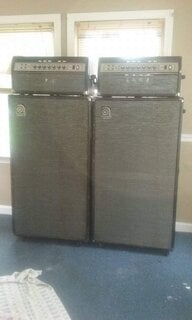
1975 AMPEG SVT - Issues (need help Video attached)

The 6C4WA/6100 is a low noise version of the 6C4. Prices are not bad here: Invalid Link Removed

The cost of their GE and Philips NOS 12DW7's are going through the roof: Invalid Link Removed. They were half that price what seem not too long ago.
 
Since your preamp is fine, I'd check the 12DW7 on the power amp chassis (most likely suspect) and the 2 12BH7's (not likely) as others have suggested and if that does not fix it I'd have a tech look at it and I wouldn't leave it on long while you're testing it, if it's not the 12DW7 it could be a dead short such as a grounded speaker jack (not likely) or an open like a bad output tranny (not very common), I have never seen a complete set of power tubes go in an amp so I doubt the power tubes are your problem, it is either something before them (likely) or after them (not likely). Did this happen all of a sudden?
 
@J.KEEFE_bass

Listen to these guys, they know what they are talking about. I have a 76 SVT that @beans-on-toast and others were able to help me troubleshoot in about 15 minutes. In my case, it was the C64 in the pre.

By the way, I would still try running a preamp out from your SWR into your SVT power amp in, and see what you get. Just to confirm you are zeroing in on the right area.
 
That tells us that the SVT pre-amp is fine. The 6C4 is not the issue.

The problem is in the power amp. The next step is to swap out the 12DW7 in the power amp in the chassis on the bottom. As I mentioned, you can use a 12AX7 for testing if you have one.

Ok. I switched out the 12AX7 in the SVT with one I knew worked and it didn't change a thing. side note It already had a 12AX7 in it.. so I tested that out in another one of my amps and it worked. So on to the next thing??

I also, used the following signal chain to test the Power amp in on the SVT. instrument cable into the SWR channel one input> SWR preamp out into SVT POWER AMP IN> SVT speaker out to Speaker Cab. I was back where i started very limited volume & distorted.
 
Sounds like you've isolated it to the power amp. Just out of curiosity, have you checked the bias on the tubes? If you can't get a proper reading it could indicate a power tube/associated circuit issue. If you can get proper readings on the power tubes it could still be a number of things but it's one less issue to check.
 
Since your preamp is fine, I'd check the 12DW7 on the power amp chassis (most likely suspect) and the 2 12BH7's (not likely) as others have suggested and if that does not fix it I'd have a tech look at it and I wouldn't leave it on long while you're testing it, if it's not the 12DW7 it could be a dead short such as a grounded speaker jack (not likely) or an open like a bad output tranny (not very common), I have never seen a complete set of power tubes go in an amp so I doubt the power tubes are your problem, it is either something before them (likely) or after them (not likely). Did this happen all of a sudden?

You guys are awesome. I haven't played this thing in a while... say 4 years.... (its soo heavy). I recently brought some of my gear home from the band room....so i had speakers to hook it up too and this is what it sounded like. :(
 
Ok. I switched out the 12AX7 in the SVT with one I knew worked and it didn't change a thing. side note It already had a 12AX7 in it.. so I tested that out in another one of my amps and it worked. So on to the next thing??

I also, used the following signal chain to test the Power amp in on the SVT. instrument cable into the SWR channel one input> SWR preamp out into SVT POWER AMP IN> SVT speaker out to Speaker Cab. I was back where i started very limited volume & distorted.

Harsh......

You guys are awesome. I haven't played this thing in a while... say 4 years.... (its soo heavy). I recently brought some of my gear home from the band room....so i had speakers to hook it up too and this is what it sounded like. :(

Hold out some hope. Mine had been idle for a long time as well, but when I brought it out and had the issue, they were on it! And, it was a minor tube issue, and I actually, for some strange reason, had a spare.
 
You guys are awesome. I haven't played this thing in a while... say 4 years.... (its soo heavy). I recently brought some of my gear home from the band room....so i had speakers to hook it up too and this is what it sounded like. :(

So it sounded good the last time you played it 4 years ago? And plugged your SWR preamp out into the SVT power amp in and it sounds the same? Also you took out a 12AX7 from the power amp and out another one in and it sounds the same?

Sounds like you've isolated it to the power amp. Just out of curiosity, have you checked the bias on the tubes? If you can't get a proper reading it could indicate a power tube/associated circuit issue. If you can get proper readings on the power tubes it could still be a number of things but it's one less issue to check.

That wouldn't cause such a drastic drop in power, it would either be very clean and soft (not that soft though) or the tubes would get very hot, start glowing cherry red and run away and melt or more likely open the plate resisters. I bought an SVT once with one bias set all the way off and one set all the way on AND had 6L6's in it instead of 6550's and it sounded ok.
Incidentally amps can get corroded sitting around, it's a good idea to run amps every 6 months or so especially tube amps.
 
Last edited:
I think the problem has clearly been isolated to the power amp section of the SVT head, based on a number of troubleshooting steps outlined above.

Yes, I realize that and the output speaker jacks are on the power amp, they are at the very end of the line and one of them could be corroded from sitting. The problem could be one many things wrong but I'm not going to tell him to pull out a multimeter and check plate voltages, plate resisters, output transformer etc. these amps can easily kill you if you don't know what you're doing. I'm not an expert but have gone to tech school and have been using and fixing these heads for 40 years now.
 
Last edited:
Although the 12AX7 will work in the amp, a 12DX7 will allow the amp to perform better.

There are many possibilities and it makes sense to try the easiest stuff first. Try swapping out the 12BH7 tubes.

If that doesn't help, the power amp needs a general servicing. The tube sockets need to be cleaned with deoxit and re-tensioned if necessary. Same for the speaker out, ext speaker, and ext amp jacks. Then the amp needs to be meticulously checked.

As Corey suggested, try setting the bias. The instructions are on the chassis. If the bias can't be set, the tubes may be worn out. Set the balance. This is best done with a dummy load and signal generator. If the tubes are not balanced, the output will have a higher total harmonic distortion.

Time to have a tech look at the amp. Take voltage readings amd compare them to the reference numbers on the schematic. This will help identify and issues. Components need to be checked to ensure that the amp is performing up to spec.
 
Last edited:
  • Like
Reactions: bobyoung53
Although the 12AX7 will work in the amp, a 12DX7 will allow the amp to perform better.

There are many possibilities and it makes sense to try the easiest stuff first. Try swapping out the 12BH7 tubes.

If that doesn't help, the power amp needs a general servicing. The tube sockets need to be cleaned with deoxit and re-tensioned if necessary. Same for the speaker out, ext speaker, and ext amp jacks. Then the amp needs to be meticulously checked.

As Corey suggested, try setting the bias. The instructions are on the chassis. If the bias can't be set, the tubes may be worn out. Set the balance. This is best done with a dummy load and signal generator. If the tubes are not balanced, the output will have a higher total harmonic distortion.

Take voltage readings amd compare them to the reference numbers on the schematic. This will help identify and issues. Components need to be checked to ensure that the amp is performing up to spec.

Time to have a tech look at the amp.


All good ideas but I doubt any of them are going to fix this amp, I'm sure it needs all that also but there is something drastically wrong with it that needs a good tech who knows these beasts. I will repeat I wouldn't keep running it you could cause a lot more damage, let a tech do it.
 
  • Like
Reactions: Salicete
The electrolytic cap in the power supply degrade as they age. First comes a reduction in headroom, the amp distorts at a lower volume level. Next there is a noticible hum which will get worse with time. If the caps short, there can be serious damage.

Having any amp sit unused isn't good. The electrolytic caps are wet inside and a chemical reaction occurs that breaks them down. Running it with the standby off (in playing mode), allows the capacitors to reform internally and reverses the degradation. If an amp is unused, it should be powered up for at least half an hour, longer is better. This should be done at least once a year, every six months is better.

If the caps are original, letting them sit for four years unused may have created this problem.
 
The electrolytic cap in the power supply degrade as they age. First comes a reduction in headroom, the amp distorts at a lower volume level. Next there is a noticible hum which will get worse with time. If the caps short, there can be serious damage.

Having any amp sit unused isn't good. The electrolytic caps are wet inside and a chemical reaction occurs that breaks them down. Running it with the standby off (in playing mode), allows the capacitors to reform internally and reverses the degradation. If an amp is unused, it should be powered up for at least half an hour, longer is better. This should be done at least once a year, every six months is better.

If the caps are original, letting them sit for four years unused may have created this problem.

Guys thanks so much for all of your responses and help! You guys are beyond awesome. I will take the old gal to a local tech. I will report back on the issues and solutions so in the future if someone else needs a reference point they can point to our thread.

To be continued...............
 
Although the 12AX7 will work in the amp, a 12DX7 will allow the amp to perform better.
...
As Corey suggested, try setting the bias. The instructions are on the chassis. If the bias can't be set, the tubes may be worn out. Set the balance. This is best done with a dummy load and signal generator. If the tubes are not balanced, the output will have a higher total harmonic distortion.
While this can be done safely by a non-technician, in the sense that one doesn't need to expose any dangerous/fragile circuitry, a dummy load for an SVT is no small thing - I remember mine being a set of huge ceramic resistors I mounted on a wood frame, and they literally scorched the wood - and while any synthesizer worth its salt will generate an approximation of a sine wave, for this kind of work a lab signal generator is best. For a tech who's already got the bench setup, it's a 5 minute operation, so I wouldn't fuss with it myself if I were taking it in to a tech anyway, I'd just add to the work order "oh, and check the bias", though if he's good he'd probably do it anyway.

Thanks for pointing out the cap degradation issue, beans, you beat me to it. I take my SVT "out for walkies" about once a year, just to make sure they get charged up, but I know they're gradually goin'...
 
  • Like
Reactions: beans-on-toast
While this can be done safely by a non-technician, in the sense that one doesn't need to expose any dangerous/fragile circuitry, a dummy load for an SVT is no small thing - I remember mine being a set of huge ceramic resistors I mounted on a wood frame, and they literally scorched the wood - and while any synthesizer worth its salt will generate an approximation of a sine wave, for this kind of work a lab signal generator is best. For a tech who's already got the bench setup, it's a 5 minute operation, so I wouldn't fuss with it myself if I were taking it in to a tech anyway, I'd just add to the work order "oh, and check the bias", though if he's good he'd probably do it anyway.

Thanks for pointing out the cap degradation issue, beans, you beat me to it. I take my SVT "out for walkies" about once a year, just to make sure they get charged up, but I know they're gradually goin'...


Yes I bought a bunch of IIRC 50 watt resisters (forgot the resistance) years ago and soldered them together to create a 4 ohm 300 watt dummy load and they do get hot and quickly. I needed them to balance the output. I put a 40 hz signal in with a signal generator and put a multimeter across the two bias points and let her rip. You don't need the dummy load to bias it though just a multimeter as it is done at resting state. Electrolytic caps dry up over time when their idle, lowering the internal resistance to the point of sometimes shorting out. I restore a lot of old ham receivers and you run across that frequently. 120 hz hum indicates the electrolytics are on their way out.
OP good idea to take it to a tech these amps are complicated and dangerous to work on especially for a beginner, if your power tubes are bad (American GE's last a long time and are great tubes) try the new Russian Tungsols, they sound as good as NOS American tubes to me
 
Bob - I've got a 1,200W dummy load (four 300W wirewounds) and even that gets warm in a short time!

OP - I hope your tech has been inside an SVT before (preferably many) and knows what he's doing. I've got three 70's SVT's and have serviced two of them. The first one I got 20 years ago bounced from supposed tech to tech before I finally found a guy who really knew his stuff and fixed it right. It wasn't cheap, though, so I decided to teach myself. Full recaps, plate, screen, bias resistors, etc. Any tube amp can kill you, but an SVT is a heavy, complicated, special kind of SOB that can kill you REAL good.
 
Last edited:
  • Like
Reactions: bobyoung53