• TalkBass has been independent since 1998. Add your voice.
    Create a free account to reply to discussions, view embedded media, and browse with fewer display ads.
    Join freeLog in
    Want zero display ads or expanded classifieds tools? Compare plans.

1979 P Bass Value

Using bleach as a solution for mold is common and ALWAYS the wrong first choice.
use white vinegar. Cheap, easy, effective, and safe, and it won't discolor everything.

All you people who are that afraid of a little mold... how do you even live in this world? Mold is omnipresent and super easy to take care of on an item with visible surfaces, like a bass.

No big whoop
 
Last edited:
With "golden era vintage" becoming out of reach for the average bass player/collector (even those who are doing pretty well financially - very few people can justify tens of thousands of dollars on an electric bass), a lot of people are moving on to '70s era Fenders as to what they think is the "next best thing".

Don't fall into that trap. The next best thing to a pre-CBS Fender is either Fender Custom Shop, or literally any modern MIA Fender that plays how you enjoy. The 1970s basses and guitars were all over the place. Some people on here claim their '70s era basses are true gems, and they might be, but you can find several sorry examples from that era for every decent one.

It's your money at the end of the day, but '70s Fender + mold? Heck no from me.
 
Using bleach as a solution for mold is common and ALWAYS the wrong first choice.
use white vinegar. Cheap, easy, effective, and safe.

All you people who are that afraid of a little mold... how do you even live in this world, It's omnipresent and super easy to take care of on an item like a bass.

People would be less scared of the mold if it were from a coveted era of Fender. It just compounds the issue of the '70s crapshoot IMO.
 
Using bleach as a solution for mold is common and ALWAYS the wrong first choice.
use white vinegar. Cheap, easy, effective, and safe, and it won't discolor everything.

All you people who are that afraid of a little mold... how do you even live in this world? Mold is omnipresent and super easy to take care of on an item with visible surfaces, like a bass.

No big whoop
It’s not the mold, it’s the likely impact on the instrument from being put in a position to grow mold. This is an instrument, not a wet sock stored on a zip lock bag for a 3rd grade science experiment. I bet the neck is completely out of wack.
 
Not a moldologist but a little mold like that ain't gonna scare me away. Obv. it should impact the price, and does make me concerned about what might be under the pickguard and in general about how the thing has been treated. It's not black mold, it won't kill you and should clean up easily. (It is black mold, but it ain't Black Mold, not according to me, who has zero evidence).
 
It’s not the mold, it’s the likely impact on the instrument from being put in a position to grow mold. This is an instrument, not a wet sock stored on a zip lock bag for a 3rd grade science experiment. I bet the neck is completely out of wack.
It's easy to see if the neck is out of whack by looking at it, and by playing the bass for a minute.
If the bass plays well, then I would welcome a significant mold discount.
It's not that I'm particularly into this bass...

On another note, Japanese P bass copies of this era are more consistent than Fenders anyway.
Why else would Fender have decided to have their basses built at the Japan factories soon after this??? maybe it's because late 70s Fenders had quality control problems and the Japanese factories were killing them.
 
Last edited:
Speaking as one of the preeminent 70s era Fender apologists here....
It might be a really great player, like my 78 all-the-time, everyday, forever P.
But your definitely gonna want to put a hands on it inspection on it to see.
And as much as I reject the majority of the bad vibes these instruments get,
The current prices these seem to be going for are pretty.....unrealistic....
When you consider how much brand new bass you can buy at those price points .... I'd think twice about it.
 
1979 model = $1,979.

I'd go with $19.79

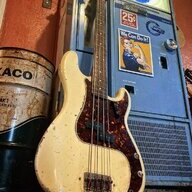
The fake relicing on the body is particularly egregious on this one - that's not even close to how natural wear looks. And a body that beat up would have dings all over the headstock - Headstocks get things run into them much more than bodies, and I don't see any dings there. So, it's not original, it has fake wear, it has mold, and it's from Fender's worst period in terms of quality. Why do you want this?

Yeah, I'm sticking with $19.79
 
I'd go with $19.79

The fake relicing on the body is particularly egregious on this one - that's not even close to how natural wear looks. And a body that beat up would have dings all over the headstock - Headstocks get things run into them much more than bodies, and I don't see any dings there. So, it's not original, it has fake wear, it has mold, and it's from Fender's worst period in terms of quality. Why do you want this?

Yeah, I'm sticking with $19.79

I was just kidding (a buck for each year).

While I like P and J basses, I don't prefer vintage ones. They're usually heavy, expensive, and because they're old they need replacement parts which defeats the purpose of having a vintage instrument in the 1st place. I'm more a player than a collector.
 
  • Like
Reactions: thetragichero
If it is indeed mold, sure mold can be removed, but why is there mold in the first place? Can the vendor provide history of the instrument?

I would get it appraised and checked by a luthier before committing to a purchase.

it is just a ‘79 Fender P bass, nothing special. Anyway, what happened in music in ‘79? I don’t remember.
 
I love my 78 P bass, which I’ve had since I bought it brand new, all 12 lbs of it. But I agree with those that say there are lots of current and recent P basses (Fender and others) that are just as good if not better. I myself wouldn’t bother taking a chance on this one unless it was ridiculously cheap (like under $500).
 
I spent the first 35 years of my life living along the Gulf Coast, where EVERYTHING (Pick One) either molds or rusts (though sometimes I swear they did both) between the warm temps, the constant humidity, and salt air.

It's nothing to play with as some folks can get mighty sick from / with it.

Here lately I've seen more 'what about this one' inquiries about used Precision Basses, and guys, used ones are just not that hard to find from real cheap to stoopid money. So I just wouldn't be in a hurry to jump at a 'deal' if there's not one there, it's too easy to find one that might suit you better. IF this is mold, and it's deep enough to NOT wipe off, then you may be into a re-fin and expense not planned for. I've lived around lots of mold at times, been run out of places while it was removed, and this axe for me would be a non-starter it if really is mold.

I'd also say the kneejerk 'all the 70's Fenders ain't all that' reflex just doesn't work. CBS Fender in the 70's were still made in the same production process as Leo had set up the factory in the 50's: Guys band sawing bodies and necks off patterns, bored housewives winding pickups, some kid pressing in frets, and the necks largely shaped by hands. The same good, mediocre, and not so good you'd see in any manufacturing environment in those days. Just think of how crummy 70's cars could be. The CNC and CAD/CAM we take for granted today was only on the horizon, so these largely hand and Mk. 1 Eyeball-built axes could and did vary. Some were very good, some were OK, and a few weren't. You just had to 'find a good one' then . . . . just as you do now when you see these old guys for sale.
 
It's easy to see if the neck is out of whack by looking at it, and by playing the bass for a minute.
If the bass plays well, then I would welcome a significant mold discount.
It's not that I'm particularly into this bass...

On another note, Japanese P bass copies of this era are more consistent than Fenders anyway.
Why else would Fender have decided to have their basses built at the Japan factories soon after this??? maybe it's because late 70s Fenders had quality control problems and the Japanese factories were killing them.
They opened up shop in Japan due to cheap labor costs (especially at that time) and to more easily tap the Asian markets. Pretty simple really - and yes the Japanese Fender were nice basses even in the 70’s
 
I was just kidding (a buck for each year).

I completely understand that. But, in a practical sense, I place no value on old, unless that gets you a great instrument. Although I'm certain there are exceptions, Fenders from the 70's are not the place I'd go looking to find a great instrument - I think I could find what I want much faster and easier in other places. Given that, my $19.79 is, yes, a bit of a joke, but there's no way I'm going to offer anything close to "market value" (what aficionados would pay) for a 70's Fender, so my valuation is pretty much not a factor. If you gave me that bass, I would donate it, as I'm sure it'd be more useful in the places I donate basses than it would be in my little herd - in my herd, it'd literally just sit in a case, and never get played.