• TalkBass has been independent since 1998. Add your voice.
    Create a free account to reply to discussions, view embedded media, and browse with fewer display ads.
    Join freeLog in
    Want zero display ads or expanded classifieds tools? Compare plans.

2500 watts, check! ..... now what?

I spent the $$ because I killed bridged high wattage power amps every few years from how I was using them. I decided the extra cash over more years was worth it. Also the performance of this amp completely outclassed all the Peavey IPR/ Creat Prolite stuff it sounds better is more dependable and has proven to be more stable on the job.

Also I could have a bunch of rigs for the cost of my Monique/M2500... but I don’t want a bunch of rigs. I want one rig I really love that can do every gig.

The Hypex module used in the M2500 is a beast. Hypex is second to none in high perfomance class D audio design.
 
The Hypex module used in the M2500 is a beast. Hypex is second to none in high perfomance class D audio design.

It’s a world class spare no consideration amp. The power supply is over-spec’ed and could drive no less than three amp modules. These are the kind of amps that get installed in some of the best of the best concert halls across the world.
 
  • Like
Reactions: fast slapper
Heat disspation consideration for the Hypex SMPS1200 mudule

upload_2019-3-10_22-6-11.png


Its the amplifier manufacurers responsibility to provide proper thermal cooling for the device.
Hypex states clearly that the use of the SMPS products was designed exclusively for audio application. This means that the device would (very likely) suffer on issues if the SMPS was used to power a 1200 Watts tooling machine

The Jule M2500 amplifier comes without active fan cooling. In this case I assume not more than 1/8 duty cycle for the program material if the amplifier shall not run into thermal issues over time if the amplifier was pushed to "full" power


Bass guitar amplifiers are often used to be "overloaded" at some content. Sometimes this is done due to "musical" reasons cause an overloaded amplifier (dependent on the design) may contribute some musical harmonics without noticable distortion. Some folks prefer some compression of the signal within the preamp while others may prefer the "compression" done with the power amp section. As usual, it all depends.


For my personal needs I "configurated" high power application the following way.
Powersoft Digam 5000 amplifier which delivers about 1700 Watts (one channel used) into a 212 4 Ohm cabinet.
The amplifier shall provide 3dB of headroom so the dynamic peaks shall not exceed about 750 Watts.
The signal compression (brick wall limiting) is done within a "slightly" satuarated preamp ampeg svp pro.

I'd not expect more than 1/8 .. 1/4 duty cycle capability with the Digam 5000 amplifier.
I ain't feel need to exaggerate the properties of my amplification gear.
 
Last edited:
Heat disspation consideration for the Hypex SMPS1200 mudule

View attachment 3351934

Its the amplifier manufacurers responsibility to provide proper thermal cooling for the device.
Hypex states clearly that the use of the SMPS products was designed exclusively for only audio application. This means that the device would (very likely) suffer on issues if the SMPS was used to power a 1200 Watts tooling machine

The Jule M2500 amplifier comes without active fan cooling. In this case I assume not more than 1/8 duty cycle for the program material if the amplifier shall not run into thermal issues over time if the amplifier was pushed to "full" power


Bass guitar amplifiers are often used to be "overloaded" at some content. Sometimes this is done due to "musical" reasons cause an overloaded amplifier (dependent on the design) may contribute some musical harmonics without noticable distortion. Some folks prefer some compression of the signal within the preamp while others may prefer the "compression" done with the power amp section. As usual, it all depends.


For my personal needs I "configurated" high power application the following way.
Powersoft Digam 5000 amplifier which delivers about 1700 Watts (one channel used) into a 212 4 Ohm cabinet.
The amplifier shall provide 3dB of headroom so the dynamic peaks shall not exceed about 750 Watts.
The signal compression (brick wall limiting) is done within a "slightly" satuarated preamp ampeg svp pro.

I'd not expect more than 1/8 .. 1/4 duty cycle capability with the Digam 5000 amplifier.
I ain't feel need to exaggerate the properties of my amplification gear.

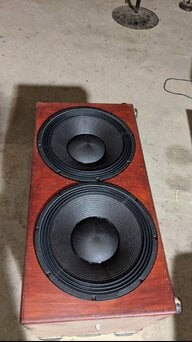
My 2500 (the first of the rack-mount 2500's by request) is equipped with 2x fans that are always running. I do have a control for fan speed on the rear though...in my case I leave it on full all the time.
 
  • Like
Reactions: ThisBass
Any high power configuration must not be mismatched with "stupid" loudness that makes ears deaf.
My 2500 (the first of the rack-mount 2500's by request) is equipped with 2x fans that are always running. I do have a control for fan speed on the rear though...in my case I leave it on full all the time.

I just googled for "Jule M2500" which is the amplifier the OP mentioned in post #1.
These don't seem to have a fan. Please correct if I'm wrong?
 
Any high power configuration must not be mismatched with "stupid" loudness that makes ears deaf.


I just googled for "Jule M2500" which is the amplifier the OP mentioned in post #1.
These don't seem to have a fan. Please correct if I'm wrong?

Jule's only made a handful of them. The stand alone doesn't because if it's standing alone it can cool itself just fine with his build (the chassis is designed to heat sink). Mine is a M2500 built as a rack mount. As such we decided it needed more cooling. It has 2 fans with a fan speed control.
 
Jule's only made a handful of them. The stand alone doesn't because if it's standing alone it can cool itself just fine with his build (the chassis is designed to heat sink). Mine is a M2500 built as a rack mount. As such we decided it needed more cooling. It has 2 fans with a fan speed control.
With smallish class D amplifiers the chassis is (in general) part of the heat dissipation unit anyway.
That's the reason why those amplifiers should not be strained with full power while the cover (chassis) was pulled off.

Some manufacturers add a fan just to improve duty cycle capability while others don't.
I think it depnds on the sound design goals if a power amp was designed to add some harmonics at overload or if (at the other hand side) the power amp section was designed to stay with some headroom all along the line. As usual, it depends.
 
Last edited:
  • Like
Reactions: agedhorse
With smallish class D amplifiers the chassis is (in general) part of the heat dissipation unit anyway.
That's the reason why those amplifiers should not be strained with full power while the cover (chassis) was pulled off.

Some manufacturers add a fan just to improve duty cycle capability while others don't.
I think it depnds on the sound design goals if a power amp was designed to add some harmonics at overload or if (at the other hand side) the power amp section was designed to stay with some headroom all along the line. As usual, it depends.

As these are 2500w RMS, most likely not intended to push to overload. ;)
 
  • Like
Reactions: ThisBass
Which may make discussions about "stupid loudness level wars" a little bit obsolete, isn't it?

It should. ;)

But people are weird about this kind of junk. I've been actively gigging a 2500w (rms) amp for so so so many gigs now...and I'm never the cause of stage volume issues. We have a guitarist who tends to be problematic, but if my volume ever comes up in stage-discussion...its that I need to turn up to help the FOH a bit. Just because you have the ability for extremes certainly doesn't mean you have to go there.

The comments I get from players who have used it are things like "I've never heard the lows sound so effortless and natural" or "it stays really clean no matter how loud" or "It just feels so effortless...you can tell it's not working hard at all".
 
It should. ;)

But people are weird about this kind of junk. I've been actively gigging a 2500w (rms) amp for so so so many gigs now...and I'm never the cause of stage volume issues. We have a guitarist who tends to be problematic, but if my volume ever comes up in stage-discussion...its that I need to turn up to help the FOH a bit. Just because you have the ability for extremes certainly doesn't mean you have to go there.

The comments I get from players who have used it are things like "I've never heard the lows sound so effortless and natural" or "it stays really clean no matter how loud" or "It just feels so effortless...you can tell it's not working hard at all".

Exactly .... +1