• TalkBass has been independent since 1998. Add your voice.
    Create a free account to reply to discussions, view embedded media, and browse with fewer display ads.
    Join freeLog in
    Want zero display ads or expanded classifieds tools? Compare plans.

2nd ever build - light weight Headless 4 string (bass cannibalising)

This is a thread for my latest build project.

For those who don't care about back ground and wanna skip to build photos and details go to post #2

sorry this might get long

Here is what it looks like now:
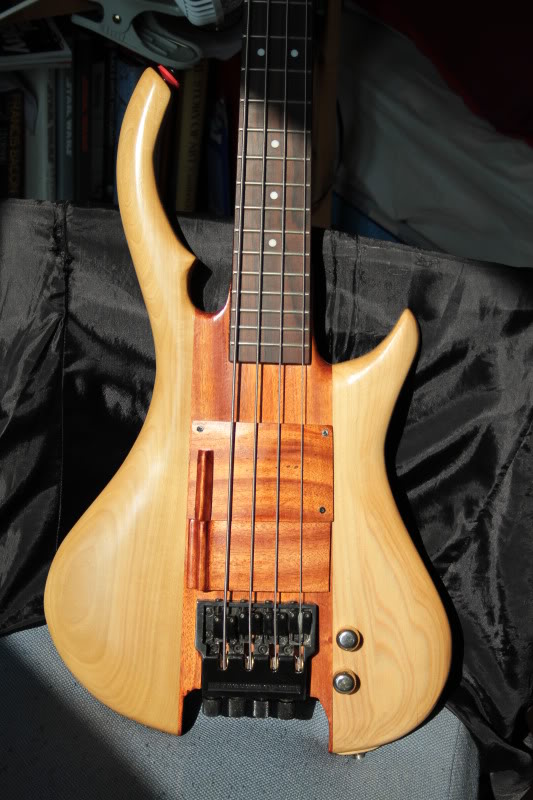
003-1.jpg


Here's some background:
4 years ago when in college I used my woodwork class exam project to build myself a bass guitar which looked like this:
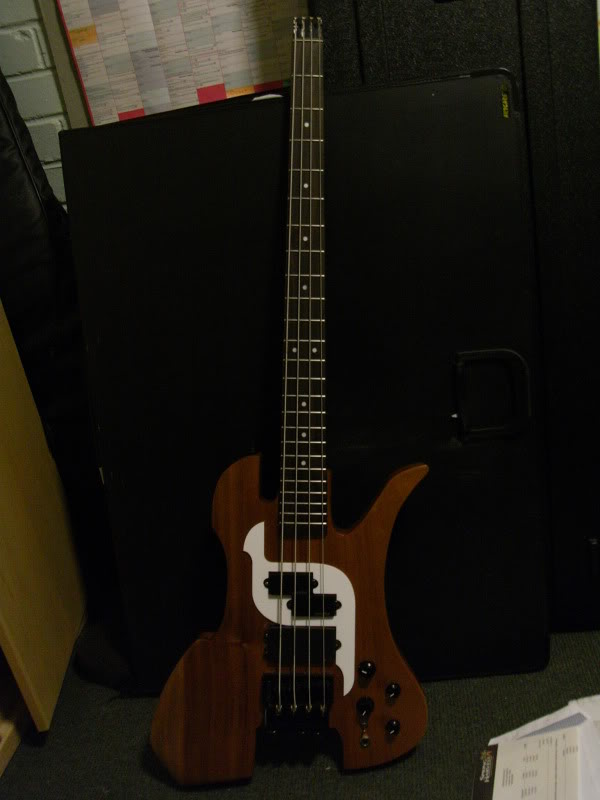
024.jpg
025.jpg


Not knowing anything about the ergonomics, balance or weight of bass guitars and not caring to do any research I designed and built this bass and I'm proud to say gigged it for a few years.

It's body is a single piece of Mahogany, it's neck and bridge were taken from a beater headless I bought on ebay years before and the electronics are Wilkinson P/MM pickups and a 2 band eq. It certainly thundered and punched its way through most mixed but it weighed a ton and was so badly balanced that the first 3 frets were a real stretch unless the bass was slung around your knees (shamefully mine was at this age... 17 I think...)

Fast forward approximately 4 years and I'm now at uni and this bass has sat gathering dust since I bought my first fender a few years ago and learnt that I was more of a jazz bass guy.

So the modder in me (I've heavily modded all my basses) starts to itch at the potential to build another bass from the parts of this headless.

Another piece of background info, I have suffered from sporadic back and shoulder trouble from an early age, something I blame on playing a big and heavy xylophone in a marching band for about 10 years between 8 and 18. Anyway this has flared up a few times at uni and I found that my heavier basses, Ibanez 6 string and HW1 jazz, became too painful to play standing up so this spurred me on to make a lightweight bass to relieve this pain should it flare up again.

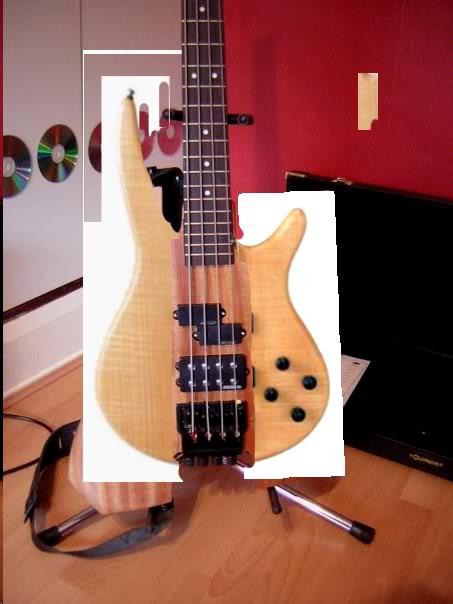
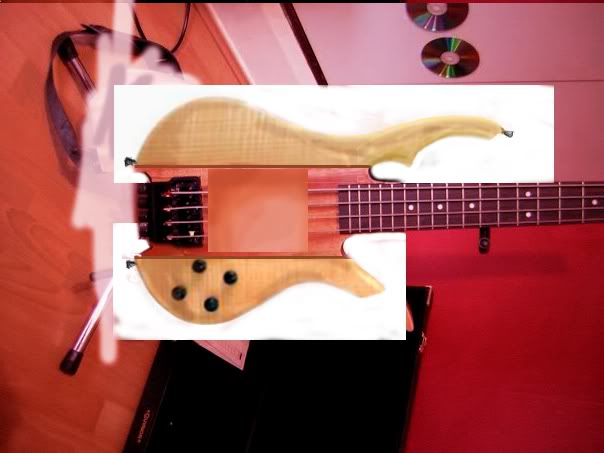
So I set about designing a bass which would cannibalise the parts and part of the body of my first project to cearte a small, light weight and properly balanced bass with my playing style in mind. After lots of scribbling and sketching (I'm an art student so my sketchbooks are full of bass scribblings) I came upon a few ideas which were made into some photoshop rough mock ups:
Untitled2.jpg


doublecutaway1.jpg


singlecut2.jpg


The upper horn starts so far back because I'm reusing the central part of my previous build which didn't really have an upper horn. as for the single cut design it was a nice thought but too hard to engineer so was abandoned but thought you might like to see it.

More info and some actual build images coming in post #2 when I've had dinner!;)
 
Here're the photos (sorry camera phone images) from the point of no return, the day I chose to start the project.

14022011284.jpg


14022011286.jpg


14022011288.jpg


14022011290.jpg


14022011293.jpg


Being an art student I have access to a great wood workshop and a technician who makes acoustics so was happy to help me with my project ideas.

After running the bass through the table saw I was left with a central core of mahogany with the neck pocket, bridge and pickup routes all intact. I chose Poplar (Tulip wood) to make the bass' new wings form as it is lightweight, light coloured and also because I couldn't find maple that I was happy to use at the local wood suppliers. Plus the two blanks of Poplar that I bought cos me £6 and I wanted to keep this bass project as cheap as possible.

Poplar blank:

14022011292.jpg


Planed edges and glued together and left clamped overnight:

14022011296.jpg


Rough template:

14022011291.jpg


This is where I'm so appreciative for the workshop and machines I have access to as the cutting and shaping took a lot less time than my previous build because I was able to do a lot of it on disk and belt sanders etc. I learnt an awful lot in a very short amount of time and enjoyed myself immensely making saw dust and wood shavings like there was no tomorrow!

Band saw cuts:
15022011301.jpg


Planing the depth to be equal on the wings and the core:
15022011303.jpg


Contouring begins:
16022011315.jpg


Contouring progresses:
16022011316.jpg


Detail:
16022011318.jpg


I wanted this build to not only be light weight but also to be very smooth and sleek, I modelled some of the contours on various Ibanez SR basses I'd played and enjoyed but generally just sanded away until I had a shape and profile that I was happy with... then I stopped. Simple really

Once contours were established and close enough I used flat files and sandpaper down to about 400 grit to smooth the surface and remove tool marks:
16022011319.jpg


I also fashioned a mahogany ramp and pickup cover.

I am a ramp player and so when building my own bass it seemed natural to combine a cover for the ugly neck pickup route with a matching wood ramp and matching pickup cover for the bridge pickup. I should probably point out that although it may not look ugly the Pbass route is actually too wide on one half of the pickup cover, owing to poor alignment on my first build and as I wasn't planning on using a Pbass pickup I decided to cover it so I could put any Pickup I chose in that position. I couldn't resist a dry run to see how it'd look:

17022011324.jpg


17022011321-1.jpg
 
Then began the hell and confusion that is wiring spare pickups to try and make a functioning bass.

21022011335.jpg


After a few coats of annoyingly yellow, apprently clear, satin varnish I started wiring up my bass.

You can see a spare MIM jazz humbucker in the now widened neck pocket and the Wilkinson MM pickup being wired up here.

21022011336.jpg


Turns out that no matter how I tried I couldn't solve the phase problems these two mismatched pickups had. This combined with a very small control cavity (I wanted to keep the bass down to 2 knobs, blend and tone, and passive) meant that I spent hopurs trying to wire this bass.

After several failed attempts and a lot of bodging I gave up trying to match the jazz pickup to the others and swapped it out for a bartolini MMC pickups I had:

23032011397.jpg


I also built a plastic cover for the MM bridge pickup as I thought it looked cool with a black cover instead of the wooden one.

After stitching the patient up (when I'd put a coil tap push/pull to try and get some more top end out of it) I then took her on the road and gigged her twice a day for a week, the bass sounded ok but I'm not a MM guy (who'd have guessed it) so when I returned I decided to crack her open again and turn things upside down, here she is getting strings changed in a dressing room:
09042011417-1.jpg
 
so after some time I decided to take the p bass pickup from a beater I had lying around and that MIM jazz p[ickup and gave them another go.

The Precision pickup was crammed under the ramp and the Jazz was put into the bridge pickup route (sans plastic cover) and after some hacking to make the phases work well together and rewiring them (thread about them here: http://www.talkbass.com/forum/f57/will-adding-maple-laminate-help-my-highs-761407/)

a new ramp built and now it's sown back up and playing (and now more importantly sounding) great!

003-1.jpg


004.jpg


007-1.jpg


009.jpg


011-1.jpg


Over all I'm pretty chuffed with the build, I know it's far from perfect as I was building it for me and so wasn't pushing for ultimate craftsmanship and perfection more just for the learning curve and to build myself a more functional and lighter bass.

My aims to make a light weight ergonomic bass, I think, has been met and I'm planning on playing it regularly, it's P/J pickups closer to the bridge than the normal p/j positioning has given it a tight and aggressive tone which the Mahogany boost to make punchy and quite enjoyable to play, a little unusual flavour to a much loved pickup combo :)

Anyway I cheers so stopping by, you stay classy TalkBass.

BB
 
I really like it, it has similar cuts to one of the bodies ive drawn up. The pickup are seems like it got a bit out of hand. lol

Unless you like the pickup area as is you can always route it out and put a new block of wood in and start over.
 
yeah I thought about doing that for a while but I was trying to keep this as simple and cheap as possible, hence the use of old and spare pickups not buying new ones. One day I'll have the time and money and will pay someone to make me a mk 2 of this bass with better pickups, better woods, better craftsmanship and a maple fretboard but for now she's my beauty and I'm gonna play her til she's got some major mojo.

Having said that one cool thing about going for fewer coats of finish is that it does wear organically but faster, after a week of playing there is a wear patch where I rest my thumb (before the thumbrest was added) and one where I pop while slapping.
 
Very interesting! thanks for posting this. It's great to see how you have taken an idea forward in the face of some disappointments. The ramp/thumb rest covering the p-ups cavities is a cool solution that makes the bass look neat and unique :)
 
thanks Miziomix coming from someone with such a talent for designing and making basses that means a lot :)

I'm looking forward to the next Uber build, I'm a closet 5 string fan so the thought of a UJ 5 makes me excited.

I'll have to try and find some scales as this bass is very light and I'd like to see how light
 
actually i like the idea of the ramp that cover the whole surface of the pickups, but i was curious, does the ramp affect the sound captured by the pickups? since the ramp was sit above those pickups..

On this bass the pickups have to sit quite far away from the strings because of the ramp so in that sense it does but other than that it just sounds like a bass with the pickups lower than some prefer.
I've put ramps on all my basses and on all but 1 they cover the pickups and I've noticed absolutely no tonal difference and I'm a bit of a tonal snob sometimes so rest assured, wood or plastic will not change the tone of your bass at all when used as a ramp
 
On this bass the pickups have to sit quite far away from the strings because of the ramp so in that sense it does but other than that it just sounds like a bass with the pickups lower than some prefer.
I've put ramps on all my basses and on all but 1 they cover the pickups and I've noticed absolutely no tonal difference and I'm a bit of a tonal snob sometimes so rest assured, wood or plastic will not change the tone of your bass at all when used as a ramp

Thank you for enlightenment :)
 
So after a hiatus from being played I reacquainted myself with this bass and knew that it could be better than it was and after a few thread about neck stability I knew it was the neck that was holding this bass back. So I contacted a friend of mine who had a Yamaha BB604 4 string bass with 24 frets, one which I hoped the neck would fit with little modding, onto this bass. I have always had a love for Yamaha bass necks, they play great, low action and very very stable plus they're one of the only manufactures to offer 24 frets without odd diagonal neck heels etc. To my surprise my friend decided to give me his bass as a wedding present! (I got married in December) and so after a few months waiting I picked up the bass and set to work seeing if a new more rigid and stable neck would change the tone of this bass.

To my even more surprise, the Yamaha neck slotted perfectly into the bass! I had to drill new screw holes but once it was fixed and the action set I couldn't believe how well this bass played and more importantly how much more alive it sounded! instantly there was a snap and twang to it that the old neck just didn't allow so I then began working on ways to "finish" this project.

After converting one of my jazz basses to a P/J I had a set of fender humcancelling jazz bass pickups lying around and decided after a brief stint with an EMG MM pickup in it's neck position to load it up with these and see how it sounds. Well after a bit of hassle getting the pickups into good tone positions under the ramp and balancing their outputs via under ramp height adjustments, I wired it up Blend, Master Volume/Master Tone and I am pretty happy with it. Here's how it looks:
basses069.jpg

basses072.jpg

basses073.jpg

basses075.jpg

basses076.jpg

basses077.jpg

basses081.jpg

basses052.jpg


as you can see I did some pretty serious modding to the bridge. I decided that since it was no longer headless that I should make ti easier to change strings and not use the bulky tuners of the headless bridge, but, having routed the bridge into the body i knew I had to find a way of using it or face filling the route and using a normal bridge... too much work for me. So I disassembled the headless bridge, removed the tuning mechanisms and then drilled string through wholes into the body (as shown) and so now the strings anchor in the back ferrules and go through the headless bridge and over its saddles to work as a normal bridge! Not the neatest job but one which makes string changing and tuning stability a great deal better and easier.

Over all I'm now fairly happy, as I;m sure you can tell from the changes I've made, I'm a modder and never completely happy but for now this bass has a punchy fairly scooped jazz bass tone to it but a LOT of bass and a fair bit of bite but a smooth mid range tone without lots of growl, a great tone for slap and for using fuzz and certainly different from my other basses. It is not a very functional, well balanced, incredibly light and unique bass which I ma happy to be using live :)
 

Latest posts