• TalkBass has been independent since 1998. Add your voice.
    Create a free account to reply to discussions, view embedded media, and browse with fewer display ads.
    Join freeLog in
    Want zero display ads or expanded classifieds tools? Compare plans.

2nd Neck for build

Hi All,

Since I finished my first build, I’m plannning the 2nd neck. I definitely want to go a slimmer than the last one. Common affliction that I’ve heard theres only one cure..... (More Cowbell!)

For this one I’ll have a thicker pseudo skunk stripe in Wenge. Now that I’ve got a table saw I’m planning on a scarf joint (just because I need to explore those) and I’ve seen such amazing work by LC members! Beautiful peg heads with caps on both sides (hiding the lines).

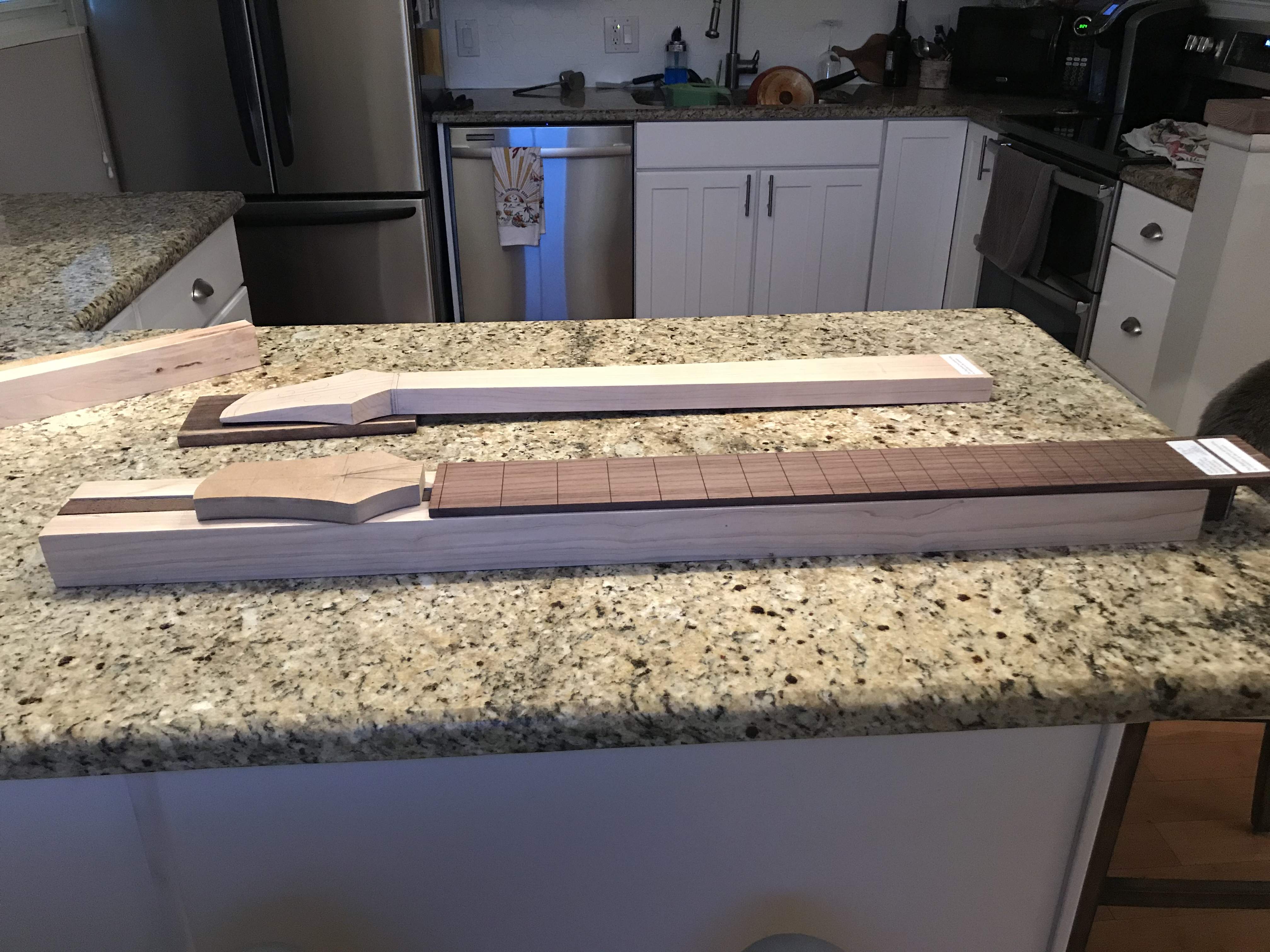
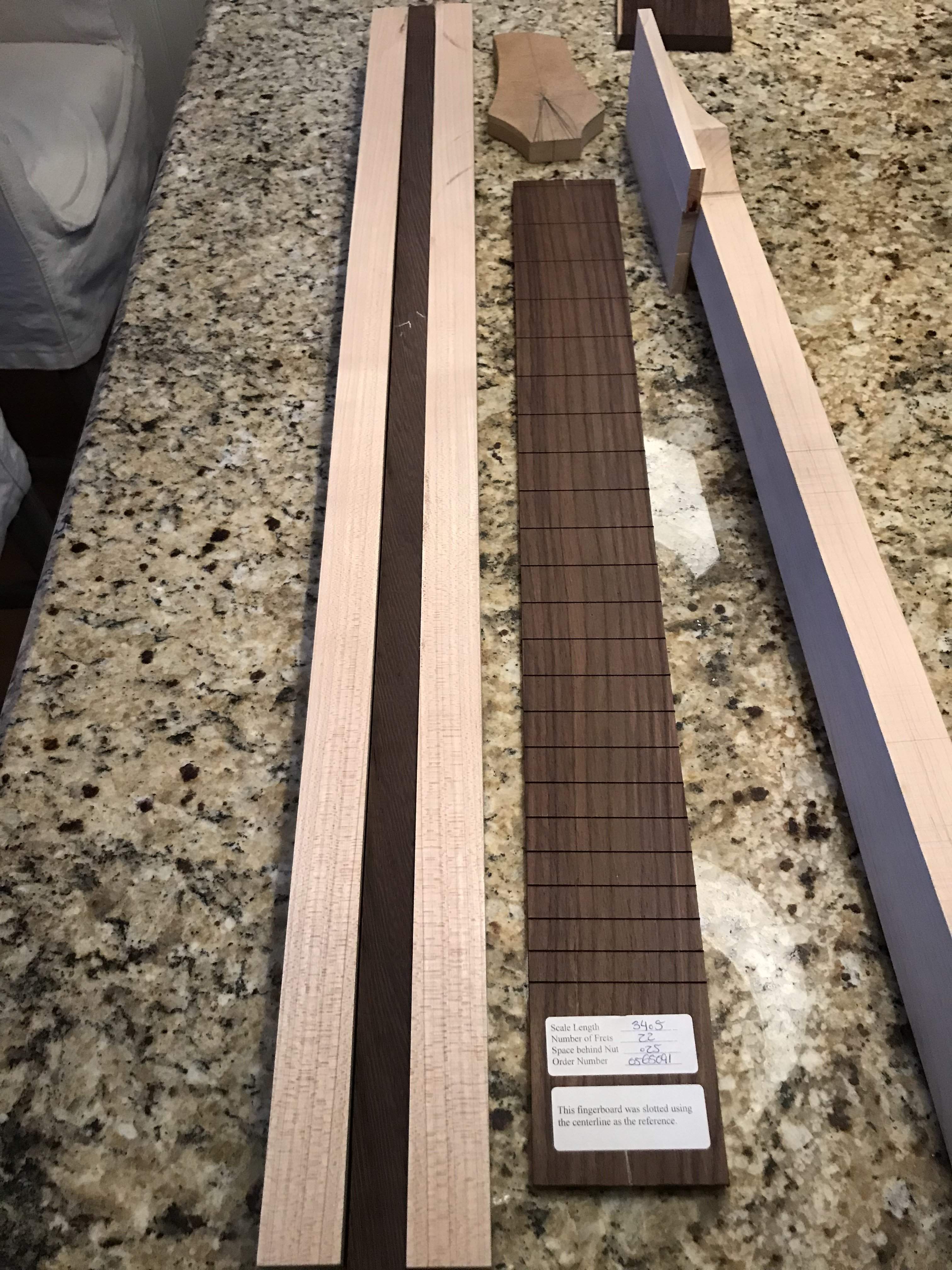
Anyway here’s what I’ve got on hand at the moment..
231FA25C-22BA-48B3-B9B3-4E5C7D0BD9DF.jpeg


77598612-8279-439C-A0E5-669096DEBCFD.jpeg


The thicker piece you see is just under 2” thick so I could cut it to make 2 neck blanks.

The LMI rosewood board is pre slotted and I’ll make a template from that before I start the shenanigans.

Pondering top or bottom places scarf joint - woo hoo!

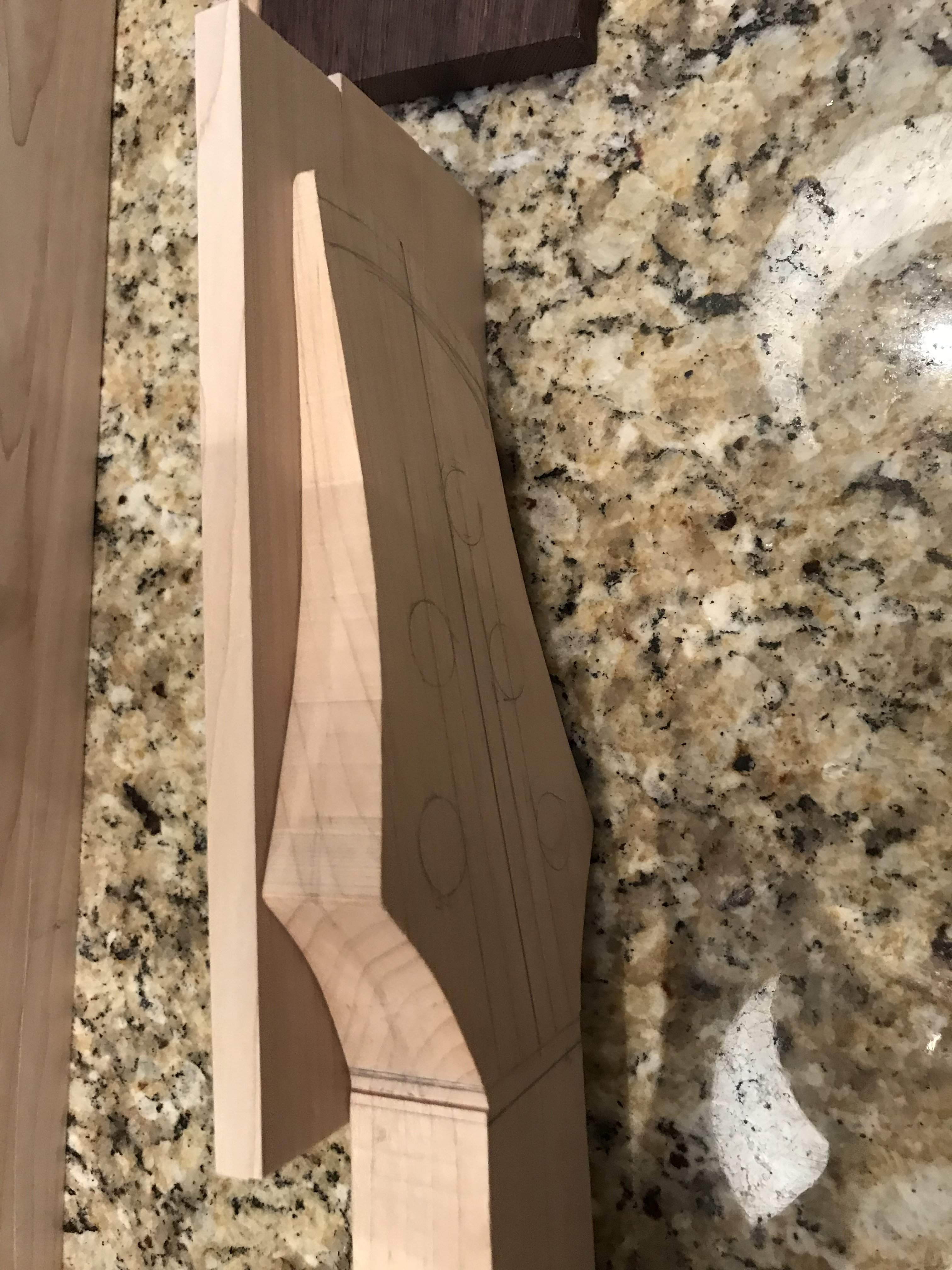
Here’s an interesting question:

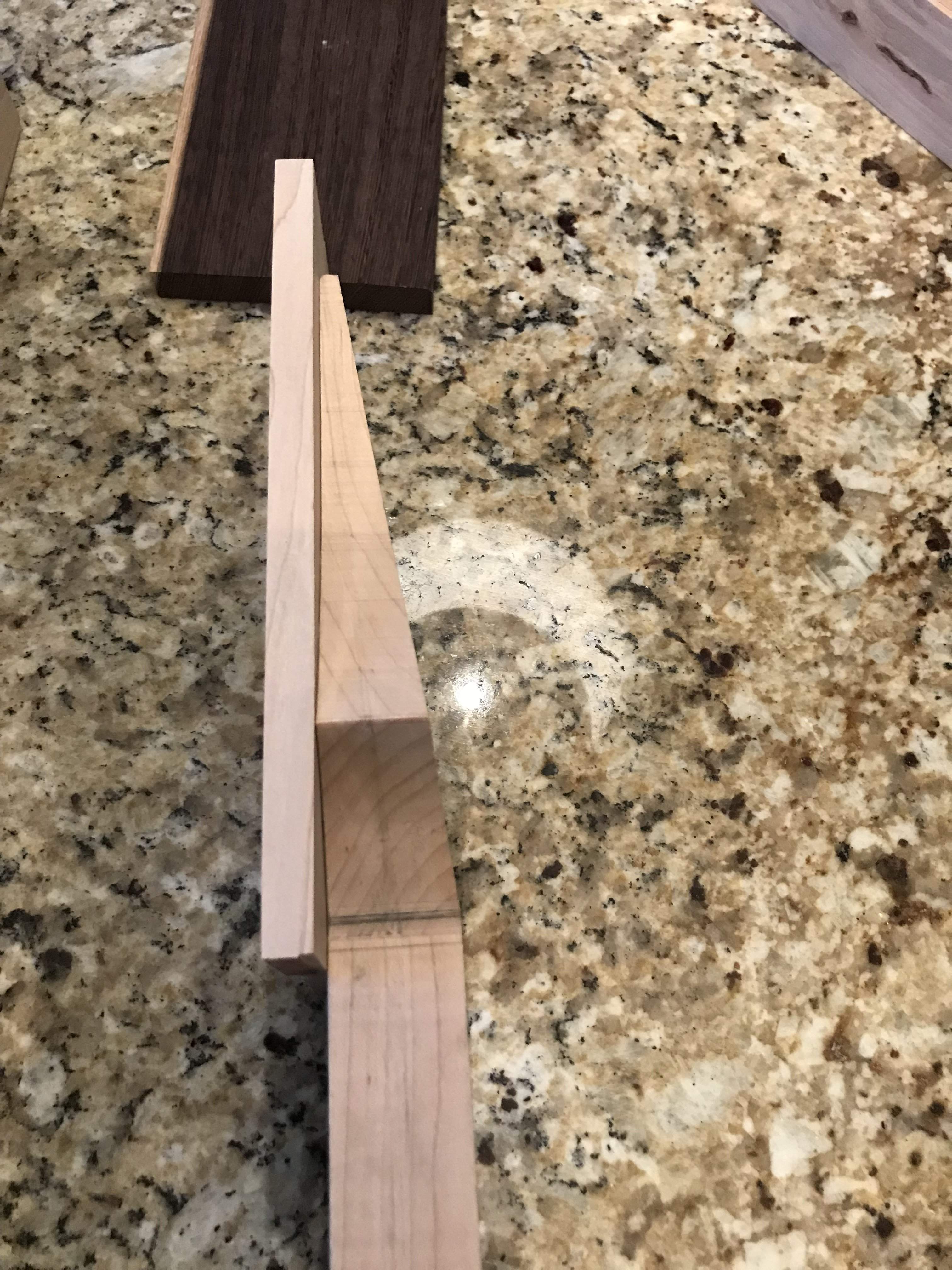
This piece is going to waste unless I do something..
E740E23F-3E64-4879-9156-AB45EA65B617.jpeg

A3F07E16-B68E-4753-8DD9-C3667ACD03EA.jpeg


This would amount to a pretty unconventional scarf joint, but it would be sold once jointed on. Thoughts?

I could end up with 3 more necks :)
 

Attachments

  • 3DBC7856-B648-429F-AC34-F9C6E96076F9.jpeg
    3DBC7856-B648-429F-AC34-F9C6E96076F9.jpeg
    1 MB · Views: 15
Structurally, it's a better way to do it. The problem with trad scarf joints is that there is a lot of tension right at the point where the glue line is. Which is always weaker than a straight piece of wood. Scarf joins are a compromise to save precious wood stock and aren't chosen for luxury, convenience or structure. Structurally, the best head stock build is one where it's carved from a solid (or vertically laminated) stock. That said...it won't make much of a difference to the final tone.
Every Luthier goes through the investigation of each type before settling on their methodology. There is no wrong or right, just how you want to make your instruments.
 
Structurally, it's a better way to do it. The problem with trad scarf joints is that there is a lot of tension right at the point where the glue line is. Which is always weaker than a straight piece of wood. Scarf joins are a compromise to save precious wood stock and aren't chosen for luxury, convenience or structure. Structurally, the best head stock build is one where it's carved from a solid (or vertically laminated) stock. That said...it won't make much of a difference to the final tone.
Every Luthier goes through the investigation of each type before settling on their methodology. There is no wrong or right, just how you want to make your instruments.

Thanks for your thoughts GMC. This is indeed my investigation. It's nice to have more options from a year ago where I started with a band saw, and now with a table saw, a few good hand planes and more experience I'm off and running :)
 
I don't know if you can get one of these State Side, but it's a lot better than just using a router. If you were going to add the next machine to your workshop....you could do a lot worse than get one of these. Most table routers are a pain to adjust, but this table has a built in router. Just turn the handle and the router moves up or down in a geared motion. Here in the Uk, they are very cheap too. Not much more than a half decent router.

Precision Bench Top Router Table with Built In 1500w Variable Speed Motor 240v | eBay
 
  • Like
Reactions: Christine
I don't know if you can get one of these State Side, but it's a lot better than just using a router. If you were going to add the next machine to your workshop....you could do a lot worse than get one of these. Most table routers are a pain to adjust, but this table has a built in router. Just turn the handle and the router moves up or down in a geared motion. Here in the Uk, they are very cheap too. Not much more than a half decent router.

Precision Bench Top Router Table with Built In 1500w Variable Speed Motor 240v | eBay

That’s a nice kit. I definitely think I could use one because I made a router table that houses my Porter Cable 690. It’s not so great on height adjusting though :)

Thanks for the link!
 
I’ve looked at one piece headstocks Gibson style and scarf joints. A few years ago I did a test where I made two necks one of each complete with fret boards. I then put both on the floor and stood on them. The one piece broke instantly in line with the bottom of the neck whereas the scarf joint held good. Ever since then I’ve used a scarf joint which in turn lets me use a slightly thinner headstock to save a little weight
 
I’ve looked at one piece headstocks Gibson style and scarf joints. A few years ago I did a test where I made two necks one of each complete with fret boards. I then put both on the floor and stood on them. The one piece broke instantly in line with the bottom of the neck whereas the scarf joint held good. Ever since then I’ve used a scarf joint which in turn lets me use a slightly thinner headstock to save a little weight

Thanks for sharing Christine! Wow, that is certainly validating. I'll have a look back at your current build.
I liked seeing how @Drake Custom hides the glue/joint lines, and of course I'm pondering top or bottom joints.
 
  • Like
Reactions: Christine
Thanks for sharing Christine! Wow, that is certainly validating. I'll have a look back at your current build.
I liked seeing how @Drake Custom hides the glue/joint lines, and of course I'm pondering top or bottom joints.
I go for the top joint as I feel it has a bigger surface area for gluing and it's supported by the fretboard too. You could rout in two 3mm bits of Maple along the join as extra mechanical strength too if you wanted, they would be hidden by the fretboard and a headstock veneer if you use one.

The bottom joint although smaller doesn't need to be as strong and can easily be hidden by top and bottom veneers as well as hiding any extra strength you may want to build in.

Which is best I don't know. I'll have to check out Drake Custom's work, a new one on me and sounds very interesting, thanks :)
 
  • Like
Reactions: chinjazz
I go for the top joint as I feel it has a bigger surface area for gluing and it's supported by the fretboard too. You could rout in two 3mm bits of Maple along the join as extra mechanical strength too if you wanted, they would be hidden by the fretboard and a headstock veneer if you use one.

The bottom joint although smaller doesn't need to be as strong and can easily be hidden by top and bottom veneers as well as hiding any extra strength you may want to build in.

Which is best I don't know. I'll have to check out Drake Custom's work, a new one on me and sounds very interesting, thanks :)

Q: The two 3mm bits of Maple along the join.. Is this like a side wall that would go around the side of the headstock, like binding wall? Just having a tough time visualizing the idea at the moment :)
 
Q: The two 3mm bits of Maple along the join.. Is this like a side wall that would go around the side of the headstock, like binding wall? Just having a tough time visualizing the idea at the moment :)
No just sat 1/4" either side of the truss rod say 3/8" deep and 3-4" long running through the scarf joint either stopping short of coming out of the top of the headstock Just under the nut or all the way through if your using a veneer on top
 
  • Like
Reactions: chinjazz
I'll advocate for some carbon fiber, I mean, heck, you are skunk-striping anyway, might as well make it real rather than pseudo. Does mean you want to figure out what this new, thinner neck profile is going to look like ahead of time, so you can bury it, but not too deep.
 
  • Like
Reactions: chinjazz
I'll advocate for some carbon fiber, I mean, heck, you are skunk-striping anyway, might as well make it real rather than pseudo. Does mean you want to figure out what this new, thinner neck profile is going to look like ahead of time, so you can bury it, but not too deep.

Yes, carbon fiber may be good (most likely as strong and probably lighter than maple). I don't know much about skunk stripes other than they served for inserting the tr thru the back. I chose the wenge to lam between the maple strips for aestics and it's what I've got left currently. Why I called it pseudo :)
 
I'll advocate for some carbon fiber, I mean, heck, you are skunk-striping anyway, might as well make it real rather than pseudo. Does mean you want to figure out what this new, thinner neck profile is going to look like ahead of time, so you can bury it, but not too deep.
Oops, my mistake.. I was mixing your and Christine's replies. You're suggesting rods to run the length around the truss rod, yes?
 
Oops, my mistake.. I was mixing your and Christine's replies. You're suggesting rods to run the length around the truss rod, yes?
Nope, I'm in the Church-o-Bruce on this - no bars, just fiber and epoxy, with the fiber as close to the tension side (back-o-the-neck) as possible. "Carbon Fiber Tow" - go look at the winter build-off thread where puzzled people were asking what the heck this stuff I put in the prize pool was for a link to several of the canonical threads about using it. Ought to be easy to come by in composite boat country, or via ebay, or if you touch base with me next time you visit your NY relatives.

Edit: I linked it up for easy reference.
 
I took a little bit to tool up my table saw to cut some laminates with the maple I had on hand. Got a featherboard and used a fence top rail.

It was a push/pull operation. I ran each piece thru 3 times (incrementally raising the blade).

D05AF4BD-DE8D-41DC-8A97-8CBBE7CDF84B.jpeg


One piece has a bow in it as you can see in this pic.

1C228A84-D1A2-44E1-B40F-1270F8E3530A.jpeg


I may fix it with the “clamp/heat and leave” for a while method, then plane it flat. or use it for something else :)
 
  • Like
Reactions: Matt Liebenau
A bit of an update and a mixing tip for small amounts of 206 Hardener.

I spent the better part of the summer finding wood suitable for neck blank laminates. It was so hot and humid for most of it but finally we landed a cool spell.

I collected and flattened everything and have enough for 3 necks. This should curb my appetite / addiction for neck carving.

West System 105/206 glue up time:

B0049F22-39F8-4014-8577-C3609071BACB.jpeg


First neck will be maple, the other two will have black walnut stringers. Rosewood and maple FBs.

E73D2F80-7FB5-48AD-AA2D-0C42EC9EE607.jpeg


Thanks for the glue up tips @Bruce Johnson!

I took your advice on transferring the hardener in a squeeze bottle.

Had no luck finding a 3mL mixing spoon in a kit with the others so used a kids medicine dropper worked.

Clean up with acetone wipes the letter markers. Doh!!!

I found these for the next go round on mixing:

Teenitor 3ML Plastic Transfer Pipettes Eye Dropper Pack of 150 - Essential Oils Pipettes Dropper Makeup Tool https://www.amazon.com/dp/B01G82SJRY/ref=cm_sw_r_cp_api_i_eiq1Bb10ZPMY7

Seems to be prudent since I don’t like cleaning up epoxy.

Thanks!!!
 
As an Amazon Associate, TalkBass may receive commissions from qualifying purchases made via links on this site.

Latest posts