
There is plenty of help on this forum. Lots of great advice.Normally I'm scared to work on my own instruments but I think learning this skill will save me a lot of money in the long run.

TalkBass has been independent since 1998. Add your voice.
Create a free account to reply to discussions, view embedded media, and browse with fewer display ads.
Join free Log in
Want zero display ads or expanded classifieds tools? Compare plans.
There is plenty of help on this forum. Lots of great advice.Normally I'm scared to work on my own instruments but I think learning this skill will save me a lot of money in the long run.
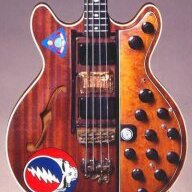


Well... It's your bass; do what you think is right. However... I have a couple of basses with the Gibson style 3-pointer; an Eastwood copy of Gibson's old Flying V Bass, and a '13 Gibson Thunderbird. IME, the only Real problem with the 3 point bridge - other than the threaded inserts wanting to leave home on some basses - is that sometimes, all 3 collars are not in full contact with the posts. Which results in loss of tone and structural wobblies. On the Eastwood, someone at the factory put the saddles in 2-1-4-3 order on the screws - and then cut the saddle notches. Annoying and stupid, but a fairly easy fix. Works like it should, now... I also had an '18 Gibson T-Bird with the factory installed Babicz full contact bridge. When I tell you that I still own the '13 T-Bird - but not the '18, that should give you a hint as to which bridge I like... To me, bridges should be easy to set up and intonate, with a minimum of fiddling around - and stay that way, until I decide to change them. And, if the saddles are in the right order, and all 3 collars are in firm contact with their posts? A 3-point bridge is the cat's ass, AFAIC. IMO, most people that complain about them, do so because they're people who absolutely have to be fiddling with things that don't need to be fiddled with - because they can't stand not to. And, there simply ain't much to fiddle around with on a 3-pointer. Which is the whole idea in the first place. The Rube Goldberg-looking contraption that is an Alembic's bridge is the same way. In spite of all the bits, pieces, and machine screws and nuts, it's really the same as a Gibson 3-pointer. Just as easy to set up and intonate; and once you're done - it stays that way... To be honest, I think the Babicz Full Contact bridge is a nice bridge - if it's finished and put together right. Which was so not the case with mine. I had to take it completely apart; attack every one of the parts with jeweler's files and 1000 grit emery cloth; reassemble; and repeat, until it worked like it was supposed to. And even then? It was harder to set up than the bridge it replaced. No, thank you... If you have to have a bridge you can fiddle with? Get the Hipshot or the Babicz. If you want easy-peasy, set and forget? Keep the one you have. Just make sure it's making good contact with the 3 posts...Curious as to the state of current opinion on the Gibson 3 point bridge.
Just got a Flying V Epiphone and I'm gonna replace the strings. Wondering if I should bother replacing the seemingly very antiquated bridge.
I see there are Hipshot and Babicz replacements. Any opinions?
Thanks!
View attachment 4514963 View attachment 4514964

I replaced the 3-pointer on my Epiphone Allen Woody with a Hipshot and was happy, although I probably didn't really need to. Good news for you, it's a clean retrofit making any change of heart painless.

I reached out to Hipshot. I wasn't the first to come to them with the issue; they sent me a pad to place under the bridge to protect the top.Hey @dalkowski - I am facing this exact dilema right now - Epiphone Allen Woody (which I love!), 3 point bridge (which I don't). I was worried that the Hipshot and the Babicz were meant for flat tops. the AW epi is arched - how did you solve that issue?
Thanks!
I reached out to Hipshot. I wasn't the first to come to them with the issue; they sent me a pad to place under the bridge to protect the top.
Pro tip (that may have already come up in this thread): Pull out the (sleeves?) that receive the mounting posts and apply a drop of super glue to each to prevent pull-out.
Good luck, lemme know how it goes!
Saving money is cool, but getting exactly the action you want is the real payoff from learning to do your own setups.Thanks. I just did it. Loosened the strings and adjusted it down just to take that front up a little bit and lower the back. Worked just fine. I have to learn how to do all the setup stuff over the winter. Normally I'm scared to work on my own instruments but I think learning this skill will save me a lot of money in the long run.
I'm afraid I don't have pics, having sold the bass a while ago. Otherwise I'd be delighted to oblige. If memory serves the material was like felt. No complaints about the action here — certainly nowhere near "super high" — but everyone's different.I see. Thank you very much! if you don't mind, another follow up - I've read here and there that the hipshot was too thick and the strings were to high up from the top, causing the action to be super high. I'm assuming that's not the case, right? do you have a picture to show the profile- string height from the top and maybe the pad (what material is it? like felt?) - just so that I can see what I'm aiming for? Thanks again!

Like @Goatrope said, best practice is to loosen the strings before bridge height, intonation or truss rod adjustments (I know you didn’t ask about the truss rod, just tossing it out there). Sometimes I’ll lower things without loosening the strings but, especially on a Gibson style bridge, you’re best to relieve some tension.





